

Commentary
Despite its flop at the box office, the film raises important questions for the climate community to answer.
Leonardo Martinez-Diaz
{
  "authors": [
    "Liliana Gamboa",
    "Kayly Ober"
  ],
  "type": "commentary",
  "blog": "Emissary",
  "centerAffiliationAll": "dc",
  "centers": [
    "Carnegie Endowment for International Peace"
  ],
  "englishNewsletterAll": "ctw",
  "nonEnglishNewsletterAll": "",
  "programAffiliation": "SCP",
  "programs": [
    "Sustainability, Climate, and Geopolitics"
  ],
  "regions": [
    "Colombia"
  ],
  "topics": [
    "Climate Change",
    "Migration",
    "Domestic Politics"
  ]
}
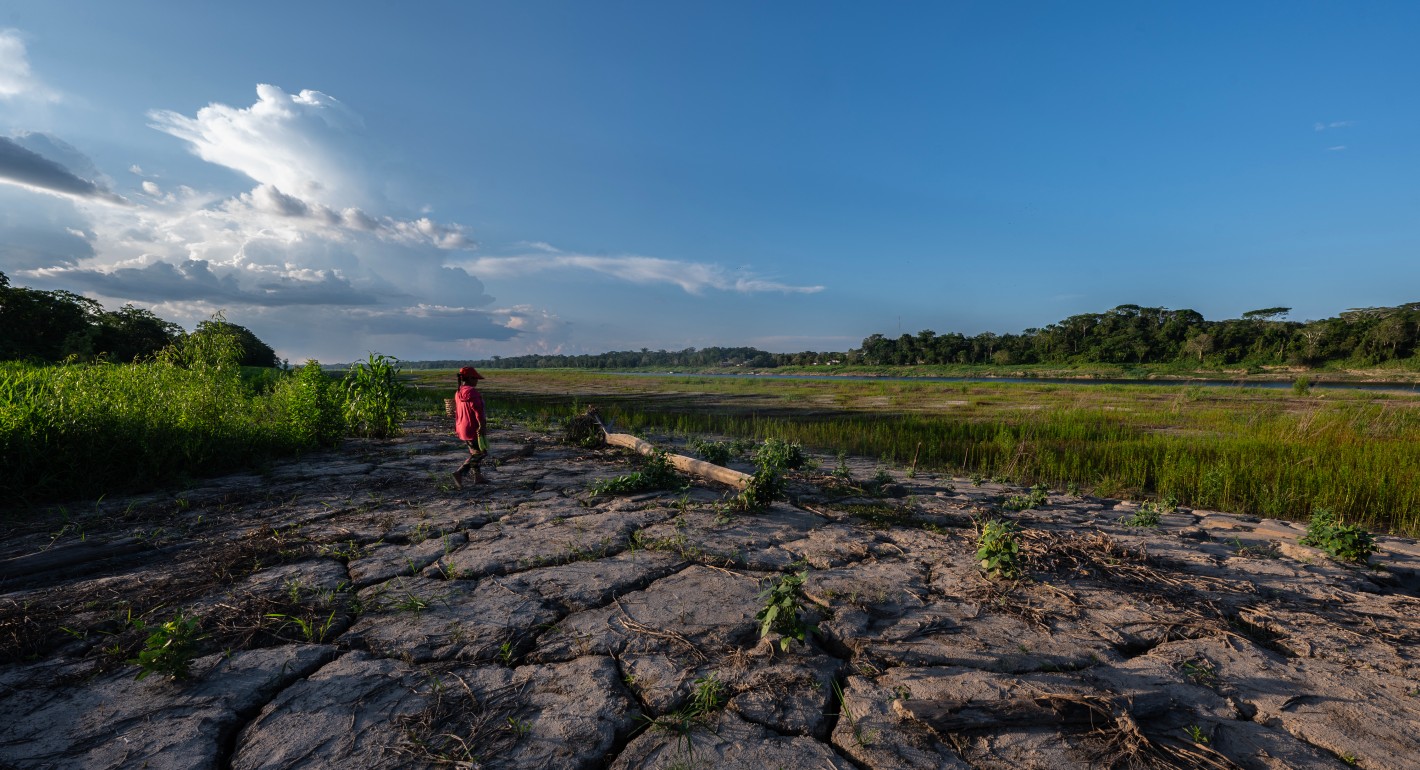
A Tikuna indigenous woman walks along the dry riverbed of the Amazon River in Colombia in 2024. (Photo by Luis Acosta/AFP via Getty Images)
The groundbreaking legislation faces an uphill battle, but it creates a framework for others to follow—especially as the effects of climate change intensify.
Last month, Colombia passed a landmark law that formally recognizes displacement caused by climate change, environmental degradation, and natural disasters as a distinct legal and humanitarian category. It is the first law of its kind in Latin America and one of the first nationally binding frameworks of its kind anywhere in the world.
This is a big deal. And could change the trajectory of climate displacement law in the region and beyond.
Colombia is no stranger to displacement. By the end of 2025, 7.2 million people were living in a state of internal displacement—accounting for nearly 69 percent of all displaced people in Latin America. This is the result of Colombia being home to the longest-running internal conflict in the Western Hemisphere, one that has shaped the country’s institutions, politics, legal system, and how it understands and responds to forced displacement.
Although the 2016 peace agreement between the government and the Revolutionary Armed Forces of Colombia (FARC) made progress in slowing down fifty years of conflict, waves of violence have reemerged. Armed groups outside the accords have driven a renewed rise in forced internal displacement. In 2025 alone, Colombia recorded 394,000 new conflict-related displacements, the highest annual figure on record.
Colombia has worked hard to mitigate the effects of displacement. For decades, it has invested in law and policy on displacement, reparations, and land rights, resulting in one of the most sophisticated frameworks for internal displacement anywhere in the world. Yet that framework was built around conflict, and disasters and environmental pressures, despite their growing toll, remained a secondary concern.
Meanwhile, climate and environmental pressures have added complexity to Colombia’s displacement story. Floods, landslides, and wildfires have uprooted tens of thousands more people each year, increasingly hitting communities that are, in many cases, already displaced or made vulnerable by conflict. In many places, the two drivers feed each other. Climate and environmental shocks deepen fragility where the state has long been absent, while conflict leaves communities with fewer resources to prepare for, withstand, or recover from disasters.
The past two years have seen a growing acknowledgement of this fact, culminating in last month’s landmark law.
Colombia has been a model for progressive internal displacement law since the late 1990s.
In 1997, it passed the first comprehensive law on internally displaced people enacted anywhere in the world. The groundbreaking law defined who counts as displaced and established that the state owes them protection. However, the government largely ignored it until a 2004 Constitutional Court ruling forced its hand, but the principle behind it established that displacement is a legal status that the state is responsible for.
In 2011, Colombia passed the Victims and Land Restitution Law, which built on the 1997 law’s foundation by guaranteeing conflict victims’ rights to truth, justice, and reparation, alongside a promise that the harm would not be repeated. It created the machinery to deliver those rights, bringing together some forty national and regional bodies responsible for humanitarian aid, land restitution, compensation, and rehabilitation. At the center sits the Single Registry of Victims, which has identified more than 9 million people affected by the conflict. The registry has been recognized internationally as one of the most comprehensive tools of its kind, and it monitors one of the largest reparation undertakings in the world. Designed to run for a decade, it was extended in 2021 for another ten years.
The 2016 Peace Agreement with the FARC further advanced this approach. Land reform sat at the center of the accords, and displaced communities took part in the negotiations themselves—a rare case of people on the move helping shape the policies meant to protect them.
Against this backdrop, an April 2024 judgment from the Constitutional Court marked the next step in Colombia’s evolution in internal displacement law and policy.
The case began with a tutela (a constitutional rights claim) brought by an elderly couple from the Arauca region who had been repeatedly forced off their farmland by flooding of the Bojabá River. The court held that the internal forced displacement driven by environmental factors is a multicausal, complex phenomenon, noting that “it would be a mistake and reductive to start from the idea that ‘natural’ is that which occurs independently of human beings.” The court then warned that environmental displacement can be caused by disasters, environmental degradation, and the effects of climate change—including sudden disasters such as floods, landslides, and volcanic eruptions and slower processes such as drought, sea-level rise, and ocean acidification. They can all legally count as causes of forced displacement and consequently, place binding obligations on the state. The court found that people displaced by climate and environmental causes fell in a gap in Colombia’s legal protections. By holding that environmental displacement triggers the same duty of state protection, the court recognized a new group of rights-holders and exposed the limits of a system built for a different era. The court asked the national ombudsman to monitor compliance and oversee the gradual restoration of displaced people’s rights, and it urged Congress and the government to build a legal framework for environmental displacement.
Fast forward to May 2026. The Congress of Colombia passed Law 2577 to formally recognize climate change, environmental degradation, and natural disasters as valid causes of forced displacement. Its definition is straightforward: People are displaced when environmental threats put their lives, health, or safety at serious risk—or when they leave to avoid those threats before they strike. It pays particular attention to the rights of women and girls in vulnerable situations, and to protecting the country’s food security.
To turn recognition into something workable, the law gives the government six months to define what actually counts as climate displacement. The country’s environmental, weather, and disaster management agencies have been tasked to work this out together. That groundwork will feed into a new registry of environmentally displaced people, run by the national disaster management agency and kept separate from the existing conflict victims’ registry.
Two features stand out. First, people don’t have to wait until they’ve already fled: They can be registered before, during, or after displacement. This makes the law anticipatory rather than purely reactive. Second, the registry includes a dedicated section for the collective lands of indigenous and Afro-Colombian communities, meant to capture their particular ties to territory and the distinct ways displacement affects them.
Understand the world with the latest from our scholars around the world.
People will have two years from the triggering event to come forward, and they can file claims through a range of local and national bodies—municipal ombuds offices, the national ombudsman, the inspector general, and local environmental authorities—rather than a single central office. Spreading intake across these bodies is meant to make access easier for rural communities, which are often most affected.
When someone files a claim, local authorities, working alongside the national government, can provide emergency humanitarian aid. More robust support comes once the disaster management agency formally certifies the case, which it must do within three months. What that support looks like depends on the cause. Where a natural event is to blame, people are entitled to the state’s full assistance. Where the damage was caused by human intervention—a company or individual whose action or neglect drove people from their homes—the case instead becomes a liability investigation, and the use of public funds earmarked for this law is restricted.
Once their cases are confirmed, displaced people are promised a defined set of guarantees, delivered step by step: food, clean water, shelter, clothing, medical and psychological care, sanitation, schooling, and the rebuilding of damaged infrastructure (and, as the law states: in a way that mitigates the same risk occurring again). They have the right to return home safely and voluntarily, or to resettle, with help until they recover what they lost. Where recovery isn’t possible, they are entitled to full reparation.
The law’s most consequential provision, though, looks past individual cases. It requires the government to write a comprehensive national policy on climate mobility within six months, updated at least every five years. In addition to assistance—safe housing, food security, and support for community rebuilding—the law places the responsibility on policy to prevent, adapt, and mitigate displacement before it begins, as part of the broader, longer-term effort highlighted by the Constitutional Court.
The law, while groundbreaking, faces an uphill battle. Its guarantees are promised “progressively” rather than immediately, which gives the state room to move slowly. And much of what will determine success has been left for later: the criteria defining who qualifies, the registry itself, and the national prevention policy. Each depends on money, coordination between national and local government, and political will.
The law also states plainly that its prevention policy cannot place any new burden on private business beyond what already exists, and that changing this would require Congress to pass another law. By ruling out new obligations on the private sector from the start, the law limits one of the main levers a government might use to prevent displacement, rather than simply respond to it.
Perhaps most worrying of all: a right-wing government will be coming into power in August, and the entire law may be in jeopardy. But Colombia has also shown that its courts will enforce climate obligations when the executive falls short. The architecture—a recognized category, a registry, and enforceable entitlements—gives affected communities something concrete to hold the state to.
Despite these obstacles, the framework can act as a blueprint for other countries to follow suit. The World Bank estimates Latin America and the Caribbean could see 17 million internal climate migrants by 2050. Several countries in the region have begun to acknowledge this reality, and they could use Colombia’s precedent as their guide. It’s happened before: The country’s 1997 displacement law was a global first that influenced the UN’s Guiding Principles on Internal Displacement.
Just as climate-fueled displacement spreads without regard to any country’s borders, the impacts of Colombia’s new law could benefit more than its own citizens: It can offer a model and inspiration for the wider world.

Nonresident Scholar, Carnegie California; Sustainability, Climate, and Geopolitics Program
Liliana Gamboa is a nonresident scholar at the Carnegie Endowment for International Peace in Carnegie California and in the Sustainability, Climate, and Geopolitics Program. Liliana most recently was program manager at the Open Society Foundations. Liliana has over fifteen years of experience working in the human rights field, in work that ranges from designing and implementing anti-discrimination projects in Dominican Republic, Colombia, and Chile to climate justice work in the Caribbean.

Visiting Scholar, Sustainability, Climate, and Geopolitics Program
Kayly Ober is a visiting scholar with the Sustainability, Climate, and Geopolitics Program at the Carnegie Endowment for International Peace.
Carnegie does not take institutional positions on public policy issues; the views represented herein are those of the author(s) and do not necessarily reflect the views of Carnegie, its staff, or its trustees.

Despite its flop at the box office, the film raises important questions for the climate community to answer.

Leonardo Martinez-Diaz
They face an uphill climb, but they could draw on a strategy that other diplomats have used in the past.


Shana Tabak, Alejandro Martin Rodriguez

By focusing only on hard security, the Shield ignores the conditions that fuel cartel power.
Alejandro Martin Rodriguez, Kayly Ober

Over the past decade, China has moved from marginal player to major producer of all things batteries. The United States, Europe, and others are aiming to balance the market.

Milo McBride

Most migrants may have left Ceuta, but the effects may linger.

Alejandro Martin Rodriguez, Sarah Yerkes