

Article
Ryo Sahashi
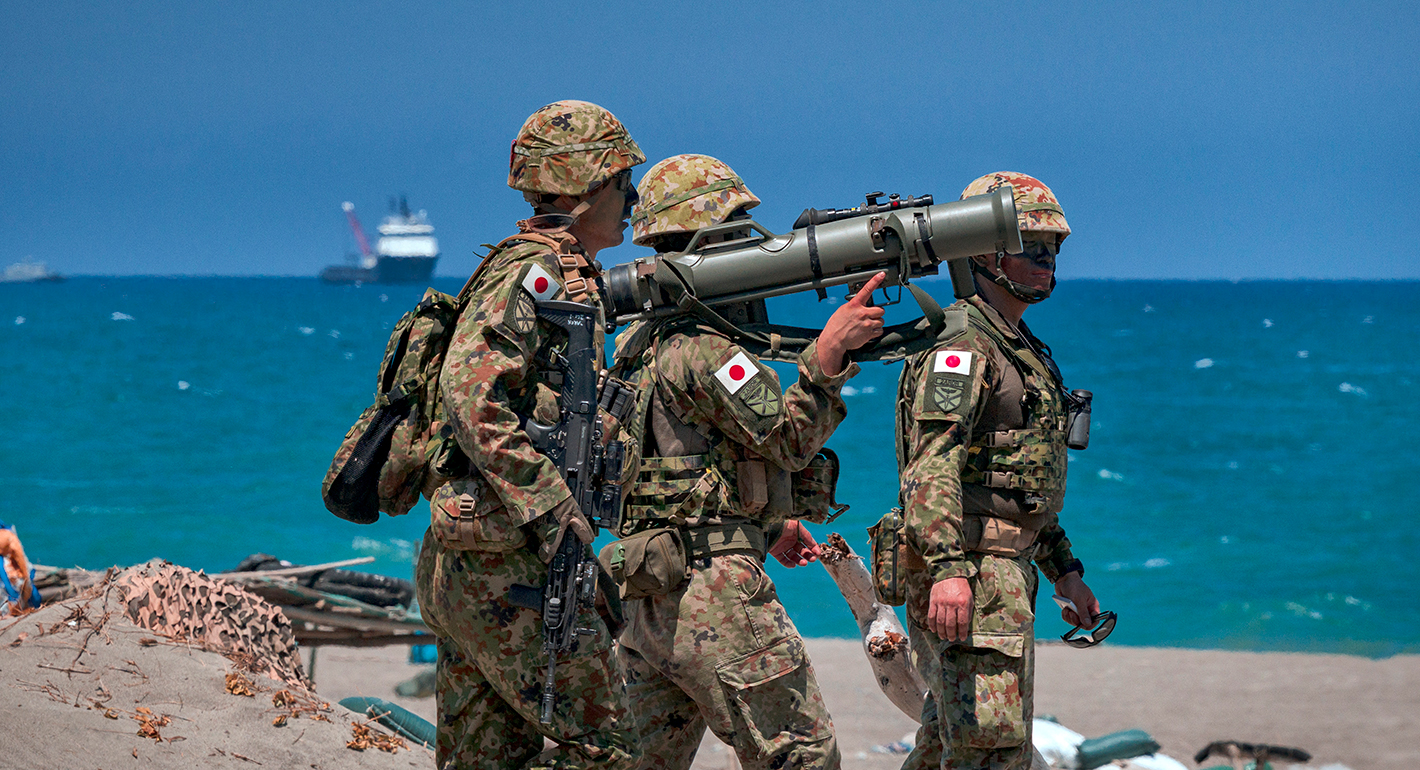
Source: Getty
Japan’s revision of its three strategic documents reflects an intention to keep the United States engaged in the region while Japan fills any vacuums of U.S. power to preserve the Indo-Pacific order.
Under the Takaichi Sanae administration, Japan’s security policy is once again approaching a major turning point. The government is moving forward with revisions to the so-called three strategic documents: the National Security Strategy, the National Defense Strategy, and the Defense Buildup Program. The concept of a Free and Open Indo-Pacific (FOIP) is also being upgraded. In addition, the government has reviewed the categories that have constrained the operation of the Three Principles on Transfer of Defense Equipment and Technology, making it possible for Japan to pursue defense cooperation more actively with like-minded countries and partners. In July, the government established the National Intelligence Council and its secretariat, the National Intelligence Bureau, which is expected to work as the overarching body of Japanese national intelligence agencies.
Each of these policies may appear to be a separate institutional reform or a policy adjustment, but seen in a broader context, they share a consistent strategic logic. Japan is seeking to strengthen its own defense capabilities, expand regional security networks, and deepen cooperation with allies and partners. Yet this is not a change driven by nationalism or militarism. Nor is it simply a passive response to American demands.
The essence of Japanese diplomacy and security policy over the past decade has been defined by two ideas: Keep the United States engaged in the Indo-Pacific and fill the strategic vacuums that may emerge from U.S. disengagement with additional defense and diplomatic efforts.
Historically, Japan has sought to preserve the regional presence of the United States and, more broadly, American engagement in the world. Now, Japan understands that U.S. engagement will not always be sufficient and that American attention and resources may at times be directed elsewhere. The Iran war has been a good example for Japan to realize the inattention of Donald Trump’s administration to the most strategically important region, considering the rise of China. Therefore, if Japan wants to manage regional stability, it will do so by maintaining U.S. engagement on broader issues while expanding defense operations to cover the gaps.
This interpretation differs from the view that sees changes in Japan’s security policy as a revival of militarism. It also differs from the view that sees Japan as merely passive, defensive, and responsive to external pressure. Japan is certainly cautious and often restrained. But this does not mean that Japan lacks agency. Japan is acting with restraint, but with a purpose, to preserve an international environment favorable to itself and to defend a free and open regional order.
When the Kishida administration revised the three strategic documents at the end of 2022, the question being asked in Japan was not simply how Japan should increase its own military power. The more important question was how to keep the United States engaged in the region.
The national security strategy adopted at the time clearly reflected the idea that Japan itself needed to accumulate greater defense capabilities to sustain the U.S. regional presence. Put differently, Japan did not increase its defense spending to move away from the alliance; it expanded its defense efforts to keep the United States in the region and to make the U.S.-Japan alliance more sustainable.
What is important here is that this decision was made not during the Trump administration, but during the Joe Biden administration. The pressure on Japan to assume a greater defense burden is not a phenomenon unique to Trump. For more than a decade, there has been a consistent expectation in Washington that Japan should assume greater defense responsibilities. Japan recognized that expectation. Behind Japan’s policy judgment was the concern that, if Japan did not increase its defense efforts, the U.S.-Japan relationship itself, or U.S. regional presence, could become unstable.
Of course, Japan’s security policy cannot be explained solely in terms of alliance maintenance. But it remains undeniable that for Japan, the U.S.-Japan alliance is still its greatest strategic asset. This is not only because visible instability in the U.S.-Japan relationship could create openings for China or encourage attempts to drive a wedge between the allies, but more fundamentally, Japan continues to regard the U.S.-Japan alliance as the foundation of its own security.
At the same time, this does not contradict Japan’s effort to enhance a degree of autonomy. Strengthening capabilities in cyber, intelligence, satellites, space, and stand-off missiles is not meant to replace the alliance. Rather, it is an effort to make the alliance more reliable. Japan’s autonomy is not autonomy for the purpose of distancing itself from the United States. It is autonomy for the purpose of reinforcing the alliance and the joint capability to defend its people.
This logic is evident in Japan’s posture toward the United States. Japan has believed that, to keep the United States engaged, it must combine all available instruments of diplomacy, economics, and security. The large-scale investment initiatives repeatedly mentioned at U.S.-Japan summit meetings are one example. They are not merely economic cooperation but are a form of economic statecraft intended to stabilize the alliance.
Japan has also avoided openly expressing anxiety about the United States. In this respect, Japan’s behavior clearly differs from that of European countries and Canada. This is not because Japan seeks to be subordinate; rather, it is part of Japan’s preferred approach to alliance management. In Japan’s judgement, publicly revealing doubts about the United States could damage the credibility of the alliance and weaken deterrence in the region.
Several years ago, interviews conducted by this author and Ayumi Teraoka with more than two dozen government officials and politicians on the major changes in Japan’s security policy under the Kishida administration found that many policy professionals denied the existence of direct pressure from the United States. In a narrow sense, they were probably correct. In reality, the United States today rarely gives Japan specific instructions about the level of its defense budget.
But that does not mean there was no pressure. When the U.S.-Japan relationship is viewed more broadly, there was certainly a widely felt sense in Tokyo that Japan should increase its defense budget—a kind of political heat transmitted from Washington to Tokyo. It was this heat that Japanese politics and the bureaucracy absorbed and translated into a concrete shift in security policy in 2022.
The basic structure has not changed very much today. The difference, if any, is that under the Trump administration, the demand that Japan shoulder a greater burden is being expressed more directly and more bluntly. But the background to Japan’s increased defense efforts is not simple subordination to the United States. It is a longer-term logic of alliance management: If Japan wants to keep the United States engaged in the region, Japan itself must do more.
Yet keeping the United States engaged is not enough. Even if the United States continues to be involved in the Indo-Pacific, its attention, political will, and resources will not always be sufficient. The United States is a global power, yet it faces many domestic and international challenges at the same time. Even if Washington says that it prioritizes the Indo-Pacific, recent resource allocation has not been concentrated there.
That is why Japan is trying to identify and fill the strategic vacuums that U.S. engagement alone cannot cover.
One such vacuum is managing defense across the Western Pacific and the wider Indo-Pacific. Japan has strengthened its defense posture around the Southwest Islands and the first island chain. Yet Chinese military activities are not confined to the first island chain. China’s behavior is also becoming more active across the wider maritime and air domains in the Indo-Pacific, extending toward the second island chain.
Responding to this broad space has not been an easy task for Japan. For example, placing radar on the Ogasawara Islands may be strategically desirable. But when budgets, infrastructure, local coordination, and personnel are considered, it was not something that could be easily achieved. Today’s strategic environment, however, is gradually presenting options that were once difficult as real possibilities. This changing environment is shaping the revision of the three strategic documents, and the idea of Indo-Pacific defense is likely to take a more concrete form.
Early examples of revisions to the old security framework are the construction of new security networks: the upgrading of FOIP; the review of the Three Principles on Transfer of Defense Equipment and Technology; new defense equipment cooperation with Southeast Asian countries, like the Philippines and Indonesia; and the strengthening of defense cooperation with Australia and New Zealand.
Japan is not rejecting the traditional hub-and-spokes regional security order centered on the United States. Rather, to support that order, Japan is trying to become another node within it. By becoming an additional hub in regional security networks, Japan seeks to encourage cooperation among partners and to strengthen the deterrence and resilience of the region. This is not an attempt to replace the United States; it is an effort to compensate for insufficiencies while presupposing continued U.S. engagement.
This point should not be misunderstood: Japan is not trying to create a new regional order from scratch. Japan’s objective is, fundamentally, to maintain the regional order. The challenge is how to preserve a free, open, and rules-based order in a new environment shaped by China’s rise, the threat from North Korea, uncertainty in U.S. politics, technological change, and a succession of global crises.
In this sense, the paradox of contemporary Japanese security policy is clear. Japan is changing in order to preserve. It is increasing defense spending, acquiring stand-off missile capabilities, strengthening the defense of the Southwest Islands, upgrading FOIP, reviewing defense equipment transfer rules, and expanding networks with like-minded countries. Its purpose is not expansion, but preservation and modernization of the existing order.
At the same time, Japan’s capabilities have clear limits. As has been repeatedly pointed out in debates over the three strategic documents, for example, even if Japan seeks to secure additional resources, the human foundation of its defense capabilities—the recruitment and retention of Self-Defense Forces personnel—remains a major constraint. Even if Japan increases its defense budget, it cannot ignore fiscal pressures, demographic trends, and domestic political constraints. Japan is trying to do more, but it cannot expand its burdens without limit.
That is why Japan’s strategy can only be conceived on the basis of alliances and partnerships. Unless the stability of the region as a whole, the security of sea lanes, the resilience of critical infrastructure, and a free and open order in the Indo-Pacific are maintained, Japan’s own security and prosperity cannot be protected. The question Japan is asking, therefore, is not simply how Japan should become stronger. The more important question is where the vulnerabilities in the regional order lie, and how Japan can reinforce them.
Seen from this perspective, changes in Japan’s security policy are neither militarization, an expression of nationalism, nor merely a passive response. They are an effort to keep the United States engaged, to fill the strategic vacuums that could emerge, and to preserve the regional order in an increasingly uncertain international environment.
For Washington, the implication is clear. Japan is willing to assume greater responsibilities. It is strengthening its defense capabilities, expanding regional networks, and deepening cooperation with the United States in areas such as economic security and defense industrial cooperation. But Japan cannot substitute for American strategy.
The U.S.-Japan alliance works best when clear American commitment and Japan’s own initiative reinforce one another. Japan is changing not because it seeks a new order, but because it fears the erosion of the existing one and is trying to assume new responsibilities to preserve it.
If the alliance with the United States were to lose its credibility—if, for instance, it no longer appeared capable of contributing to the defense of Japan’s territorial integrity—Japan would have no choice but to pursue a different path. Indeed, nationalist sentiment is already gaining ground in Japan, reflecting a desire for outright self-reliance. Yet the core of Japan’s current foreign and security policy is not driven by such radical impulses. It is far better understood as an accumulation of self-help efforts—undertaken while keeping the U.S. alliance as its foundation—designed to prevent the geopolitical openings created by American domestic politics from translating into strategic losses for Japan and for the world. To put it another way, Japan is still at the stage of upgrading Plan A to Plan A-plus; it has not yet fallen back to Plan B.
It’s not a question of whether Japan is becoming a “normal country” or a “militarized country.” The best way to understand Japan’s security policy is to consider how Japan is trying to keep the United States engaged while filling the strategic vacuums that remain.
These two logics have shaped Japanese diplomacy and security policy over the past decade, and they are likely to remain central to Japan’s strategy for some time to come.
Sign up for the latest analysis and invitations to public events from the Carnegie Asia Program.

Nonresident Scholar, Asia Program
Ryo Sahashi is a nonresident scholar in the Asia Program at the Carnegie Endowment for International Peace.
Recent Work

A deep dive into the policy ecosystems behind battery development in China, South Korea, Japan, the European Union (including some of its member states), the United States, Canada, and India.



Milo McBride, Herbert Crowther, Darcie Draudt-Véjares, …

The Plaza Accord was not an externally imposed punishment of Japan but part of a broader restructuring that Japanese economists and policymakers themselves recognized was necessary. Its effects were undermined, however, when Tokyo responded to the resulting slowdown with policies that exacerbated investment, credit expansion, and the very imbalances the adjustment was intended to resolve.

Michael Pettis

A look at why states without nuclear weapons are seeking naval nuclear propulsion, whether they can legally and technically deliver it, what it will cost them, and what responsible stewardship of the capability would look like.

Jamie Kwong

Over the past decade, China has moved from marginal player to major producer of all things batteries. The United States, Europe, and others are aiming to balance the market.
Milo McBride

The truth is that Japan’s government is seeking a degree of reengagement but at a vastly reduced level than under Abe. Most significantly, Japan has shown no willingness to ease sanctions.

James D.J. Brown