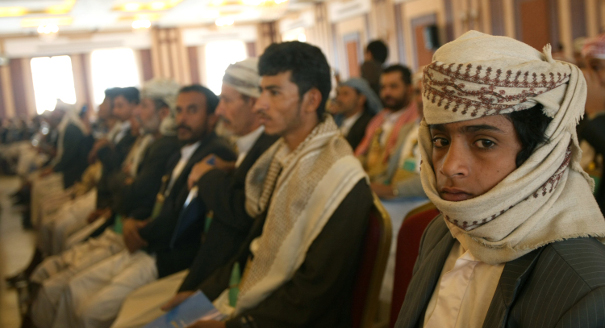
February’s presidential election in Yemen by no means marks the end of the country’s troubles. However, Brian O’Neill’s suggestion that the United States host a new arrangement based on decentralized negotiation between tribal and regional leaders is not the way to solve them. This call ignores lessons from Yemen’s past and underestimates the deep changes that have taken place in Yemeni society over the last decades. Although the tribal system continues to operate as the prevalent mode of social organization, it is crucial to recognize that the nature of their networks and institutions has changed quite drastically.
Historically, tribal networks compensated for the state’s lack of capacity. The tribe assumed the role of protector and provider: securing tribal territory, protecting water wells, and resolving conflicts between its members or with other tribes. In many ways, the tribe was the institution of first resort for financial backing and social support in times of crisis. It is perhaps very telling that Aden—where the nuclear family has displaced the tribe as the main social unit—is more affected by poverty than regions that have preserved tribalism, such as Shabwah, Mahra, and ad Dali.
Tribal sheikhs were also once accountable to their constituents: they were elected and could be voted out. Thus, a sheikh was often regarded as a first among equals, rather than an absolute ruler. Custom (‘urf) governed the mediation of conflict within or outside the tribe and could not be violated without loss of honor—a distinct disgrace—and threat of severe penalty.
However, the calculated politics of patronage applied by former president Ali Abdullah Saleh changed the nature of the relationship between tribal leaders and their constituencies. Saleh and the sheikhs had a number of incentives to engage in a new relationship. From the regime’s perspective, offering assistance to warring or otherwise weakened tribes undercut potentially strong alliances against it, and by incorporating tribal forms of arbitration, the regime also depleted tribal resources that could be used in opposition to the state.1 On the other side of the bargain, this patronage system afforded sheikhs freedom from accountability to their constituencies.2
By successfully co-opting these leaders and rendering them dependent on Sanaa for privileges and largesse, Saleh’s patronage system eroded tribal codes and norms—ultimately leading to a leadership vacuum. Many sheikhs today are dramatically wealthier than their fellow tribesmen—and thus no longer dependent on their constituencies. Gradually, more tribesmen are alienated from their leaders—who often take up residence in Sanaa3 and are only just beginning to abuse their power. The most famous example is the case of the Ja‘ashin area in Ibb, where the sheikh there evicted dozens of families in 2009 after they refused to pay “taxes”—they instead insisted on paying the municipalities directly. Additionally, there are reports of “private” prisons run by sheikhs who use them to intimidate and terrorize their own tribesmen—enough to cause Yemen’s Human Rights Minister Huriyya Mashhour to pledge to shut them down.
Saleh understood this reality belatedly. He mistakenly thought that securing the allegiance of sheikhs would ensure their tribes’ loyalties. But as revealed in the uprisings that led to his removal from office, many tribe members did not follow the orders of their “leaders.” In this context, it is difficult to imagine how the United States would host a new arrangement based on decentralized negotiation with leaders who can no longer deliver.
Perhaps we should look to the Sultanate of Oman as a source of inspiration—particularly to its strategy used to integrate the region’s tribes and end the Dhofar Rebellion in the 1970s. Oman managed to overcome Dhofar’s isolation by connecting it to Muscat while simultaneously instilling a sense of national identity in its population through three major initiatives.
First, the government pardoned all the Dhofari fighters who were willing to switch sides: those who accepted amnesty were retrained and incorporated into the armed forces. As a result, hundreds of Dhofari rebels deserted and joined Qaboos's “Firqat” Irregulars. These squads ranged in size from 30 to 100 men, the majority of which were defected rebels and local tribesmen trained to operate as a paramilitary force. Not only did this strategy help secure the support of the tribes from which members of the Firqat were drawn, but it also built up the squads as provisional regional governments, which may have helped rebuild trust in the central government. At the very least, this was a clear departure from previous policies of dispatching regular forces composed mostly of Pakistani soldiers.
The tribal factor was also especially important in Oman’s efforts to create an administrative network in the region and to ensure the allegiance of both tribal leaders and local people. Like the rest of the country at the time, Dhofar lacked a basic civil service. Starting in 1974, the new Sultan set up several ministries to run Dhofar’s public affairs and although the heads of these ministries lived in Muscat, local branches were set up for each, and their representatives were usually elected—rather than appointed—tribal leaders.
By addressing the economic and social demands and grievances of the population of Dhofar, the state aimed to undermine the very basis of the rebels’ cause. Between 1971 and 1975 the Omani government used generous funding from Saudi Arabia and the United Arab Emirates to allocate 25 percent of the nation's development budget to Dhofar alone and provide for the construction of local roads, airports, schools, clinics, and power stations. While promising to make the province economically self-sufficient by 1980, the overarching objective of the program was, however, to instill “pride in the community and a spirit of nation-building.” These efforts both appeased the Dhofari population and strengthened the connection between the center and the periphery.
All of this would not have been possible if the state was absent from the equation. The state is very much key to any attempt to solve Yemen’s problems, and hitherto has been hampered by weakness and corruption stemming from the rule of a single clan—one more interested in filling its coffers than addressing the needs of its population. But for this, we should not blame the state: Blame instead the leaders—and get to work.
Elham Manea is an associate professor at Zurich University’s Institute of Political Science. She specializes in Yemeni affairs and is the author of Regional Politics in the Gulf (2005) and The Arab State and Women's Rights: the Trap of Authoritarian Governance (2011).
[1] Philips, Sarah. (2008). Yemen’s Democracy Experiment in Regional Perspective: Patronage and Pluralized Authoritarianism, New York: Palgrave, p. 106.
[2] al-Sharjabi, Adel et al. (2009). The Palace and the Diwan: The Political Role of the Tribe in Yemen, in Arabic, Sana’a, p.46.
[3] Gray, Jefferson. (2010). Conceptual Paper –Yemen, unpublished, presented to a USAID Workshop, Washington D.C.