Tunisia’s Islamist movement Ennahda is facing its most serious crisis since coming to power. A second political assassination in just five months has deepened polarization between the Islamists and their critics. Opposition parties, long fragmented, have coalesced around demands for the resignation of the Ennahda-led government and the appointment of an unelected “national salvation” cabinet. At the same time the threat of Salafi radicalism is deepening in a country long presumed to be an oasis of secularism in the Arab world.
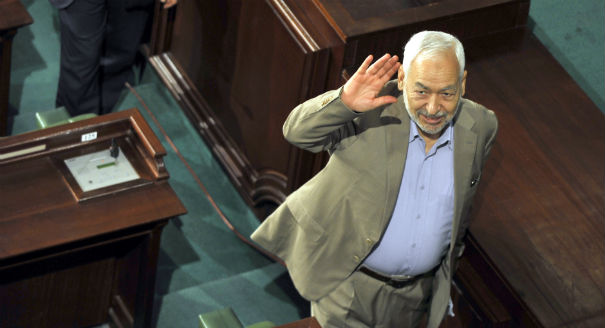
Ennahda leaders insist their party has been a model of consensus and compromise, which is why, according to the movement’s leader, Rachid Ghannouchi, the Tunisian democratic transition remains “the only successful model in the region.” There is much truth to this. The party chose not to put up a candidate for the presidency early in the transition for fear of provoking a backlash. Then it agreed to share power in a coalition cabinet with secular parties. In debates over the new constitution, Ennahda retreated from its demand to include mention of sharia law, it revised an ambiguously worded article that gave Tunisian women only “complementary” status to that of men, it dropped a plan to include a vague ban on “attacks against the sacred,” and it ceded ground to those who wanted a mixed parliamentary and presidential system of government. The drafting of the constitution has been inexplicably slow, but has at least forced political opponents to negotiate compromises among each other.
However, even though there has been a marked growth in popular piety across the Arab world in the past decade, newly-elected Islamist leaders underestimate the mistrust they still face. This is largely because the Islamic project they espouse is often ambiguous, the better to rally divergent tendencies within their movements. For example, Ennahda politicians assert that in order to appease those supporters angered by the sharia compromise, the leadership proposed in the latest constitutional draft Article 141, which states that no future constitutional amendment can challenge the fact that Islam is “the religion of the state.” There is no agreement on what this new sentence means, but at least one Ennahda politician mentioned that their understanding was that future laws must be in accordance with Islam. Likewise, the latest draft of the constitution declares, in Article 6, the state is the “protector of the sacred” (hamiya lil-muqqadasat), without detailing what “the sacred” means and what protecting it might involve. Interpretations of this, even among Ennahda politicians, vary from those who believe it means only preserving religious buildings to those who argue it is effectively a law against blasphemy, intended to prevent criticism of God, the Prophet, or the Quran. Such ambiguities have angered the opposition and forced significant delays in the finalizing of the constitution, even before the assassination of the leftist politician Mohamed Brahmi on July 25.
Another problem is the perceived failure of the government to tackle the root causes of the original uprising. Unemployment has dipped slightly but remains high at 16.5%, though it is much higher among young Tunisians, particularly graduates, in the poorer interior. Regional economic disparities persist, transitional justice is still unimplemented, and large parts of the former regime’s bureaucracy have yet to be reformed. It is perhaps just as likely that a secular-led government would have struggled on this front too; nevertheless, a sense of inaction and lack of change has fueled much popular cynicism about the Islamists.
Now, with the assassination of Brahmi, the crisis has intensified. Most of the opposition’s criticism is focused on the security question: Ennahda is accused of allowing a climate of impunity in which violent radicalism has flourished. It is true that the Salafi threat, itself a product of marginalization under the repression of the Ben Ali regime, is greater than Ennahda first appreciated. The party was slow to realize the loss of its monopoly as the sole representative of Islam in politics and was reluctant to give up its originally conciliatory approach to the Salafis. Only in recent months, after the discovery of arms caches, reports of thousands of young men travelling to Syria to fight, and attacks on soldiers operating near the Algerian border, did the party harden its position. In recent days the threat has grown. The interior ministry believes Salafis were behind the assassination of both Brahmi and Chokri Belaid, another leftist politician killed in identical circumstances in February. Over the past week 10 soldiers were killed in two different attacks by suspected Salafis near the Algerian border and two bombs exploded in Tunis.
For Ennahda itself, Salafism poses a major internal challenge. Ennahda is moving away from its Islamist roots to become a socially conservative, economically neoliberal political party. But its leadership has remained unchanged since the 1980s and it has not found it as easy as hoped to recruit young new supporters. Instead, it is being outflanked by young, upstart Salafi groups, with their clear ideology based on sharia law and their strong appeal to disenfranchised, unemployed young people.
The opposition, long fragmented, has come together to call for the resignation of the Ennahda-led coalition government and its replacement by an appointed “national salvation” cabinet. Even Ettakatol, a party within the coalition government, agrees with this demand. The Tunisian General Labor Union (Union Générale Tunisienne du Travail or UGTT), the country’s main trade union, which has already held two general strikes this year, is pressing for immediate change. Many among the opposition even want the Constituent Assembly dissolved. However, their plan to appoint both a new government and a commission to finish the constitution and present it to a referendum lacks both detail and democratic accountability. The army is historically apolitical and unlikely to take sides. Many Tunisians are dismissive of elite politics, symbolized by bickering, delays, and absenteeism at the assembly, far removed from the real challenges faced in the poorer regions. Others warn that opposition demands are a counter-revolutionary step too far. It would dislocate the transitional process just months before the next elections without addressing the fundamental socio-economic crisis confronting the new Tunisia.
Ennahda’s Prime Minister, Ali Laayaredh, has offered to finish the constitution quickly, drop controversial draft bills, and hold elections as early as December. However, this may not be enough. Although the opposition has yet to gather protesters on the scale of those seen in Cairo against the Muslim Brotherhood, demonstrations by both sides are continuing and around a quarter of opposition members have withdrawn from the Constituent Assembly.
After the last assassination in February, Ennahda eventually gave up the interior, justice, and foreign affairs ministries in favor of independent figures. But that compromise came only after a deep internal division within the party. Ghannouchi still resists giving up power and has criticized those who would “politically exhort” the government. His party will strongly resist attempts to unseat it and to interrupt the democratic transition, particularly in light of the crackdown against the Muslim Brotherhood in Egypt. Ennahda is ready to go some way towards a compromise, but that may not be enough for an increasingly angry opposition.
Rory McCarthy is researching a DPhil at St Antony’s College, Oxford, about Islamist activism in contemporary Tunisia. He is a former Middle East correspondent of the Guardian.