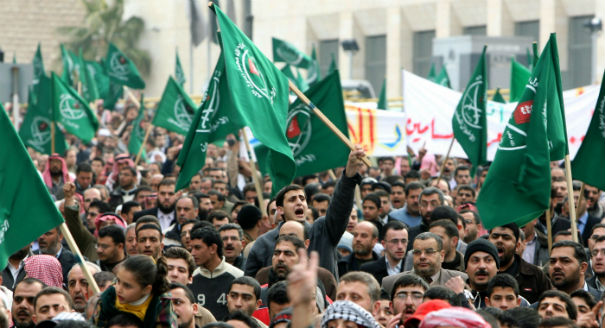
Over the past few years, the ranks of the Jordanian Muslim Brotherhood have been roiled by disagreements. This extended period of grave internal disputes—personal, intellectual, and ethnic—finally culminated in a group of key leaders breaking away to form the Jordanian Building Initiative, an organization that aspires to be a political party unassociated with the Brotherhood. However, more than a year after its launch, it is unclear whether the group, more commonly called the Zamzam Initiative, has anything new to offer. Its platform focuses on national consensus and political, economic, and social reform in vague terms while offering few concrete ideas. This is all too similar to the standard, time-worn slogans adopted by the Jordanian Brotherhood for years.
Zamzam was officially launched on October 5, 2012, following nearly a year of controversy after it was announced. According to its founders, the new Brotherhood offshoot's goals include “political reform, especially reforming the constitution, because it is the basis of any political, economic, and social reform, as well as developing and renewing Islamist rhetoric as is compatible with being a broad civilizational framework for the umma [Islamic community] in all its components.” The genesis of the Zamzam initiative goes back to Brotherhood’s internal elections of 2008, when Salem Felahat’s moderate supporters split the seats in the Brotherhood’s Executive Bureau with the hawks. However, the two sides continued to quarrel throughout their time in office until the moderates came to the conclusion that working within the Brotherhood was a waste of time, given their substantial internal disagreements. They therefore decided to branch out on their own.
The internal disputes within the movement, which eventually drove the moderates away, were no doubt compounded by the state’s relentless repression of the Brotherhood between 2007 and 2010. These attacks included a negative media campaign, the imprisonment of some leaders, and the 2007 takeover of the Islamic Center Association (Jama‘iat al-Markaz al-Islami), the largest Brotherhood-affiliated economic and social foundation. Today, the Islamic Center Association case continues to inch its way through a byzantine judicial process that the government keeps alive as a possible bargaining chip. As the Brotherhood was reeling from these blows, discontent was growing with Controller-General Salem Falahat and his administration’s management of the situation. The hawks turned against Falahat after the group’s leadership issued a joint statement with the Jordanian Prime Minister at the time, Marouf Al-Bakhit, in which they asserted their loyalty to the regime, among other things. This was seen as a major concession and a truce with a government. The disputes within the Brotherhood leadership grew following the debate about withdrawing from the 2007 parliamentary elections—marking a historic loss for the group—which they claimed was rigged.
Zamzam acknowledges that its arrival in the political scene coincides with a critical juncture for the Muslim Brotherhood after the events of July 3 in Egypt. It has cautioned against any “rash actions” in a transitional period “that is dangerous and requires the utmost wisdom and collective intelligence in order to benefit from what is taking place in surrounding countries and an agreement on the rules of the political game before starting partisan competition.” The founders of Zamzam said that of their 500 members, 20 percent of them came from within the Brotherhood, and projected their membership to grow rapidly in the near future—likely from independents. The founders, most prominently the two moderate leaders Rheil Gharaibeh and Nabil Kofahi, emphasized that their initiative did not comprise a complete break with the Brotherhood. Yet, hostility between the Muslim Brotherhood and the new initiative flared up when the Brotherhood launched an internal trial of the Zamzam leaders in December 2013, which could lead to either their dismissal from the organization or suspension of membership.
The Zamzam founders say that they are trying to break down the duopoly of the regime versus the Brotherhood, which has dominated both local and regional politics, and create a third way toward achieving political reform in a country exhausted by economic crises. Likewise, the sweeping scope of the initiative is reminiscent of the Brotherhood’s style of presenting itself as simultaneously expert in economics, politics, social policy, and moral guidance. Zamzam has not convinced observers that it is a new political project able to effect change in the political arena—particularly given the experience of the Wasat Party, a group that broke away from the Muslim Brotherhood in the mid-1990s and which saw little success in attracting Brotherhood supporters.
The political atmosphere and public mood in Jordan hardly create a friendly environment for fostering new political parties. After decades of deterrence and intimidation of political engagement, as well as the failure on the part of parties themselves to gain broad popular support, Zamzam’s chances of convincing the masses that it is a worthwhile entity appear remote. It is also noteworthy that the regime welcomed the Zamzam Initiative with significant state-run media coverage of the launch announcement, attended by government officials. This suggests that the regime wants to portray Zamzam as an alternative to the Brotherhood, which it claims is splintering and weakening. This reception has also raised doubts about the initiative’s neutrality and whether it is being used by the regime to weaken its staunchest political opponents.
Zamzam’s ability to draw popular support away from the Brotherhood appears limited, given the Brotherhood’s still-potent cohesion (despite the occasional departures of former leading figures). Zamzam’s vague promises of political change are more likely to fade away than to become reality.
Tareq Alnaimat is a Jordanian journalist and researcher specializing in Islamist movements and author of The History of the Islamic Student Movement in Jordan (Al Umah Study Center, Amman, 2010). He was recently a Visiting Arab Journalist at the Woodrow Wilson International Center for Scholars.
This article was translated from Arabic.