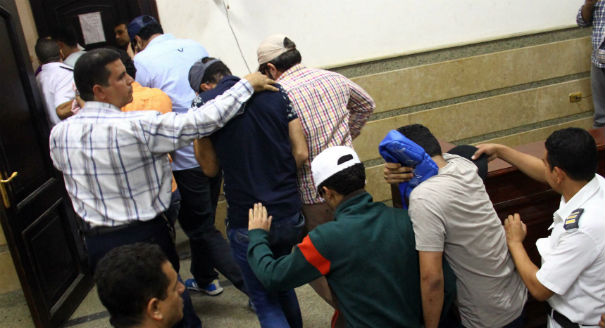
In what may be a forerunner of more to come, Egypt’s capital is witnessing a fierce campaign against what is being presented as a decline in morals and a loss of traditional values. The Ministry of Interior’s vice squad raided a hammam in downtown Cairo on December 7, like a similar raid in October 2013, in each instance charging gay men with “debauchery.” Authorities also announced the confiscation of a coffee shop under charges of Satanism, and al-Azhar, the Ministry of Youth, and the Ministry of Religious Endowments issued a joint proclamation of a national strategy to combat atheism. These are just the most visible symptoms of a concerted effort to restore the state’s moral authority in the eyes of the public.
Against the backdrop of a shattered economy and signs of upheaval in Sinai and the Western Desert, authorities have increased their public references to morality. Homosexuals and atheists in particular have come under attack by officials, and the Egyptian press has portrayed them as public enemies (alongside the Muslim Brotherhood). Some observers have attributed this sudden moralism to the need to distract popular attention from the recent “Sisi-Leaks” corruption scandal that has dominated Egypt’s social media sphere for the last few weeks. Others believe that the country’s new strongman is trying to prove that he is capable of guarding society’s traditions and values. Ultimately, it may be an opportunity for the state to do both.
These developments have troubled Egyptian liberals, many of whom had expected that last year’s overthrow of President Morsi legitimized the need to curb Islamists’ illiberal influence and pave the way for a more secular Egyptian society. Supporters of the military takeover alleged that the Brotherhood sought to impose their anachronistic ideology on all facets of life. In retrospect, however, the Morsi administration—whether by design or by default—did not herald a new ultraconservative era in Egypt. Instead of enforcing the rigid moralism that derives from conservative readings of Islamic norms, the Brotherhood confined itself by and large to the education sphere, with some excursions into arts and media production. The group dismissed leading cultural figures, censored cartoons, and arrested prominent satirist Bassem Youssef on charges of offending religion. But calls by their Salafi coalition partners in the Egyptian parliament to prohibit ballet as an “art of nudes,” to dissolve women’s rights groups, to ban alcoholic beverages, or to regulate beachwear only marginally inspired actual legislation. Aware of the implications for Egypt’s tourism industry, the Morsi administration refrained from implementing gender segregation on beaches. A decision in December 2012 to increase taxes on alcohol and tobacco was put off and did not come into force until July 6, 2014, when President Abdel Fattah el-Sisi decreed it to reduce the country’s budget deficit.
The Muslim Brothers’ religious conservatism had even less impact on the ground: they did not stop Egyptians from consuming alcohol, expanding the party scene, or challenging sexual taboos. On the contrary, after a temporary drop in the aftermath of the 2011 uprising, the volume of alcoholic drinks sales rebounded strongly in 2012 despite sharp declines in the tourism sector. Several new upscale bars and cafés opened in Cairo, some catering specifically to the country’s LGBT community. In spite of Brotherhood rule, Egypt also witnessed the emergence of a new LGBT activism (among others an initiative to create a National Day Against Homophobia and Transphobia), stirring up hopes for more tolerance and social liberalization.
These hopes did not last. Half a year into Sisi’s term, Egyptian homosexuals still face stigmatization and social discrimination. Polls show that homophobia is rampant, with only 3 percent of Egyptians agreeing that homosexuality should be accepted by society. Worried about placating its conservative constituency, the Sisi government has stepped up its assault on the Egyptian gay scene. Since Morsi’s ouster, rights groups have recorded the worst state crackdown on the LGBT community since the days of Hosni Mubarak. More than 150 people have been arrested since June 30, 2013 on the assumption that they are gay or transgender, and many face long prison sentences up to twelve years. Since same-sex relations are not formally forbidden under Egyptian law, authorities have resorted to a plethora of legal provisions regarding “debauchery,” “contempt of religion,” and “public morality” to prosecute gay men—some of which have also been used to charge alleged atheists and apostates. In addition, laws against immoral advertising have been used to indict men seeking gay partners on the Internet. In September, in what may be the first case of a conviction based on evidence gathered online, a Cairo court sentenced six men to two years of hard labor after advertising their home as a gay meeting spot on Facebook.
In addition, discrimination against suspected homosexuals, going beyond the legislative and discursive sphere, has increased at an alarming rate in recent months. In the latest bathhouse raid, in addition to being force stripped and beaten, the arrested were publicly shamed and paraded in front of TV cameras. The humiliation, reminiscent of the Mubarak era, has become routine in the security forces’ treatment of alleged gay citizens. The physical exams endured by suspected homosexuals bear a resemblance in brutality to the virginity tests conducted by army staff on female protesters in early 2011. (Following an international outcry, the Cairo Administrative Court had ordered an end to the shameful procedure in December 2011, declaring the tests illegal.) To a large part, this can be attributed to lack of depth and nuance in the state’s official discourse on sexual discrimination. While the discrimination of women has received a certain degree of attention from the authorities (and even Sisi himself)— representations of sexuality and gender that do not fit into a hetero male-female binary seem to have no space in Sisi’s approach to public morality. In a recent move, Egypt has criminalized the physical and verbal harassment of women, setting unprecedented penalties for such crimes. It is unlikely that similar protective measures will end the physical assault on homosexuals or other members of the LGBT community anytime soon.
Instead, calls by the head of al-Azhar’s Fatwa Committee to expel homosexuals “so that vice would not be allowed to spread,” as well as remarks by Egypt’s prosecutor-general that displays of homosexual affection were “humiliating, regrettable, and would anger God,” illustrate how the use of religion to prove the state’s morality is not contingent on Islamist rule. In fact, contempt for basic human rights like sexual self-determination and freedom of belief abound even under a president that has declared reforming Egypt’s religious discourse as his firm goal. So far, the new secular version of conservative moralism that the Sisi government is promoting is proving to be far more harmful to Egypt’s LGBT community than the year-long Brotherhood rule. After targeting Islamists, activists, journalists, students, atheists, and now homosexuals, the question remains, who is next?
Jannis Grimm is an assistant to the project “Elite Change and New Social Mobilization in the Arab World” at the German Institute for International and Security Affairs (SWP).