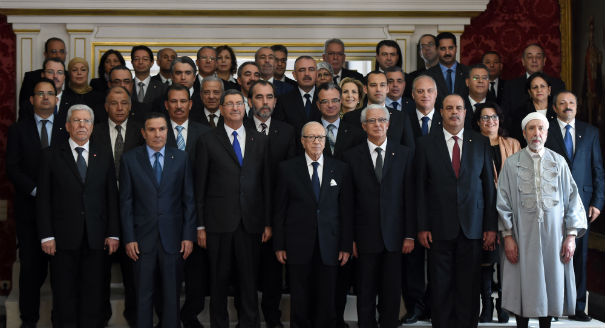
After months of wondering whether the new Tunisian cabinet would include Islamist members, many Tunisian voters were surprised that designated Prime Minister Habib Essid decided to integrate Ennahda into his government. The Islamist party, the main opponent of Nidaa Tounes, had come second in parliamentary elections in October 2014. Even though Ennahda only has one minister and three undersecretaries in the new government, their presence unsettles disappointed voters and members of Nidaa Tounes, which has positioned itself as an anti-Islamist political project since its creation in 2012.
Newly elected president Beji Caid Essebsi had charged Habib Essid, an independent politician, to form a government in early January. Essid’s first proposal for a government made up solely of Nidaa Tounes and the populist Free Patriotic Union (UPL) had been attacked from all sides for lack of cohesion and expertise. Seeing that this proposed cabinet had no chance of meeting parliamentary approval, Essid came back in early February with a second proposal that included ministers from the liberal Afek Tounes party (which has 8 representatives in parliament) and Ennahda (69 representatives).
Yet the first proposal was mainly a tactical maneuver. Nidaa Tounes had built its parliamentary and presidential election campaigns around its opposition to Ennahda. But with 86 of 217 seats, the party was far from the 109 seats needed for a majority in parliament. Even a coalition with both UPL (16 seats) and Afek Tounes (8 seats) and independents, would garner only 110 seats—barely past the 109-seat threshold, and with no guarantee that the parties and their members would vote in unison. In the long run, such a coalition would be unlikely to survive until the next elections, scheduled for 2019. The leftist Popular Front (15 seats) also refused to enter the coalition due to the presence of old regime figures in it. Nidaa Tounes realized it had no option but to form a coalition with Ennahda, but this was a bitter pill to swallow for many. To appease party members, Essid had to at least try to form a government without Ennahda, even though he knew this first proposal was likely to be rejected.
The second version of Essid’s cabinet was adopted on February 5 with 166 votes in favor, more than 75 percent of parliament. But observers were quick to point out critical aspects of the new power arrangement. “They won’t last longer than a year or two,” critics said. Ideological differences between Nidaa Tounes and Ennahdha, especially on social issues, risk straining the newly formed coalition—as do the lack of governing experience for many in Nidaa Tounes, Afek Tounes, and the UPL. Both Ennadha and Nidaa are likely to pay a high price for their alliance in terms of supporters.
Ennahda has already paid the price in the parliamentary elections for how they ran the government, losing 20 percent of the votes they had obtained in 2011. They agreed to participate in the new coalition, even with very limited representation, instead of taking a step back and cultivating an opposition role that would be more palatable to their voter base. Former Ennahda spokesperson Zied Laadhari became minister of vocational training and employment, which is an important portfolio in post-revolution Tunisia, where unemployment is one of the new government’s biggest challenges. But because the country is facing such difficult economic conditions, Laadhari is likely to suffer in public opinion, no matter what he does.
For its part, Nidaa Tounes’s decision to include Ennahda in the cabinet risks driving away some of its supporters, which could impact upcoming elections if they believe the party is not following through on their election promises. This decision also reinforces internal divides within Nidaa Tounes, which is already pulled in different directions by old regime figures, unionists, and disappointed social democrats from various smaller parties. Of the 86 Nidaa Tounes deputies, one refused to give a vote of confidence in the new government and another four abstained. However, a press release by Nidaa Tounes’s secretary-general and new Minister of Foreign Affairs, Taïeb Baccouche, strongly condemned those deputies who did not vote for the new government, saying that they will be sanctioned for not following the party line. This incident prompted new discussions about the party’s internal quarrels.
Other critics have pointed out the lack of women and young politicians in the government. Only three women are among the 24 ministers, of whom the majority are over 50 years old. This is in a country where about half the population is under 30 and politicians often cite the emancipation of women as a signature national achievement. In addition, Essebsi’s nomination of Habib Essid and the choice of his Minister of Interior, Najem Gharsalli, has raised concerns among civil society. Having figures strongly associated with the old regime in these key positions has triggered fear and staunch criticism from the opposition. Essid has a long political career that dates back to the early 1990s and the rule of Zine El Abidine Ben Ali, under whom he served as the undersecretary to the minister of agriculture, environment, and water resources. Najem Gharsalli, a judge during the Ben Ali era, has been governor of the center-east Mahdia province since 2011.
Tunisians were also surprised at the appointment of 87-year-old Lazhar Karoui Chebbi as President Essebsi’s “personal representative” (mumathil shakhsi li-ra’is al-jumhuriya), a new position that carries the rank of minister. The announcement triggered jokes that the two elderly politicians would take turns heading the country, reflecting Tunisians’ concerns that the 88-year-old Essebsi might be too old to lead the country for a five year period. More seriously, concerns have been raised that this position could be an attempt to circumvent the presidential succession process laid out in the constitution.
With a number of challenges ahead for the new government—among them socio-economic reforms, security threats, and municipal elections—a clear plan of action and coordination between the different portfolios are necessary to get Tunisia back on track. While the institutional steps toward democracy are moving forward, the socio-economic issues that underpinned the 2011 uprising persist. Differences in ideology, along with the need to coordinate the positions of four different parties, risk slowing decisionmaking. This will place further strains on citizens who are still waiting for the more tangible results of their uprising.
Sarah Mersch is a Tunis-based freelance journalist.