Migrants from sub-Saharan Africa stranded in the desert after their truck broke down. Photo by Tom Westcott, November 29, 2015.
Migrants from sub-Saharan Africa stranded in the desert after their truck broke down. Photo by Tom Westcott, November 29, 2015.
Migrants from sub-Saharan Africa stranded in the desert after their truck broke down. Photo by Tom Westcott, November 29, 2015.
Migrants from sub-Saharan Africa trying to fix the vehicle they were traveling in. Photo by Tom Westcott, November 29, 2015.
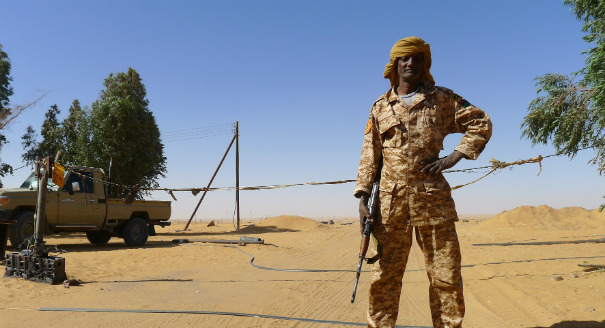
Security personnel at one of the makeshift checkpoints along the highway. Photo by Tom Westcott, November 29, 2015.
A Tebu security official at one of the checkpoints along the highway. Photo by Tom Westcott, November 29, 2015.
Trucks heavily laden with goods not readily available in Niger and Chad. Photo by Tom Westcott, November 24, 2015.
Trucks heavily laden with goods not readily available in Niger and Chad. Photo by Tom Westcott, November 24, 2015.
A makeshift checkpoint. Photo by Tom Westcott, November 29, 2015.
Migrant workers loading bags of flour being smuggled to Chad. The first truck had an accident, and the goods had to be
Show More >
guarded in the middle of the desert until a replacement could be found. Photo by Tom Westcott, November 29, 2015.
< Show less
Migrants heading back to their home countries after failing to find work in Libya. Photo by Tom Westcott, November 28, 2015.
Migrants heading back to their home countries after failing to find work in Libya. Photo by Tom Westcott, November 28, 2015.
Heavily-laden trucks take a rest stop on the way to Chad and Niger. Photo by Tom Westcott, November 29, 2015.
Libyan border guards. Photo by Tom Westcott, November 29, 2015.
A patrol of military personnel from the Tebu tribe. Photo by Tom Westcott, November 29, 2015.
The long-since closed gas station in Libya’s southernmost town of Qatrun. All fuel in the area is now sold from oil
Show More >
tankers or barrels by the side of the road. Photo by Tom Westcott, November 26, 2015.
< Show less
Two trucks involved in a crash that killed several local people. Photo by Tom Westcott, November 30, 2015.
The Libya–Niger border crossing. Photo by Tom Westcott, November 29, 2015.
Libya’s Saharan highway of smuggling stretches 600 kilometers (400 miles) from the Libya–Niger border to the town of Sabha, through the heart of Libya’s south. Known as Qaddafi’s Road and once heavily-policed under the former dictator’s border forces, since Libya’s 2011 uprising it has become a route where smugglers operate with impunity. Libyan security forces from the Tebu tribe—a semi-nomadic Saharan people living in Libya, Chad, and Niger—have tried to control the area since Muammar al-Qaddafi’s soldiers abandoned their posts in 2011, but, unpaid and poorly-trained, their scope is limited.
Under the midday Saharan sun last November, a people smuggler tried to repair the broken engine of his truck that four days earlier left Niger packed with 23 migrants from sub-Saharan Africa. The truck’s few water barrels—just enough for the three-day desert journey—were empty, a tiny amount reserved for cleaning engine components, and all aboard were suffering from dehydration. Mostly from Niger, one of Africa’s poorest countries, the young migrants ranged from as young as twelve to their late twenties. “We’ve been here for two days, ever since the truck broke down,” said 24 year-old Joseph, one of two migrants from Ghana, who explained that he was initially planning to find work in Libya but shyly admitted hoping to reach Europe one day.
The trucks usually avoid the checkpoints, weaving between the road and desert terrain to pass by the limited security forces along the highway unnoticed. “We can’t do anything for these people, but now we’ve seen them, we’ll have to report them at the next checkpoint,” said a soldier heading to the Tummo border crossing. “Maybe someone from the checkpoint will come to help them or arrest them,” he said. But arrest is just a notion. Operations against illegal immigration in southern Libya have been at a standstill for the last two years, after limited financial support dried up altogether when Libya’s political sphere divided into rival governments. Without enough money even to feed detainees, detention centers across Libya’s south, each one originally built to hold hundreds of migrants, now stand empty.
According to Rejab Agey Mohamed, the head of the Department for Combatting Illegal Immigration in the southern town of Murzuq, before 2011 the department arrested thousands of migrants and transferred them to holding centers in Sabha and Qatrun, from where many were deported. “Since 2011, there has been no proper functioning state, and now there is no support from either government in the west or east,” he said. Personnel are reduced to using their own money and cars to work, and the department has become completely disempowered. “The borders are wide open, and this is the road migrants pass along toward the north of Libya, but we have no power to stop them now,” Mohamed said.
Like the security forces along Qaddafi’s Road, the majority of people smugglers are Tebu. Marginalized under Qaddafi’s regime—and again since political, racial, and tribal divisions re-emerged once Libya’s short-lived unity splintered in 2014—the Libyan Tebu claim they have been pushed into smuggling by poverty and lack of education. “Many see smuggling as the only option for making a living,” explained one Tebu civil society activist.
But transporting desperate people across the desert is just one of the illegal operations on the Saharan Highway. The most prominent—and one often undertaken by other southern Libyan tribes—is smuggling goods out of Libya. Overloaded trucks carry mainly food and a range of domestic goods, from mattresses to bicycles, chairs, and wheelbarrows. Despite Libya’s crumbling economy and rising prices, such items remain cheaper than in Chad or Niger. At a makeshift roadside cafe along the highway, two smugglers rested near their trucks, which were piled high with goods. Both were from two powerful tribes in the south—the Warfalla and Qaddafa—and they spoke of the Sahara as a country in itself. “It’s a triangle, our country, stretching across Libya, Niger and Chad,” said Hassan. “Since we were born we have known these three countries as our own. And we have always worked the desert, for nearly 30 years now, from Sabha to Niger and Chad.”
Unlike the trucks carrying migrants, goods-laden vehicles pass through the checkpoints, many greeting security personnel stationed there like old friends. “I am proof that it is not just Tebu doing the smuggling,” said one man, posing for photographs at a shabby, makeshift checkpoint. “This is my country, and I have been doing this job for fourteen years,” he said. He operated two ancient Toyota trucks, loaded with goods upon which sat a few migrants returning to their home countries.
Military personnel operating the handful of checkpoints between the Niger border and Sabha describe these trucks as “commercial vehicles.” Blaming a lack of financial or material support, they admit the trucks are allowed to travel freely. “Look at this vehicle passing in front of us, in front of our very eyes. We can do nothing, but anyway, it’s mainly carrying food to our neighboring countries, which are very poor,” said Agi Lundi, the commander at a desert checkpoint 200 kilometers (135 miles) from the border. “If there was a functioning government, we might ask whether this is legal or not, but there isn’t, so what can we do?” Lundi explained, “It’s better that these trucks use the road and go through checkpoints, otherwise they would use the desert where they can’t be monitored at all.” He claimed all trucks were tracked from Sabha and their cargo inspected at Qatrun, but the inspection point at Qatrun has been closed for months, as government salaries for its personnel have long since gone unpaid.
Tebu commanders in the South freely admit that the smuggling of people and drugs keeps the border area unstable and dangerous but say that, if they were funded and supported either by Libyan or international help, they could secure the borders. “We don’t even need GPS to work here, because we know the land, but we do need support,” said Rejab Agey Mohamed in Murzuq. “We need vehicles, equipment and money to restart our operations to stop illegal immigration and secure the border.”
Until that time, the Tebu troops manning the border and checkpoints—effectively working as volunteers—say they will continue with the limited security duties they are able to perform. “If we were paid, we wouldn’t be stuck in this crumbling checkpoint and have cars with no lights because we can’t even afford to replace the bulbs,” Lundi said, gesturing to a battered truck in much worse shape than any of those used by people smugglers, who frequently change their vehicles to ensure they can cope with the tough desert climate. He counted off things his men needed to do their job: vehicles, weapons, ammunition, and gasoline. “The oil is under the ground, under our feet, but we don’t even have enough gasoline to do our job,” Lundi said. “But we will stay here, doing what we can to protect our country. Even if there continues to be no government for 100 years, we will stay here. We are prepared to die for Libya.”
Tom Westcott is a Libya-based British journalist and writer.