In the context of its continuing rivalry with Iran, Saudi Arabia’s response to limited success in Yemen and setbacks in Syria has been to try and reassert its influence, contain its enemies, and close ranks—reevaluating some of its alliances in the process. Recent Saudi moves to apply financial and diplomatic pressure on Lebanon suggest the country may be the first casualty of Riyadh’s new policy. But squeezing the Lebanese state may merely weaken it and Saudi Arabia’s own allies in Beirut while failing to achieve the kingdom’s strategic objectives.
In the past, although Lebanon often served as an arena in which the Saudis competed with Iran and Syria, Riyadh nevertheless sought to find an uneasy but pragmatic working relationship with Damascus and its local allies in Beirut. For example, when Syrian troops were stationed in Lebanon following the civil war, Riyadh heavily supported post-war reconstruction and greatly invested in the Lebanese economy. While Riyadh’s investment was channeled through its main local political ally—the Hariri economic and political dynasty—it did so while trying not to step directly on Syria’s toes. Even following the shocking assassination of Rafik Hariri, the Saudi resolute stance against Syria, Iran, and their domestic allies was relatively short-lived. By 2008 Riyadh had abandoned its strategy of confrontation and instead resorted to a policy of rapprochement with Damascus, a de facto acceptance that it was impossible to end Syria’s influence on Lebanese domestic politics.
Yet the impact of both the civil war in Syria and the rising Saudi–Iranian rivalry on Lebanon has been direct—pre-existing cleavages between the pro- and anti-Assad camp have intensified. This has led to a long and crippling paralysis of Lebanese domestic politics that has left the presidential residence, Baabda Palace, vacant since May 2014. Frustrated by recent blows to its influence in Syria and Yemen, Saudi Arabia has taken a series of assertive actions in the past few months seemingly aimed at breaking the impasse, containing Hezbollah, and attempting to force a change in Lebanon’s ambivalent regional alignment.
The tightening of the screws officially began as a response to Lebanese Foreign Minister Gebran Bassil’s reluctance to endorse an Arab League condemnation of the January 2016 mob attack on the Saudi Embassy in Tehran, an episode triggered by the Saudi execution of prominent Shia cleric Sheikh Nimr al-Nimr. While Bassil—who is also the new leader of the Hezbollah-allied Free Patriotic Movement party—expressed solidarity with Riyadh, he fell short of endorsing its broader criticism of Iran’s and Hezbollah’s regional roles, citing Lebanon’s policy of “official neutrality.”
Since then, it seems Riyadh has decided to do everything in its power to make sure that Lebanon’s regional balancing act ends once and for all. On February 19, the kingdom officially halted both a $3 billion military aid package for the Lebanese Armed Forces to buy French weapons and a separate $1 billion earmarked for the Lebanese security sector at large. Together with Bahrain and the United Arab Emirates, Saudi Arabia also urged its citizens to refrain from traveling to Lebanon, historically a popular destination for Gulf tourists. While Saudi Arabia has so far held off from taking even more damaging economic moves, such as bulk withdrawal of money and investments from Lebanon or expelling Lebanese workers from Gulf countries en masse, still it is clear that Saudi Arabia is seeking to place a hefty price tag on Lebanon’s attempt to balance between Tehran and Riyadh.
But Saudi Arabia upped the ante by seeking regional isolation for Hezbollah, Iran’s strongest ally in the country. In the past few weeks, Saudi instigation has prompted the Gulf Cooperation Council and the Arab League, in meetings of both the Council of Arab Ministries of Internal Affairs and then the Council of Arab Ministries of Foreign Affairs, to designate Hezbollah as a “terrorist organization.” These moves were followed by GCC threats to prosecute and sanction those who work with Hezbollah indirectly. Meanwhile, Saudi ally Bahrain announced it would deport alleged Lebanese “Hezbollah supporters.”
The success of these steps largely depends on Saudi Arabia’s strategic goals. If the kingdom hopes to pressure Lebanon into ridding the country of Iran’s and Hezbollah’s influence, then the chances of success are incredibly slim. Short of igniting internal strife—a situation which would not especially benefit anyone, including Saudi Arabia—the Lebanese government does not have the political (or military) ability to curtail Hezbollah.
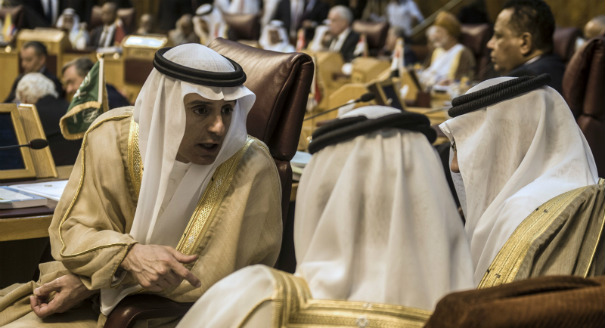
If the goal is instead not to change Lebanon’s regional stance, but rather to signal to other countries in the region that it is time to “pick a side” and unite under the Saudi flag against Iran and Hezbollah, then Saudi Arabia may have more success. Getting the Arab League to label Hezbollah a terrorist organization is one achievement on this front, even though it did elicit a degree of dissent within the league. Notably, the designation did not just raise objections in Lebanon, but also in Iraq and, to a lesser degree, in Tunisia and Algeria.
However, any potential regional success comes with a price in Lebanon. Ironically, the biggest casualty of Saudi Arabia’s more confrontational policy toward Lebanon and Hezbollah will be its own local allies. First and foremost, former Prime Minister Saad Hariri and his Future Movement are placed in an especially difficult position. Recent Saudi pressure has prompted the movement to make more vitriolic attacks against Hezbollah. Yet Hariri’s posturing still falls short of satisfying Riyadh, which has signaled it will not back down until Lebanon rids itself of “Hezbollah interference.” Needless to say, this is an objective Hariri cannot deliver, making him look weak and isolated at a time when his March 14 coalition is confronting new divisions over the presidential elections and Hariri himself faces declining popularity within his own community. It appears to the Lebanese that Saudi Arabia is hanging Hariri out to dry and, along with him, what is left of the political capital of the forces that spurred the 2005 Cedar Revolution.
In terms of Saudi influence in Lebanon, these moves will at best further increase the political cleavage between the competing March 14 and the March 8 camps. Indeed, finding a balance between the respective “pro-Saudi” and the “pro-Syrian-Iranian” orientations of the opposing coalitions will prove an incredibly difficult task. In addition, any long-term rift between Saudi Arabia and its domestic allies would further weaken the March 14 forces, disempowering the kingdom’s only political allies in Lebanon. At worst, Saudi withdrawal of support from Lebanon will open the door to increased Iranian political and financial involvement. Iran has already offered to step up and support the Lebanese armed forces, which would further weaken Saudi Arabia’s own influence.
The possibility of both increased Iranian involvement in Lebanon and more political and economic instability in the fragile country has led the United States to express its misgivings with the latest Saudi maneuver. France has also criticized the move, a logical position given that its defense industry stands to lose $3 billion over the freezing of the military aid package. While neither American nor French reservations are substantial enough to have an impact on the kingdom’s bilateral relations with them, it would be worthwhile for Riyadh to take the criticism seriously. Further tightening the screws on Lebanon may not just fail to achieve Saudi’s geostrategic objectives, but complicate an already unstable and frail situation within Lebanon itself.
Benedetta Berti is a fellow at the Institute for National Security Studies (INSS), a TED senior fellow, and a non-resident senior fellow at the Foreign Policy Research Institute (FPRI).