Two factions within the Muslim Brotherhood are dueling for control, diminishing the group’s ability to address challenges from the regime and driving its supporters to other actors, among them the Islamic State.
In February 2014, the youth—who were increasingly calling for revolutionary action—successfully pressured the group to hold internal elections to restructure its governing bodies and address the leadership vacuum. This allowed them to take a more active role in internal leadership, especially on the “crisis management committee.” Since then, following the arrest of Mohamed Wahdan, a member of the guidance bureau aligned with the youth, the crisis management committee has been disbanded and replaced by the “high administrative committee.” This has added to the tension between the youth and old guard, whom the youth claim were behind Wahdan’s arrest and took advantage of the leadership vacuum to place Mahmoud Ezzat (also a member of the guidance office and deputy guide) as the Brotherhood’s default supreme guide.
Led by guidance bureau member Mohamed Kamal and the Brotherhood’s official spokesman, Mohamed Montasser, the youth group—which includes members in Egypt and abroad—has united under what is now called the “current of conscience.” The group is keen to keep the decentralized structures produced by last year’s internal elections; they also call for violent action against President Abdel Fattah el-Sisi and reject prospects of political reconciliation and integration.
The second is the “old guard,” or the “elders’ current,” led by Mahmoud Ezzat. The old guard, not accustomed to such rebellion, is looking to undo the younger members’ rise to leadership. Each of these factions has its own administrative offices, rhetoric, and spokesman. Although the split lines up along generational lines, it is more ideological, as even within each demographic there are figures that support the other camp’s approach. But beyond seeking greater influence over what is left of the organization, neither group has a comprehensive vision for the future of the Brotherhood.
Although Ezzat’s faction is currently stronger—as it benefits from more funding, international ties, and the support of historical heavyweights in the group, like the London-based deputy head of the Muslim Brotherhood, Ibrahim Mounir, and Secretary-General Mahmoud Hussein—it is still not able to solidify Ezzat’s grasp over the organization. The group has stopped providing financial support to the youth who either support or are associated with Kamal’s group, which doesn’t appear to have access to outside funding.* It has also shut down the Brotherhood’s semi-official IkhwanOnline site, which was operated by Kamal’s front, and instead launched a new page, IkhwanSite. Ezzat’s front likewise launched a new channel, Watan, to replace Misr Alaan—which was shut down for airing statements by Kamal and Montasser.
Yet Mohamed Kamal’s group enjoys significant support among the youth and controls a large number of powerful administrative offices, including in Cairo and Alexandria. According to a Brotherhood youth leader in Egypt, of the 27 Brotherhood administrative offices, “there are at least 10 offices that announced their rejection of the old guard’s resolutions and support the so-called revolutionary movement led by Kamal’s front.” And on February 16, the pro-Kamal leaders of Fayoum and Beni Suef offices threatened to expose Ezzat’s group for alleged misuse of funds.
Despite financial pressure, the youth faction is still looking for ways to diminish the influence of the older generation. Frustrated with the lack of changes, they have begun pursuing their own version of reforms. Some of these youth have opted to develop their skills to help them engage in politics in the future. Others have formed small, secret groups to avoid being discovered—particularly what are known as the “specific committees,” which carry out violent operations.
Many within the organization are frustrated by the split and are encouraging an end to the rivalry. Yusuf al-Qaradawi, issued a statement in January 2016 calling for new elections to resolve the split, to no avail. Both factions indicated their agreement to another round of elections and restructuring to promote unification, but the two groups disagree over the details of these reforms and who should take the lead on them. The continued imprisonment of Brotherhood Supreme Guide Mohammed Badie and his deputy Khairat al-Shater—and the resulting absence of a central voice on the dispute—further complicate debate over the group’s future.
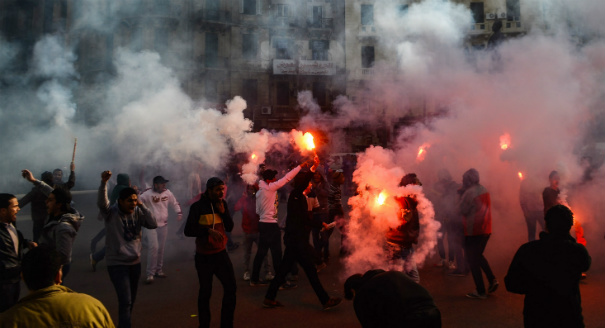
This division is driving away large segments of Brotherhood members and supporters who are already in despair over the heavy state crackdown, human rights violations, and lack of economic and political opportunities in Egypt. Many of them are turning to groups like the Islamic State, which is taking advantage of the rift to recruit frustrated members—two videos on January 23 and February 7 targeted Brotherhood youth, urging them to reject peaceful methods and join its ranks. According to several sources within the group, a number of Brotherhood youth have recently joined the Islamic State. The divisions within the Brotherhood serve the Islamic State as youth stop believing in political solutions. And while the Brotherhood is busy fighting itself, Egypt remains without a viable opposition.
Mostafa Hashem is an Egyptian journalist specialized in youth issues and Jihadi and Political Islam movements.
* This article is the result of a series of interviews with Brotherhood youth and leaders over several months.