The massacre on May 26 of Coptic Christians in Minya by Islamic State-affiliated gunmen was the fourth such incident in six months, following several attacks on churches in Cairo, Alexandria, and Tanta. Instead of addressing glaring security deficits—and protecting Copts, who have been singled out by the Islamic State—President Abdel Fattah el-Sisi has focused on escalating the government crackdown on what remains of the opposition.
After the tragedy in Minya, President Sisi did not declare a day of national mourning. Instead, the state seems to be using the attacks on Copts to further tighten the noose on civil society. This included passing an NGO law that essentially criminalizes normal NGO activity, blocking the few remaining independent media sites, and arresting and interrogating secular opposition party members.
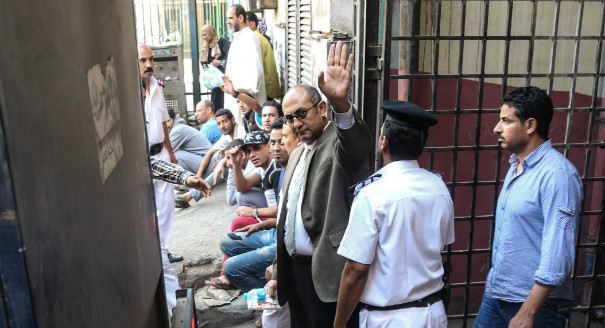
In the past two weeks, over 40 people have been arrested or detained, mainly from the Dostour Party and the secular Bread and Freedom Party, including its Coptic Christian members such as Andrew Nassif from Zagazig. In the most publicized case, on May 23 security forces detained Khaled Ali, a key figure within Egypt’s human rights community and founder of both the Bread and Freedom Party and the Egyptian Center for Economic and Social Rights, who had suggested he may run against Sisi in the presidential elections in spring 2018. He rose to prominence nationwide in April 2016, when he filed a lawsuit against the government’s plan to transfer the Tiran and Sanafir islands to Saudi Arabia. When the Supreme Administrative Court ruled on January 16, 2017 to halt the transfer, there was an impromptu street celebration. Four months later, Khaled Ali is now being accused of having made a rude hand gesture while celebrating the victory, which qualifies as public indecency. If convicted, he would be disqualified from running in the presidential elections next spring. The crackdown against him and members of his party all across the country seems intended to destroy the rudimentary political infrastructure he had set up.
On May 24, Mohamed Zaree, Director of the Egypt office of the Tunisia-based Cairo Institute for Human Rights Studies (CIHRS) and a finalist for the prestigious Martin Ennals Award for Human Rights Defenders, was interrogated as part of Case 173 of 2011, the ongoing NGO “foreign funding case.” He has been banned from traveling for over a year and could face life imprisonment. Yet the new NGO law upon which the case will be tried criminalizes what would be considered normal NGO activity. The draft law issued by parliament in mid-November 2016 requires civil society associations to “work within the scope of the state’s plans” and gives security authorities oversight over their work and funding. This prompted a number of NGOs to immediately shut down, especially in the governorates outside the capital, where human rights groups are smaller and more vital than in Cairo. However, following strongly-worded criticism from U.S. senators John McCain and Lindsey Graham, Sisi did not sign the law for six months. Then suddenly, three days after the massacre in Minya, an announcement appeared in the official gazette that the NGO law is now in effect.
Also on May 24, the government ordered service providers to block 21 online media sites for “content that supports terrorism and extremism and deliberately spreads lies,” including Mada Masr, arguably Egypt’s most independent and critical news site. This sweep surpasses any media censorship Egypt has seen since Sisi became president three years ago. And amid muted international condemnation, the regime subsequently added the business-oriented Daily News Egypt and Al Borsa News to the list of blocked sites. When Mubarak ordered the internet shut down in late January 2011 in an attempt to prevent further protests, this strategy quickly backfired, as people took to the streets and occupied public squares across the country, eventually leading to his downfall. Sisi’s attempt to crush civil society may not backfire immediately, but neither is it likely to succeed in the long run.
Instead of seeing secular political parties that oppose sectarianism as potential allies in the fight against the Islamic State, the regime is trying to silence them. Instead of seeing independent media as a potentially useful source of information on security issues, it has blocked two dozen news sites. And instead of welcoming NGOs and charities that offer poor communities services the state is either unable or unwilling to provide, the new NGO law will make much of this work impossible—potentially leading already struggling communities to become further impoverished.
Censoring more than 20 news sites is a wistful attempt to prevent critical reporting, or even just the spread of information. And the NGO law is intended to bring Egypt’s independent civil society associations under the full control of the state and starve them of the funds they need to operate. The arrest of Khaled Ali and members of his political party one year before the presidential elections is clearly intended to prevent the emergence of any challengers to President Sisi. None of these actions will protect Coptic Christians. They are meant to bolster the regime that has failed, once again, to protect them.
Amy Austin Holmes is an associate professor of sociology and head of the sociology unit at the American University in Cairo. She is the author of Social Unrest and American Military Bases in Turkey and Germany since 1945 (Cambridge University Press, 2016). Follow her on Twitter @AmyAustinHolmes.