In the wake of the Kurdish independence referendum on September 25, the Kurdish peshmerga and the Iran-backed Popular Mobilization Forces (PMF) clashed in Kirkuk on October 16, potentially opening up a drawn-out struggle over the city. The conflict between Iraq and the Kurdistan Regional Government (KRG) over Kirkuk also has geoeconomic importance, as the triumphant party will be able to control oil fields and use them to extract concessions. These tensions are driving Tehran and Baghdad closer, each fearing loss of influence over the Kurdistan Region and the high volume of trade that passes through it.
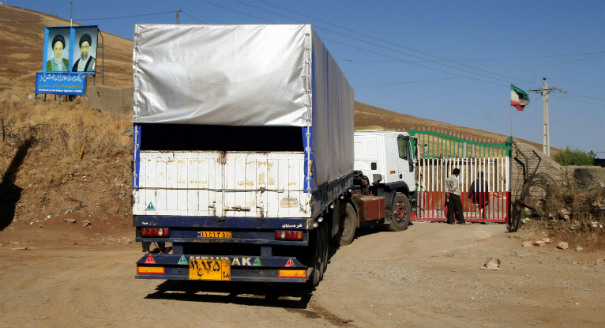
Baghdad and the PMF are gaining the upper hand over the KRG, partly due to coordination with neighboring countries. On October 16, at Baghdad’s request, Iran shut down the economically vital Parviz Khan border crossing, demanding the KRG hand the crossing over to Baghdad’s security forces, though the following day the PMF entered the Parviz Khan crossing via Iran and captured the Iraqi side. Likewise, and without giving a reason, it closed the Piranshahr (Haji Omaran) and Bashmaq border crossings on October 15 until further notice—effectively imposing an unofficial trade embargo. Between 50 and 60 percent of Iranian exports had entered Iraq through these three crossings, and about 80 percent of Iranian exports to Iraq pass through the Kurdistan Region overall. Instead of these crossings, Tehran and Baghdad agreed to use the Khosravi border crossing, which was planned to be reopened in November and is controlled on the Iraqi side by Baghdad’s security forces. These swift responses highlight not only how Iran is attempting to diversify its trade routes to Iraq—to address the geoeconomic vulnerability of relying so heavily on the KRG for its trade—but also how indispensable the current routes are.
Responding to the rising tensions that led to the clashes in Kirkuk, the head of Iran’s Export Confederation said on October 4 that Iranian traders must compensate for anticipated closed borders with the Kurdistan Region by stepping up exports to other Iraqi regions. While Iran has been already attempting to diversify its road-freight routes in Iraq, the conflict over Kirkuk might accelerate these efforts. However, Iran is unlikely to keep its de facto trade embargo for long, provided the KRG gives in and surrenders the border crossings with Iran to Baghdad’s security forces, as has begun to take place. Iran, which has a significant ethnic Kurdish population in its northwestern provinces, is the KRG’s second largest trade partner after Turkey, and while blocking border crossings might be an effective weapon in the short term, cutting trade ties with KRG would curb its ability to exert its influence there in the long run.
Reportedly, over 75 percent of domestic consumption in the Kurdistan Region, including 90 percent of foodstuffs, relies on imports. Nonetheless, the prolonged slump in crude oil prices has triggered an economic crisis in the Kurdistan Region, reducing its non-oil imports from Tehran from $8 billion in 2014 to $4 billion in September 2017. Yet as global crude oil prices gradually recover and reconstruction is anticipated in areas formerly held by the Islamic State, the KRG’s imports are also expected to increase. This is already seen in Tehran’s exports: Iran’s Trade Promotion Organization (TPO) reported that the value of Iranian exports to Iraq, including the Kurdistan Region, grew by 4 percent in the first five months of the current Persian year 1396 (March 21, 2017 to March 20, 2018) compared to the same period in the previous year. This is a relative improvement compared to the first five months of year 1395 (March 20, 2016 to March 20, 2017), which due to low oil prices saw negative growth of 2 percent, far from the 19 percent export growth the TPO reported for the same period in year 1394 (March 21, 2015 to March 19, 2016).
Hoping to recover this growth and maintain its economic influence, Iran had stepped up its efforts to improve its trade ties with the KRG in the months prior to the Kurdish referendum. Kurdish and Iranian trade officials met earlier in 2017 to focus on better connecting Kurdish markets with Iran’s adjacent provinces, including conferences in the Kurdistan Region in July and August to discuss trade deals and plans to open joint trade offices in Erbil and Tehran. Likewise, Iran has sought to increase its railways and roads through the Kurdistan Region. President Hassan Rouhani has advocated extending the railway project between Hamadan and Sanandaj in Iran to the Syrian border to connect Iran with the Mediterranean region. However, given the referendum crisis, it is unclear the extent to which Tehran will pursue new projects with the KRG. For example, a pipeline to export crude oil from Kirkuk via Iranian seaports in the Gulf was proposed in 2014 during disagreements between Erbil and Baghdad over revenue share of crude oil exported via the Turkish Ceyhan pipeline. Strategic projects such as the pipeline project are not likely to move forward in the near future, as it would give Erbil an additional lifeline, unless incorporated into a comprehensive agreement to settle the dispute over exporting crude oil coming from Kirkuk’s fields.
Meanwhile, Haider al-Abadi’s government is continuing its long-standing push for less dependence on Iran and increased political openness toward Iraq’s Arab neighbors, especially Saudi Arabia, the United Arab Emirates, and Jordan. In mid-August 2017, Iraq and Saudi Arabia agreed to reopen the Arar border crossing. According to Iraq’s transportation minister, there are ongoing talks to reopen seven more border crossings with Saudi Arabia, which is also attempting to significantly increase its non-oil exports as part of Vision2030. Similarly, Iraq and Jordan reopened the Karameh border crossing on August 30 after highways controlled by the Islamic State were liberated. Moreover, Amman is negotiating with Baghdad a tariff exemption on its exports.
While the heightened tensions are driving Tehran and Baghdad closer, the more Iran fears loss of influence in the Kurdistan Region, the more it will project its influence in Iraq to capitalize on its gains to continue its economic and strategic reach toward the Mediterranean. In return, this will likely push Abadi further toward a more multi-pronged foreign policy, with improved political and economic ties with Iraq’s Arab neighbors. As an indirect, long-term consequence of the referendum, Iran could face more challenges to expanding its market share in Iraq and presence in provincial markets.
Tamer Badawi is a research fellow at the Istanbul-based Al-Sharq Forum specializing in the political economy of the Middle East with a focus on Iran. Follow him on Twitter @TamerBadawi1.
* Correction: An earlier version of this articles stated Sanandaj was in the Kurdistan Region.