Efforts to combat extremism through religious counter-narratives are expanding across the Muslim-majority world. But while a new study of over three thousand diverse religious texts showcases the rich potential for mainstream Islam to rebut extremist interpretations of theology, it also finds that counter-narrative efforts are inadequately confronting extremists’ abuse of scripture and recourse to disputed religious concepts.
The analysis of contemporary texts put out by groups from across a broad ideological spectrum highlights that the ideology of Salafi-jihadism, held by groups such as the Islamic State and al-Qaeda, is palpably distinct from mainstream Sunni Islam. Across a sample of thousands of documents, of the 50 most quoted verses (ayat) of the Quran in Salafi-jihadi texts, only 8 percent are also prevalent in mainstream material. Salafi-jihadi texts do quote Islamic scripture extensively to justify their ideology, with five times more Quranic references than mainstream texts. However, they cherry-pick the Quran, drawing on a small cluster of verses to affirm their ideological position. In contrast, the mainstream quotes from a broader range of verses, reflecting a wider thematic focus. Such scriptural selectivity undermines arguments, made by both Islamist and anti-Muslim ideologues, that extremists have more religious legitimacy than mainstream interpretations. Pointing out extremists’ selective and narrow references to scripture may be one way to prevent them from defining the rules of the game.
Beyond references to specific verses, analysis of texts’ predominant religious concepts demonstrates how different interpretations draw on distinct “arsenals of ideas.” The analysis suggests extremists are considerably more concerned with legalistic elements of scripture than personal piety.
Notably, a number of hardline Islamist groups—including Hizb ut-Tahrir, Jamaat-i-Islami, and some variations of the Muslim Brotherhood (more mainstream political parties, such as Ennahda in Tunisia and the Justice and Development Party in Turkey, were not included in analysis because they drew on considerably less religious content)—use scripture and concepts similarly to Salafi-jihadi groups in their core texts. This ideological proximity between Islamists and Salafi-jihadis, and their distance from the mainstream, becomes particularly apparent in their respective uses of the Quran. In the study’s sample, 64 percent of the 50 most-referenced Quranic verses in the Islamists’ texts overlap with those of the Salafi-jihadi groups, whereas Islamists and the mainstream only have 12 percent in common. This similarity does not necessarily indicate a shared ideological character, as texts may reach different interpretations of the same quotations. However, understanding such relationships can inform the growing global policy debate around the interplay between violent and nonviolent extremism.
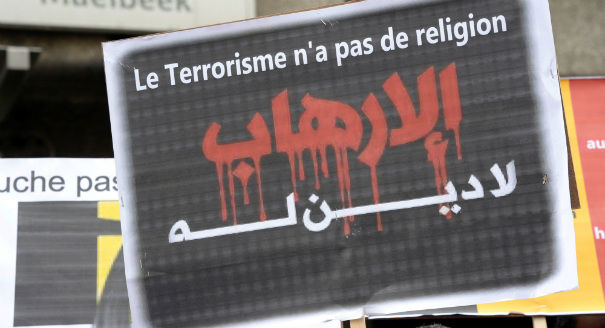
These findings can also help evaluate the success of religiously rooted counter-narratives to extremism. The study analyzed what Quranic verses and hadith counter-narratives reference, what concepts they promote or refute, and what scholarship they draw on, comparing these with the narratives in both Salafi-jihadi and Islamist texts. The counter-narratives split roughly three ways: content either condemns extremist actions as un-Islamic, offers peaceful alternatives and interpretations, or directly takes on and unpacks extremist arguments.
Yet most efforts are currently failing to respond to the key arguments peddled by extremists. They are only addressing and challenging the interpretations of 16 percent of the Quranic references prominently used by Salafi-jihadis in the study’s sample, demonstrating that much more can be done to reclaim religious discourse from Islamist and jihadi ideologues. For example, one of the most commonly quoted verses in Salafi-jihadi literature (Surat Al-Anfal, verse 60) warns Muslims to prepare against armed battle with their opponents, but counter-narratives are currently failing to capitalize on the verse that follows, which emphasizes peaceful resolution of conflict.
Counter-narratives seem to address the religious ideas explored in Salafi-jihadi literature more successfully, but still do not prominently tackle about 40 percent of the key ideological concepts of Salafi-jihadism. Most efforts are focused exclusively on tackling narratives of violence, such as suicide attacks. For example, “This is not the Path to Paradise,” a widely shared fatwa by Mauritanian sheikh Abdullah Bin Bayyah condemning the Islamic State’s claim to have established a caliphate, is one of only a few examples of a counter-narrative that directly confronts the religious nuance of an Islamic state.
Around the Muslim-majority world, prominent religious institutions and leaders are increasingly proactively issuing rebuttals of extremist thought rooted in sound Islamic knowledge. While it is still in its early stages of development, Al-Azhar University’s online Observatory for Combating Extremism, launched in June 2015, tracks the Islamic State’s propaganda and rebuts extremist religious interpretations—for example, it issued an online feature correcting common misconceptions about Islam and publishes theologically founded replies to terrorist ideologies. It is also expanding its work to train young imams to use social media to effectively counter such narratives in their own communities. In addition, political leaders in Muslim-majority countries are increasingly associating good citizenship with confronting extremist worldviews. For the United Arab Emirates’ national day, Crown Prince of Abu Dhabi Mohammed bin Zayed stressed “the pressing need that the Arab peoples, the young in particular, know that [extremist] ideologies are maiming the beautiful and shining face of our faith.” Saudi Arabia’s Etidal Center, opened in May 2017, aims to coordinate efforts by governments and international organizations to fight extremism, and hundreds of its analysts have been tasked with identifying and engaging with extremist “perversions” of Islam online.
Although some counter-narratives directly address the scripture and concepts violent extremist groups express, those who follow such a violent stance often have louder voices. Extremist interpretations are well funded, well organized, and effectively communicated. To drown them out, alternative Muslim voices are seeking to amplify their rebuttals against distortions of their faith. Initiatives such as the Sawab Center in Abu Dhabi provide strategic communications expertise on understanding audiences, helping mainstream religious leaders effectively engage a range of media and platforms when presenting arguments. For example, in November 2017 the Sawab Center launched a joint Twitter campaign with the Al-Azhar Observatory to emphasize the values of mercy and tolerance. But grassroots religious responses still face challenges in garnering resources, using effective platforms, and coordinating efforts with counterparts.
In Western countries, diverse Muslim-led civil-society responses—such as the UK-sponsored Imams Online project—also provide credibility and community access for counter-narratives. And as more local actors refute extremist interpretations of Islamic scripture, governments can distance themselves from accusations that their efforts to counter destructive ideologies are an attempt to cultivate a state-sanctioned Islam, a perception that plays into extremists’ hands. As public debates about Islamist extremism grow, efforts to counter it may be more effective if they directly take on verses and hadith most cited by extremists, engaging with the concepts they most focus on, and offering alternative interpretations.
Rachel Bryson and Milo Comerford are analysts in the Co-Existence team at the Tony Blair Institute for Global Change.