Introduction:
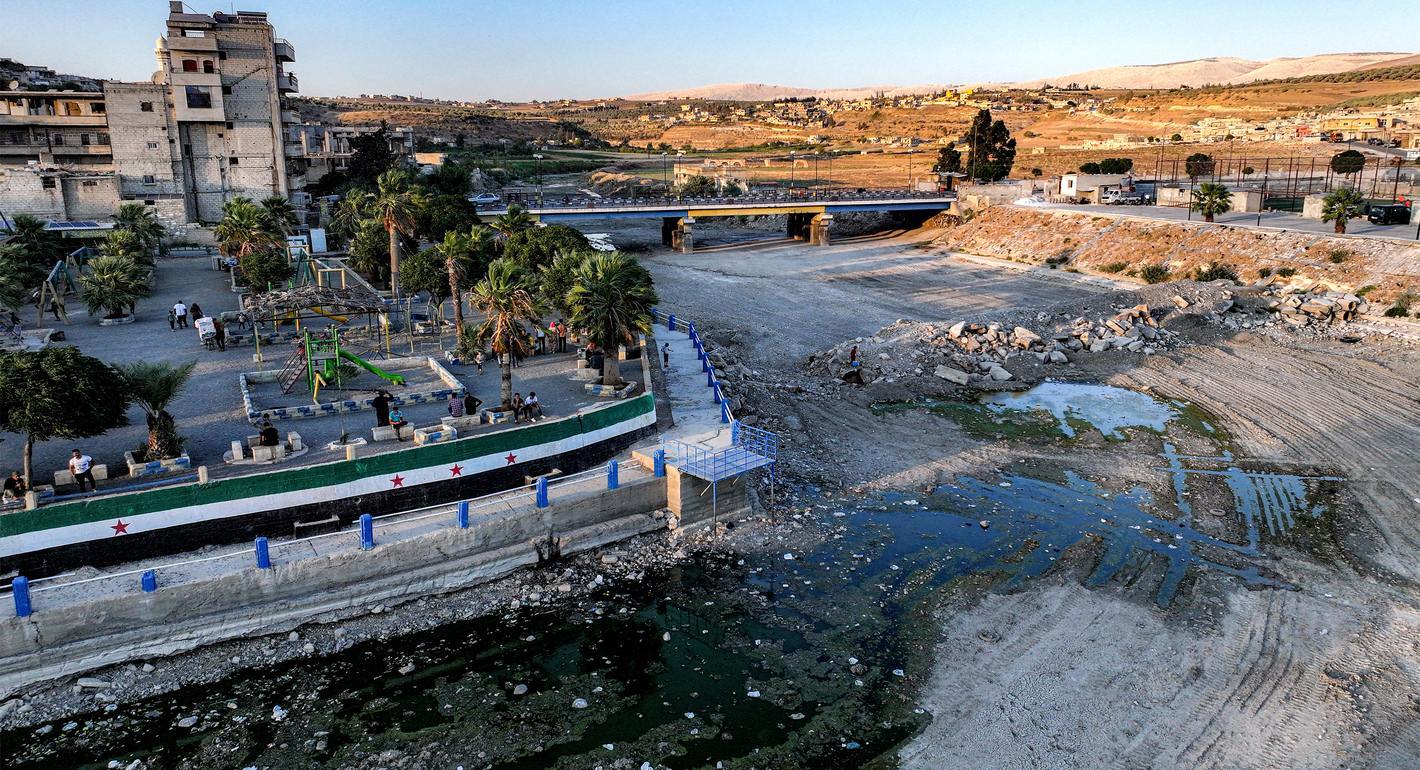
In recent years, Syria has entered a period of acute environmental stress in which drought has emerged not merely as a seasonal anomaly, but as a defining and destabilizing force shaping everyday life. The precipitation seasons of 2024 and 2025 have transformed drought from a recurrent climatic concern into a central and urgent crisis that threatens the very foundations of life across the country. Marked increases in temperature, coupled with significant declines in rainfall and snowfall, have led to a severe depletion of water resources, with immediate consequences for agriculture, livestock production, and access to safe drinking water. In addition, numerous dams have reached what experts describe as “dead storage” levels in governorates such as Daraa and Deir Ezzor. At the same time, unprecedented desiccation of the Orontes River has triggered urgent warnings of an impending nationwide water crisis.
This evolving situation raises a critical analytical question: Does the current crisis in Syria reflect merely a shortfall in average precipitation, or does it signal a deeper transformation in the relationship between climate systems, natural resources, and food security?
Current evidence suggests that the crisis cannot be understood as an anomaly or a temporary fluctuation. The recurrence of three major drought episodes between 2006 and 2021 has depleted approximately 60% of groundwater reserves in northeastern Syria, while desertification has expanded to nearly 73% of the country. As vegetation cover continues to recede and wildfires become more frequent due to prolonged dryness, Syria appears to be undergoing a profound environmental and economic transition—one that may fundamentally reshape agricultural systems and intensify the vulnerability of rural communities.
Drought represents the intersection of three interrelated dynamics: climatic variability, resource depletion, and limited institutional capacity for effective management.
This article examines how climate change has manifested in Syria through a set of interconnected processes, beginning with declining and increasingly irregular precipitation patterns, the deterioration of surface water reserves in dams, and the depletion of groundwater resources. These developments have contributed to severe disruptions in the agricultural sector, particularly in wheat production, a strategic pillar of national food security. The analysis further explores the escalation of wildfires, the contraction of forest cover, and the expansion of desertification across large areas of the country, as well as their impacts on soil quality, rangelands, and livestock production. It also assesses the broader implications of these dynamics—understood as an extension of the ongoing climate crisis—for human security in Syria.
Rather than treating these developments as a list of “climate impacts,” the article adopts an analytical framework that conceptualizes them as components of a self-reinforcing system. Within this system, water scarcity accelerates soil degradation; degraded soils reduce agricultural productivity; and declining productivity, in turn, increases pressure on already limited natural resources, thereby deepening and perpetuating the crisis.
It is equally important to situate this environmental crisis within its broader political and social context. The protracted conflict since 2011 has severely damaged water and agricultural infrastructure, while simultaneously constraining the state’s capacity to respond effectively, implement sustainable solutions, and strengthen resource management systems. Within this framework, the article examines the role of Syrian institutions and relevant international organizations in addressing the crisis, as well as the adequacy of existing policies in preventing Syria’s gradual transition from a country with relative self-sufficiency to one increasingly dependent on imports and less able to secure its water and food needs.
Rainfall Patterns in Syria: From Seasonal Regularity to Increasing Variability and Scarcity:
Hassan Jerdi, a meteorologist at the Syrian General Authority of Meteorology, stated in an interview with Sada magazine that climate change has played a significant role in altering the temporal and spatial distribution of rainfall patterns in Syria, thereby affecting overall precipitation levels, expanding arid zones, intensifying water scarcity, and increasing temperatures. He noted that the 2024–2025 season is considered one of the most severe in recent years, with rainfall levels declining by approximately 60 percent below the annual average.
Rainfall is no longer distributed within a stable and predictable seasonal cycle; rather, it has become increasingly irregular and intermittent, thereby reshaping the very concept of a “rainy season” in Syria.
Jerdi further emphasized that changes in rainfall patterns—including a decline in the frequency of winter depressions of polar origin and an increase in transitional periods between seasons—are particularly concerning. He stressed that, when considering the total quantity, duration, and spatial distribution of precipitation during the rainy season, the concentration of heavy rainfall within short time intervals represents one of the most problematic precipitation regimes.
This is because it transforms rainfall from a “stabilizing ecological component” into an additional environmental stressor. The growing temporal imbalance in precipitation means that the land surface is no longer able to gradually absorb and retain water; instead, it is subjected to short, intense bursts of rainfall that primarily generate surface runoff rather than contributing to effective storage or groundwater recharge.
This shift generates a range of cascading environmental consequences, including increased soil erosion, declining soil fertility, a higher incidence of flooding, the proliferation of soil-borne diseases, and root asphyxiation due to excessive soil saturation. It also contributes to the deterioration of groundwater quality, as surface pollutants are more readily transported into subsurface aquifers during intense runoff events.
Jerdi further noted that snow cover in the Hermon Mountains is declining at an estimated rate of 0.7 percent annually. He explained that insufficient snowfall places additional pressure on groundwater reserves, which constitute a critical recharge source for the Damascus and Yarmouk basins.
Dams and Water Crisis Management: Structural Deficits and Adaptation Efforts:
In an exclusive statement to Sada magazine, Ahmed Kawan, Director of the Syrian General Authority for Water Resources, stated that climate change, along with declining rainfall and snowfall, has had a significant adverse impact on dam reservoirs across all Syrian governorates, particularly in the southern regions. He noted that these pressures have affected the entire dam system, which comprises 164 dams, including 161 managed by the General Authority for Water Resources, with a total designed storage capacity of approximately 2.9 billion cubic meters.
However, these figures reflect more than a simple reduction in storage capacity; they indicate a fundamental disruption in the functional role of dams within the national hydrological system. Rather than serving as infrastructure for the regulation of seasonal water surpluses, dams are increasingly becoming indicators of a chronic failure in system-wide water recharge and replenishment.
Kawan further reported that reservoir storage levels have declined to critically low thresholds across multiple governorates, including Damascus (1%), Daraa (0%), Suwayda (13%), Quneitra (4%), Homs (20%), Hama (10%), Idlib (2%), Aleppo (37%), Al-Hasakah (10%), Raqqa (0%), Deir Ezzor (0%), Tartous (27%), and Latakia (32%).
These variations suggest that the crisis is no longer uniform in its intensity. Rather, it reflects an increasingly uneven geography of scarcity, in which certain regions have effectively become zones of near-total depletion, while others experience more gradual yet persistent declines in water availability.
Kawan also revealed that the agricultural sector constitutes the largest consumer of water resources in Syria, accounting for approximately 88 percent of total use, compared to 9 percent allocated to drinking water and 3 percent distributed across other sectors, including industry and tourism. This distribution reflects existing structural patterns of water consumption and highlights how any disruption in water availability will translate directly into immediate pressure on food security, placing agriculture at the core of the crisis rather than at its periphery.
On the Brink: Water Scarcity and Strategic Planning in Syria:
Ahmed Darwish, Director General of the Syrian Water Corporation, has warned that Syria may be approaching a severe water crisis if declining rainfall trends persist. He noted that the Water Corporation, in coordination with the Ministry of Energy, is developing a strategic plan aimed at securing more sustainable water sources. Among the initiatives under consideration is a project to extract water from the Syrian coast and adopt seawater desalination as a means of compensating for the depletion of traditional freshwater resources.
Darwish further explained that this initiative is a long-term strategic undertaking, expected to require approximately five years for implementation and costing more than five billion US dollars. He stressed that the scale and complexity of the project necessitate significant time and resources, reinforcing the need to explore alternative water sources capable of alleviating shortages under continued climate stress, at least until more sustainable supply systems are established.
He added that Damascus and its surrounding rural areas require approximately one million cubic meters of drinking water per day; however, the corporation is currently able to meet only around 60% of this demand, with significant consequences for residents of the capital. He identified two main challenges facing the water sector: the impacts of climate change, particularly the decline in water availability, and the loss of numerous water sources during the years of conflict.
Darwish also noted that despite the recent addition of 450 pumps to the system, the corporation continues to suffer from a shortage of modern and efficient equipment, as well as the deterioration of existing pumps, generators, and control panels. He emphasized that the water crisis is not limited to Damascus and its surroundings but extends across the country. Climate change, he explained, has affected multiple governorates, including Homs and Hama, to the extent that it has contributed to the drying up of the Orontes River—an unprecedented development in Syria’s recorded history.
Finally, Darwish highlighted the potential of collective conservation efforts, noting that if each of the approximately 1.2 million subscribers to the Syrian Water Corporation were to save just one liter of water per day, this would result in a nationwide saving of 1.2 million liters daily without imposing additional burdens on households. Such measures, he suggested, could help improve distribution efficiency and ensure that limited water resources reach a larger number of people in need.
Groundwater Depletion and Desertification: Environmental Change and the Restructuring of Agricultural Production:
In an interview, Dr. Younis Idris, Director of Soil Classification Research at the General Authority for Remote Sensing, stated that northern and eastern Syria have experienced a decline in rainfall of up to 40% compared to historical averages over the past two decades. This has been accompanied by an average temperature increase of approximately 1.5°C since the beginning of the millennium. As a result, the duration of agricultural seasons in the Euphrates Basin has decreased by an estimated 20–30%, largely due to increasingly irregular precipitation patterns.
Idris further explained that northeastern Syria has experienced a decline of approximately 60% in groundwater levels, primarily as a result of three major drought episodes between 2006 and 2021. This has been compounded by the drying up of around 50% of traditional wells in rural areas of Aleppo and al-Hasakah. In parallel, forested areas have declined by roughly 20% due to recurrent fires, with national forest cover falling from 3.5% to 2.7% of total land area. At the same time, desert areas have expanded by an estimated 30% since 2000 and now cover nearly 80% of Syria’s territory.
Rather than being understood simply as the physical expansion of desert landscapes, this accelerating process of desertification reflects a deeper structural transformation in the geography of agricultural production. Productive land is steadily contracting, giving way to increasingly arid and ecologically fragile environments.
These environmental shifts have already had significant socio-economic consequences. Idris noted that approximately 400,000 hectares of agricultural land have been removed from production, while agricultural output in the Deir Ezzor and Raqqa regions has declined by around 40%. These pressures have also contributed to the displacement of at least two million people from rural areas to urban centers.
Environmental degradation, therefore, emerges as a direct driver of demographic change. Rural displacement can no longer be explained solely through economic factors; it increasingly reflects the erosion of agricultural viability and the diminishing capacity of rural regions to sustain livelihoods.
Dr. Idris also highlighted the deterioration of soil quality as a key dimension of this process. Soil salinity in irrigated areas has increased by approximately 25%, while declining levels of organic matter have reduced overall fertility. Consequently, many farmers have shifted toward less water-intensive crops, such as barley instead of wheat, a change that has contributed to an estimated 30% decline in productivity.
He warned that, if current trends continue, average temperatures in Syria could rise by an additional 2°C by 2050, potentially leading to the loss of up to half of the remaining agricultural land. These risks are further exacerbated by limited funding for climate change adaptation, which does not exceed 1% of the national budget, as well as the continued degradation of water and agricultural infrastructure due to prolonged conflict.
Desertification as a Structural Crisis: When Geography Becomes a Security Risk:
In an interview with Sada, Dr. Nasr Al-Din Al-Obaid, Director General of the Arab Center for the Studies of Arid Zones and Dry Lands (ACSAD), emphasized that desertification in Syria is accelerating at an alarming rate. He noted that Syria is among the most vulnerable Arab countries to desertification due to its predominantly arid and semi-arid climate. In recent years, this vulnerability has intensified under the combined pressures of recurrent heatwaves and increasing strain on natural resources, including water, soil, and vegetation. As a result, the proportion of land affected by desertification is currently estimated at 55–60% of the country’s territory.
In the Syrian context, however, desertification should not be understood merely as a process of natural land degradation. Rather, it reflects a deeper structural imbalance that affects the country’s environmental and socio-economic systems. The decline in soil fertility and water retention capacity reduces the extent of economically viable land, with direct implications for agricultural production and population stability.
Dr. Al-Obaid explained that the pace of desertification has increased steadily over recent decades. The proportion of desertified land rose from approximately 35% of Syria’s total area in 2000 to 55–60% by 2023—representing an increase of roughly 57–70% over 23 years. He added that this trend has accelerated significantly since 2011, with a further increase of 15–20% over the subsequent 12 years.
He further stated that Syria’s total land area is approximately 185,180 square kilometers. According to classifications by ACSAD and the FAO, around 35,000 square kilometers (19%) are fully desertified, while approximately 65,000 square kilometers (35%) are highly vulnerable to desertification. A further 35,000 square kilometers (19%) are moderately affected. In total, about 135,000 square kilometers—roughly 73% of Syria’s territory—are affected by desertification to varying degrees.
Al-Obaid noted that official estimates often adopt a more conservative figure of around 55%, which includes only areas already in advanced stages of degradation. Broader scientific assessments, however, suggest that approximately 60% of the country is directly or indirectly affected by desertification processes.
He further explained that the growing severity of desertification is driven by persistent climatic pressures and unsustainable resource use. These factors have had far-reaching consequences for food security, while also accelerating the depletion of water resources and the degradation of soil and vegetation cover.
In terms of food security, land degradation reduces the productivity of crops and pastures, threatening the livelihoods of farming and pastoral communities. It also lowers domestic food production, increasing reliance on imports and exposing the country to greater vulnerability from fluctuations in global markets.
Concerning water resources, desertification intensifies pressure on already scarce supplies by increasing irrigation demands under increasingly arid conditions, while simultaneously reducing the land’s capacity to retain water.
In relation to soils, it accelerates erosion caused by wind and rainfall, leading to the loss of fertile topsoil and rising salinity levels, both of which directly undermine agricultural productivity. At the level of vegetation, it contributes to declining biodiversity and the disappearance of native plant species, alongside the encroachment of sand into agricultural land, rangelands, and even residential areas.
Wheat Production and Food Security in Syria: Drought, Livelihoods, and Sovereignty Risks:
Estimates indicate that Syria is facing a wheat deficit of approximately 2.7 million tons during the current agricultural season, largely because of severe climatic conditions in 2024-2025. Scarce and irregular rainfall has led to widespread losses in rain-fed crops, particularly wheat, which remains a strategic pillar of national food security. At the same time, irrigated production has declined by nearly half. The expansion of drought conditions has also reduced natural pastures, adversely affecting livestock, especially in the Syrian Badia.
The significance of this deficit extends beyond its scale to its broader political and economic implications. In Syria, wheat is not merely an agricultural commodity; it is a cornerstone of social stability and a key component of national food security. Historically, the legitimacy of the state has been closely tied to its ability to ensure the availability of bread at affordable prices.
In an interview with Sada, Dr. Manhal al-Zoubi, Director of the Natural Resources Research Department at the Syrian Ministry of Agriculture, noted that the Food and Agriculture Organization (FAO) anticipates this deficit as a direct consequence of declining domestic production. He explained that the projected shortfall is sufficient to feed approximately 16.3 million people for an entire year, underscoring the magnitude of the threat.
Under these conditions, the decline in wheat production evolves from an agricultural challenge into a broader livelihood crisis. Increasing reliance on imports—within the context of a fragile economy and rising transportation and insurance costs—heightens exposure to global market fluctuations, particularly during periods of geopolitical instability.
Al-Zoubi further noted that wheat production has declined by approximately 20% over the past three decades, while olive production in coastal regions has fallen by nearly 50% over the past two decades, largely due to recurring droughts and reduced rainfall. Prolonged dry conditions have also contributed to an increase in forest fires, with Syria experiencing one of the most severe wildfire seasons in its recorded history. These developments have led to declining carbon stocks and significant biodiversity loss.
He also indicated that land degradation now affects approximately 30.09% of the country’s total area, while soil salinity in Deir Ezzor has reached 26.6%. In parallel, soil organic carbon levels have declined significantly as a result of persistent drought and broader climatic changes.
Soil degradation, therefore, can be seen as a central indicator of the depth of the crisis. Declining soil fertility not only reduces agricultural output in the short term but also undermines the long-term productive capacity of the land. This gradual erosion of resilience places Syria at risk of losing a substantial portion of its agricultural base.
Human Security in Syria: Water, Health, and Displacement under Climate Stress:
While declining wheat production remains a visible indicator of mounting food insecurity, the impacts of climate change in Syria extend well beyond agriculture to encompass the broader domain of human security. Water availability, public health, and population stability are increasingly interconnected within the context of prolonged drought and environmental stress.
As rainfall declines and water infrastructure—particularly dams and groundwater reserves—continues to deteriorate, the water crisis has expanded from agricultural irrigation to the provision of drinking water, especially in major urban centers dependent on limited water basins. Shortages have become a persistent burden on households and a driver of regional inequality, disproportionately affecting communities with limited access to safe alternatives or reliable distribution networks.
Diminishing water availability has implications not only for supply continuity but also for water quality. Rising levels of pollution and salinity present growing risks, compounding public health challenges. Where access to clean water cannot be consistently ensured, populations become increasingly vulnerable to a range of health threats, particularly in areas already constrained by weak infrastructure and inadequate public services.
At the same time, recurrent droughts, soil degradation, and the decline of natural pastures are undermining rural livelihoods. For farmers and pastoralists, repeated production losses translate into more than immediate economic hardship; they gradually erode the viability of remaining in place.
The climate crisis, therefore, intersects directly with demographic change. Internal displacement is no longer driven solely by conflict but increasingly by environmental degradation and the declining sustainability of agricultural and pastoral systems. Rural-to-urban migration reflects a broader structural shift, placing additional pressure on already strained urban services and infrastructure.
Conclusion:
The evidence presented in this article demonstrates that climate change in Syria is not a temporary or seasonal phenomenon, but a structural force accelerating the degradation of natural resources and intensifying the vulnerability of key sectors, particularly water and agriculture. Rising temperatures and the continued decline in rainfall and snowfall have not only reduced surface and groundwater reserves but have also disrupted natural cycles of resource replenishment, making the crisis more complex and prolonged.
Addressing climate challenges requires the development of an integrated national climate adaptation strategy based on a coherent set of policy measures. Priority actions include expanding water harvesting initiatives through the construction of dams and reservoirs, improving the efficiency of water use—particularly in agriculture—and strengthening regulatory frameworks to reduce overexploitation. This should be accompanied by accelerating the transition to modern irrigation systems and expanding the reuse of treated wastewater and industrial water to alleviate pressure on conventional resources.
At the same time, mitigating desertification requires targeted interventions, including the construction of small-scale rainwater harvesting structures, the expansion of afforestation programs using drought-resistant species, and the adoption of conservation agriculture practices. Strengthening agricultural resilience also depends on supporting scientific research, promoting drought-resistant crop varieties, and establishing strategic reserves of staple commodities. In parallel, enhanced regional cooperation remains essential, particularly in the management of shared water resources such as the Euphrates River Basin.
Experiences from research and agricultural institutions, including ACSAD, indicate that technical solutions—such as the development of drought-resistant crops, rangeland rehabilitation, and improved farming practices—can yield measurable benefits. However, their impact remains limited in the absence of comprehensive national policies that integrate water, land, and agricultural management within a unified framework.
Ultimately, the future of water and food security in Syria will depend on the ability to shift from reactive crisis management toward long-term, sustainability-oriented resource governance. Without such a transition, current trends suggest that drought will evolve from a recurring climatic shock into a structural condition, reshaping the country’s economic foundations and patterns of population stability.
AI was used for editing this article.