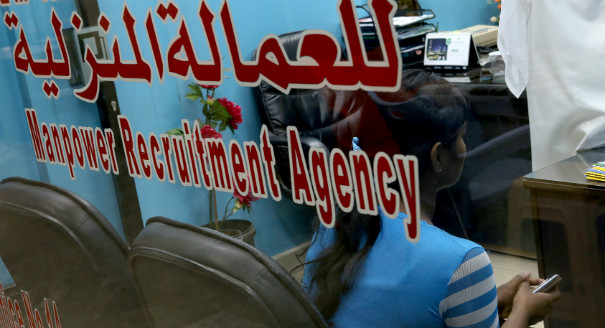
On February 12, the Philippine Department of Labor issued Administrative Order 54, which banned the deployment of overseas workers to Kuwait, launching a diplomatic impasse over the treatment of domestic laborers in the Gulf country. While ongoing negotiations to re-open the flow of workers will likely succeed, they illustrate the extent to which Kuwait is dependent on this labor until it can oversee sustainable economic reform that incentivizes Kuwaitis to work in the retail, hospitality, and service sectors.
On February 6, 2018, Kuwaiti police discovered the body of 29-year-old Joanna Demafelis in a refrigerator. Demafelis was a Filipina domestic worker who had gone missing in December 2016. When discovered, her body showed signs of strangulation and torture. Police pursued the couple that had hired Demafelis—the Lebanese national Nader Essam Assaf and his Syrian wife, Mona Assaf—who were subsequently arrested in Damascus. Philippine President Rodrigo Duterte lashed out at Kuwait in response to the news, making assertions that Kuwaiti employers routinely rape Filipina workers, force them to work 21-hour days, and feed them scraps. In addition to the ban on sending Filipino workers to Kuwait, the government also arranged free flights on Philippine Airlines and Cebu Pacific for any of Kuwait’s Filipino residents wishing to return home. Kuwait publicly condemned these actions as an escalation of an already tense situation but sent diplomats to the Philippines in the hopes of resolving the issue and lifting the ban. This engagement has resulted in an agreement regulating working conditions for Filipinos in Kuwait but has not yet lifted the ban entirely. In the wake of the Philippines’ worker ban, MP Safa al-Hashem called for Kuwait to cut foreign aid to the country. Such proposals build on populist sentiments against Kuwait’s South Asian expatriate population. However, Kuwait's government has not given serious consideration to the proposal, which would have little positive effect.
Expatriates comprise about two-thirds of Kuwait’s 4.5 million residents, working in both blue collar and white collar jobs. In mid-March, Kuwait’s government reportedly proposed allowing foreign nationals to own property, but otherwise expatriates have few opportunities to participate officially in Kuwaiti society. While Kuwait has recently taken steps to reduce the percent of expatriates working in the Kuwaiti economy, these steps have mostly targeted white-collar workers. The country recently set 2023 as the deadline to replace foreign nationals working in the government and seeks to increase Kuwaiti employment in the banking sector to 80 percent by the end of 2018. The government also seeks to end hiring expatriates under age 30 with college degrees after July 2018.
However, as seen in its haste to push the Philippines to reverse its ban, Kuwait’s economy remains heavily dependent on foreign labor. Since many Kuwaitis receive government subsidies or public sector employment, few are willing to work in low-paying jobs. Expatriates are thus heavily represented in Kuwait’s service economy and blue-collar labor market. For example, a slight majority of the 251,000 Filipinos in Kuwait are domestic workers. Kuwait’s government has taken a few steps to limit foreign hiring for these positions, for example imposing a temporary restriction on recruitment from Bangladesh on March 5. Yet the limited nature of such measures simultaneously recognizes the need for these workers to maintain Kuwait's economic stability. Compounding the issue is the fact that Kuwait and other Gulf states are playing a greater role in the global economy. As Gulf economies rise in international prominence, so too will questions about labor conditions and the rights of expatriates in the region.
While Duterte’s statements exaggerate the extent of mistreatment—and despite a domestic workers law passed in June 2015 requiring greater transparency regarding hiring and wages—mistreatment still exists. Nearly 200 Filipino workers have died in Kuwait in the past two years, 22 of them from suicide. In addition, in January 2017, Kuwaiti police detained a man in Farwaniya for allegedly beating his Filipina maid to death, and on February 22, 2018, a Kuwaiti citizen was sentenced to seven years in prison for assaulting his Filipina maid. The Philippines, through its embassy, has worked closely with Kuwait’s government to verify that recruiters abide by the law, but cannot regulate households where many Filipinos work. Kuwait’s kafala system, which ties workers’ visas to their employer, further opens up many opportunities for the abuse of foreign laborers. Kuwait’s announcement on March 27 that it would introduce a 100-day “probation visa” for expatriates switching jobs will help mitigate opportunities for abuse but will not eliminate them entirely.
The attention Kuwait’s government and media gave the Philippines’ worker ban is a clear indication that it cannot simply get rid of expatriates from the labor force. While targeting expatriates may make political sense in response to populist nationalism, the government knows that expatriates are a major element of Kuwait’s economic success. A workforce based on foreign labor may not be ideal for Kuwaiti nationalist factions but it is, for the foreseeable future, an intrinsic element of the country’s labor economy. Reducing the number of expatriates in Kuwait’s economy will ultimately require convincing Kuwaitis to work in lower-paying labor-intensive jobs—an unattractive prospect for both Kuwaitis and the government. However, keeping expatriates in the workforce while preventing another ban akin to the Philippines’ current one will require providing further assurances against abuse and exploitation of foreign workers, meet their basic income and health needs, and give them incentives to invest their wages back into Kuwait’s economy. Kuwait’s expatriate population has supported the economy for decades, and change will not come quickly. However, supporting foreign workers in Kuwait while incentivizing greater Kuwaiti participation in the private labor force can begin to shift the country toward a more sustainable economic future.
Scott Weiner is an adjunct professor of Political Science at George Washington University.