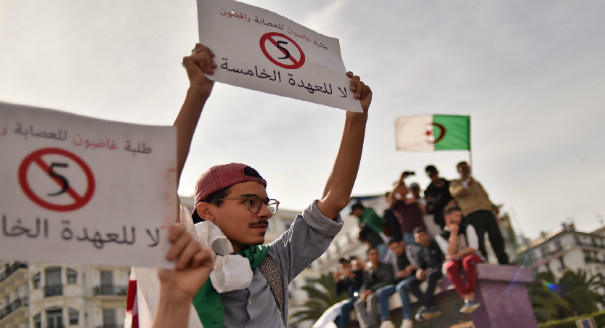
On March 11, Algerian President Abdelaziz Bouteflika announced that he was withdrawing from running for a fifth presidential term, in response to a wave of protests that has shaken Algeria’s political system. Yet neither have these protests spared the country’s business class. Since the protests started on February 22, several high-profile defections from within Algeria’s prominent business organization, the Business Leaders Forum (Forum des Chefs d’Entreprise, FCE) were an early indication that the regime was losing support from its core constituencies. In early March, Mohamed Laid Benamor, CEO of the agri-food company Benamor Group; Mohamed Arezki Aberkane, CEO of steel manufacturer Sogemetal; Hassan Khelifati, owner of Alliance Assurances; and Madjid Meddahi of the Granitex firm (which specializes in building materials) resigned from the FCE in protest at the forum’s open support for Bouteflika running on the 2019 presidential ballot.
Their resignations have sent a clear signal that even the Algerian regime’s core constituencies are showing widening fissures, with an increasing number of people willing to stand publicly against the sitting president and in favor of the protest movement. That several high-profile businessmen have done this is even more remarkable, as their resignations have highlighted FCE Chairman Ali Haddad’s increasingly weak position and contributed to isolating Bouteflika, thus paving the way for his eventual decision to renounce running. Over the past few years, Haddad has played a key role in securing the support of Algeria’s business class for Bouteflika, contributing to the widespread perception that these entrepreneurs are oligarchs that have benefited from their close connections to the political power.
Since Haddad became head of the FCE in 2014, the relationship between businesses and the Bouteflika faction has become increasingly evident. The deal between these two sides has been that the regime provides all the support, protection, and contracts the entrepreneurs need in return for the FCE’s explicit backing and, most importantly, generous financing for Bouteflika’s electoral campaigns.
Indeed, for years domestic and external observers alike have assumed the business elite have been staunchly supportive of Bouteflika. Under his presidency, an emerging class of increasingly self-assertive entrepreneurs has thrived, benefiting from the end of the civil war and the recycling of oil revenues into the non-hydrocarbon economy through government contracts and various forms of protectionism. Shielded from domestic and international competition, entrepreneurs such as Ali Haddad, Karim Kouninef of the KouGC construction company, Mahieddine Tahkout of the automobile manufacturing Takhout Company, and others have successfully diversified their portfolios, building conglomerates that dominate the Algerian economy.
This arrangement has been part of the presidential faction’s attempt to centralize rent management and gradually muscle out other competing patronage networks within the regime. Since his election in 1999, Bouteflika has aimed to impose his authority within the country by carefully strengthening his clientelist network at the expense of the army generals and, later, the military intelligence. While this effort has been relatively successful in reducing these groups’ influence, the Algerian polity has remained stubbornly divided into a series of power networks that have prevented the presidential faction from establishing a monopoly over society and the business sector.
This has been particularly evident in the business sector. Even before the 2019 protests, some of the most high-profile entrepreneurs dared to openly criticize Haddad’s approach—the most notable examples being Issad Rebrab, owner of Cevital, and Slim Othmani, CEO of NCA Rouiba. Rebrab emerged as a vocal dissident and critic of the regime and never shied away from attacking the presidential faction. His conflict with the Algerian regime has become apparent in the standoff that has pitted him against Kouninef’s KouGC conglomerate in Bejaia since 2017. The authorities have thrown a series of administrative obstacles in Rebrab’s way, in a not-so-subtle attempt to favor Kouninef. Rather than accept a compromise with the regime, Rebrab has upped the ante by mobilizing his workforce and supporting a series of civil society groups to push back against the regime’s ploy to undermine his project.
In a similarly outspoken fashion, Othmani has also made his critical opinions of the government known through social media and the press and even resigned from the FCE in 2014 in protest at its decision to support Bouteflika’s candidacy for a fourth term. Yet despite the regime’s displeasure with their statements and actions—and despite its threat to arrest Rebrab—it permitted them to continue doing business, and these entrepreneurs managed to protect their property rights from any possible predation by the authorities.
Other entrepreneurs have fallen afoul of the regime’s attempt to centralize the distribution of economic rents, despite their pro-Bouteflika credentials. The most relevant example is Benamor, who resigned from FCE to express his support for the protest movement. In recent years, rumors about Benamor’s falling out with the regime have abounded in the Algerian press, despite his supposedly close relationship with the president’s brother Said Bouteflika. Only a few weeks before the protests erupted, Benamor had to issue a statement denying an alleged secret meeting with presidential challenger Ali Ghediri. Benamor has been the target of various rumors and speculation, from alleged involvement in the Oran cocaine scandal due to his links with informal businessman Kamel Chikhi to efforts by Prime Minister Ahmed Ouyahia to undermine his activities. The main reason for his difficult relationship with the regime, however, seems to have been his failed attempt to remove Haddad from the FCE with the support of former Prime Minister Abdelmalek Sellal. Regardless of their plausibility, these rumors indicate Benamor’s difficult relationship with some of the regime’s competing patronage networks, which likely fed these stories to local media outlets.
Bouteflika’s failure to impose a tight grip over the business sector has been most obvious in the government’s effort to pursue an industrial policy in the automobile sector. Faced with dwindling oil revenues, high unemployment, and an increasingly precarious economic outlook, the Algerian regime has tried to boost local manufacturing, particularly in the automobile sector. Former Minister of Industry Abdelsalem Bouchouareb was the mastermind behind this policy, as he tried to emulate the positive results Morocco and Tunisia achieved in this sector. The strategy elaborated by Bouchouareb focused on curbing car imports while forcing global car manufacturers such as Peugeot and Volkswagen to accept producing some automobiles in Algeria to bypass the trade restrictions. This policy should have offered enough incentives for local entrepreneurs to supply spare parts to these manufacturers and thus gradually lay the foundation for the development of Algeria’s domestic car industry.
However, Algeria’s industrial policy has failed to achieve any of its goals, due to the regime’s intrinsic instability and its inability to discipline dissenting entrepreneurs. Bouchouareb has fallen victim of political instability, as he was ousted from the ministry of industry under the short-lived government headed by Abdelmajid Tebboune and not since been reinstated. His successors have harshly criticized his policies, highlighting the inefficiencies and high costs involved in the industrialization strategy. Even some of the entrepreneurs in this sector have accused Bouchouareb of playing favorites, while Rebrab (himself holder of a license to import Hyundai vehicles) has also criticized this policy. Other pro-regime entrepreneurs, such as Tahkout, have taken advantage of this chaotic implementation to continue to import cars while disguising his activity as manufacturing.
Unable to centralize rent management completely and forced by the intrinsic instability of the political system to focus on short-term goals, the Algerian regime’s industrial policy has been a complete failure. The Bouteflika faction has been completely absorbed by its short-term survival imperatives, neglecting any commitment to more difficult long-term policy objectives in its focus on trying to manage regime infighting. As a result, the business class has managed to avoid being completely strangled by the regime and has retained a degree of autonomy that the presidential faction has been unable to control once the most recent protest movement began.
With Bouteflika’s official announcement that he will not run for a fifth term and the postponement of the presidential elections, the existing divisions within the business class are only likely to widen further. While pro-Bouteflika entrepreneurs are increasingly concerned with the outcome of the current transition and fear that a leadership change could threaten their positions, dissident business owners are likely to rely on their networks to influence the succession process and protect their interests. The fragmentation of the Algerian political system is only likely to increase, offering the country’s business class opportunities for greater jockeying and maneuvering.
Riccardo Fabiani is a Senior Analyst on geopolitics at consulting firm Energy Aspects. Follow him on Twitter @Ricfabiani.