On February 20, Egyptian authorities carried out the executions of nine defendants accused of assassinating Egyptian General Prosecutor Hisham Barakat, prompting international accusations that their trials were unfair and that torture was used to extract confessions. The Egyptian government, aware of the possible international backlash stemming from the use of execution as a primary tool for repression, has instead increasingly relied on systematic extrajudicial killings and medical negligence in detention facilities during lengthy detention periods without trials in lieu of official executions. The regime is also combining this with a policy of forced disappearances, with hundreds abducted every year and only some people re-appearing. In 2015, according to the Nadeem Center for Rehabilitation of Victims of Violence and Torture, there were 464 cases of enforced disappearances, skyrocketing to 980 cases in 2016. Enforced disappearances are particularly used against political activists, as noted by the United Nations Working Group on Enforced or Involuntary Disappearances (WGEID). While these policies date back to 2013, they are gaining momentum as the power of the security establishment grows—cumulating in the constitutional referendum on April 20–22 that saw President Abdel Fattah el-Sisi extend his grip on power.
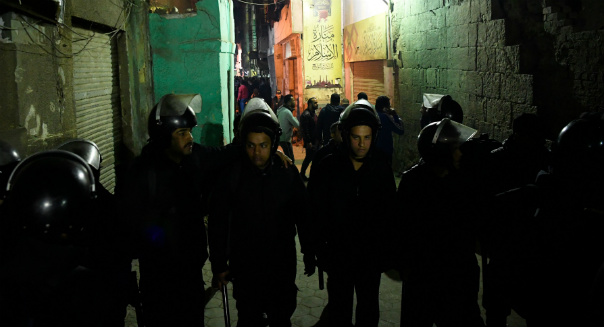
Egyptian security forces are using extrajudicial killings in a systematic way in place of official executions, which have decreased in recent years despite the higher rates at which death sentences have been issued. Of around 600 death sentences issued in the first eleven months of 2018, only 32 executions were carried out. As the number of official executions went down, from 44 in 2016 to 32 in 2018, the number of extrajudicial killings rose dramatically. Between July 1, 2015 and December 31, 2018, the Egyptian Ministry of Interior announced security forces killed 465 suspected “militants” during what were claimed to be shootouts. The ministry identified 117 of these men as members of the Muslim Brotherhood, 320 as “terrorists,” and 28 as “criminals.” Out of the total, only 104 men were killed in North Sinai, where Egyptian security forces are struggling to contain a violent insurgency. Thus, the majority of killings are not limited to Sinai, where the regime can plausibly claim that the causalities are all members of the Islamic State. Many of the victims of extrajudicial killings appear to be Muslim Brotherhood supporters or sympathizers, who are then portrayed as militants.
The security forces’ explanations following these shootouts is often the same. Generally, they claim that the police approached the hideout of suspected militants or members of the Muslim Brotherhood, who then engaged in a shootout with the police—resulting in the death of the suspected “militants” while the security forces suffered limited or no causalities.
According to some eyewitnesses, these stories of shootings are fabricated, and photographs released by the Ministry of Interior are inconsistent with police accounts. Rather than the shootouts the security forces claim occurred, these photographs suggest victims died from close-range execution and were moved after death. In one video leaked in April 2017, a man in a uniform of the military intelligence service appears to interrogate two men and shoot them at point-blank range, and their families claimed the men had been forcibly disappeared the previous year. In another incident, after five men were allegedly killed in a police shootout near the North Sinai city of Arish in February 2017, local tribes threatened partial civil disobedience, including not paying electricity and water bills. The victims claimed that the five men killed were already in police custody at the time. And one day after a car bomb attack on a tourist bus in Giza that killed four people on December 28, 2018, the Egyptian security forces announced they had killed the 40 militants responsible in a shootout. However, after the incident, photos emerged of the victims that suggested extrajudicial killings instead.
The few causalities among the members of the security forces also undermine the narrative of a shootout—there were only five reported killed and thirty-seven injured between July 1, 2015 and the end of 2018. While security forces would likely be better equipped and trained than militants in a shootout, this still leaves a ratio of one fatality to 93 in favor of the security forces.
Beyond deaths explained as shootouts, other tallies of extrajudicial killings are also telling. In 2015, according to the Nadeem Center for Rehabilitation of Victims of Violence and Torture, the number of killings “connected to contact with the security forces” reached 474—some in shootouts, including innocent bystanders, but also 175 cases of direct execution of suspects and 137 cases inside detention centers. In 2016, this number skyrocketed, reaching 1384 fatalities, mostly concentrated in Sinai. The state justifies these killings through the anti-terrorism law ratified in August 2015. Article eight of the law gives members of the security forces immunity from prosecution if “they use force to carry out their duties,” regardless of whether this is in self-defense. This essentially removes any accountability for killing prisoners, even those in pre-trial detention.
In addition, deliberate medical negligence in Egyptian prisons and detention centers has led to the death of hundreds in detention. In 2015, for example, the Nadeem Center documented 81 cases of death in detention centers due to medical negligence (separate from the 137 they listed as having been directly killed inside detention centers). This number remained consistent in 2016, at 80 cases. Before that, there were 170 documented cases of death due to medical negligence starting from July 2013 until May 2015. The trend has continued, with seven detainees dying from medical negligence in January 2019 alone. This includes prominent figures such as Gamal Sorour, a prominent human rights defender who passed away on November 5, 2017, due to lack of access to medication. Similarly, Muslim Brotherhood members Mohamed el-Falahgy (a former member of parliament) and Farid Ismail died on May 25 and May 13, 2015, respectively, both due to medical negligence. This is compounded by a general policy of abuse, torture, overcrowding, that also result in prisoners’ deaths. For example, the notorious Scorpion prison was allegedly “designed so that those who go in don’t come out again unless dead.
Since a constitutional referendum on April 20–22 approved amendments that further consolidate power in the hands of the security establishment, extrajudicial killings can be expected to accelerate. This will almost certainly lead to increased radicalization and further instability.
Maged Mandour is a political analyst and writes the “Chronicles of the Arab Revolt” column for Open Democracy. Follow him on Twitter @MagedMandour.