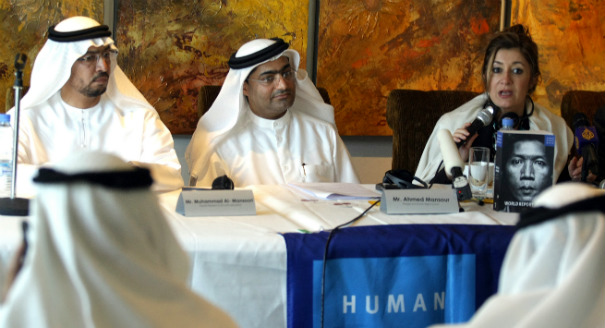
Wednesday, May 29 marks one year since the State Security Chamber of the Federal Appeals Court of the United Arab Emirates (UAE) sentenced Ahmed Mansoor to ten years in prison and imposed a fine equivalent to more than a quarter of a million dollars. He was convicted for allegedly insulting “the status and prestige of the UAE,” including its rulers, and publishing false reports on social media intending to harm the country’s relations with neighboring countries.
Prior to his arrest in a midnight raid on his home on March 20, 2017, Ahmed Mansoor used to quip that he was “the last man talking” in the UAE, reflecting that over the previous several years the authorities had jailed almost all other Emirati rights activists and their lawyers. For more than a year, Mansoor’s whereabouts were unknown. Since the Federal Supreme Court upheld his conviction and sentencing on December 31, 2018, according to people familiar with his situation, he remains in solitary confinement in a 4-meter by 4-meter cell with no bed or water—conditions that led him to undertake a hunger strike in mid-March 2019. On May 7, the UN Special Rapporteur on Torture and six other UN human rights experts condemned this situation, noting that “the poor conditions of his detention in the United Arab Emirates, including prolonged solitary confinement, may constitute torture.”
In the weeks before his 2017 arrest, Mansoor had criticized the UAE’s prosecutions of other activists for speech “crimes” and tweeted about rights violations in Egypt and Yemen. At the time, the UAE Ministry of Foreign Affairs said he was arrested for “inciting hatred and defaming the country online” and promoting “false and shaded” information.
This is the same country whose ruler, Sheikh Khalifa bin Zayed Al Nahyan, declared 2019 as the year dedicated to “solidify[ing] the UAE as the global capital of tolerance.” When Pope Francis visited in early February as part of an “interfaith” display, Prime Minister Sheikh Mohammed bin Rashid Al Maktoum proclaimed the UAE would not allow “ideological, cultural, and religious bigotry.” Obviously, this proclamation does not include tolerance of peaceful dissent.
The UAE’s political repression had escalated sharply in 2011, in the wake of Arab uprisings in the region. There were no demonstrations in the streets of Abu Dhabi or Dubai or any other Emirate even though, as one scholar wrote in 2012, “the country has one of the least participatory political systems in the world.” Ahmed Mansoor and a handful of other Emiratis addressed a petition to Sheikh Khalifa, signed by 132 people, asking that all adult Emirati citizens be allowed to vote for the Federal National Council (FNC), not just the fewer than 7,000 enfranchised at the time. They also called for the FNC to be empowered to legislate, not merely discuss legislation proposed by the rulers.
As an Economist headline put it, it did not take long for the UAE to “get twitchy about democracy.” In January 2010, authorities had blocked all access to UAEhewar.net, the site Ahmed Mansoor had started in 2009. In April 2011, authorities arrested Mansoor—as well as economist and Sorbonne Abu Dhabi lecturer Nasser Bin Ghaith and three others collectively known as the “UAE 5”—in connection with the petition effort. That same month, authorities shut down the Teachers’ Association and the Jurists’ Association, among the country’s oldest civil society institutions, after they issued a joint statement “appealing for greater democracy.” The trial of the UAE 5 on charges of “publicly insulting” UAE officials was rife with fair-trial violations and concluded on November 27 with guilty verdicts. Mansoor received a three-year sentence, the others two years each. The next day, Sheikh Khalifa commuted their sentences but did not expunge the criminal convictions, which left them unable to obtain the “certificate of good conduct” necessary for securing employment and other civic necessities such as a marriage license.
Mansoor was never able to recover his passport, effectively banning him from travel. He continued to communicate information about arrests and trials of other rights activists and peaceful dissidents to organizations such as Human Rights Watch and the Gulf Centre for Human Rights as the government widened and intensified its campaign to snuff out all manner of political dissent. One sophisticated attack by hackers targeting him in 2014 appeared to be so well financed that Citizenlab investigators at the University of Toronto dubbed him the “million dollar dissident.”
In November 2012, Sheikh Khalifa issued Federal Legal Decree No. 5/2012 on combatting cybercrimes. Article 29—the basis for Mansoor’s 2018 conviction—made it a crime to use information technology “with the intent of deriding or harming the reputation, stature, or status of the state, any of its institutions, its president or vice president, the rulers of the emirates, their crown princes or their deputies, the state flag, national safety, its motto, its national anthem, or its symbols.”
Despite the harassment directed against him, Mansoor continued to speak out on social media about the intensifying rights violations in the UAE, and he was often the sole source of reliable information about arrests and trials. There was plenty to report: Starting in late March 2012, security forces arrested scores of Emiratis for their association with Islah, shorthand for the Reform and Social Guidance Association, which had been a registered NGO in the UAE since 1974. Many of those detained, including prominent human rights lawyers Mohammed al-Roken and Mohammed al-Mansoori, were held in undisclosed locations. (Al-Roken had been one of Ahmed Mansoor’s lawyers in his 2011 trial, and the presence of Islah members among those who signed the UAE 5 petition likely spurred these arrests.) Another lawyer, Salim al-Shehhi, was detained when he went to the office of the State Security Prosecutor with the intention of representing al-Roken. Authorities arrested and deported non-Emirati lawyers working for Abdulhameed al-Kumaiti, the last remaining defense lawyer willing to represent those arrested in the Islah crackdown—and who has since left the country.
The move to suppress Islah reflected Emirati rulers’ concerns regarding the rise to power of the Muslim Brotherhood in Egypt, though some Islah members had also publicly endorsed the UAE 5 petition in 2011. When the Islah defendants finally went to trial in early March 2013, their number had swelled to 94, eight of whom were tried in absentia. According to the official news agency, they were charged with “opposing the constitution and the basic principles of the UAE ruling system” as well as “affiliations with organizations with foreign agendas”—meaning the Muslim Brotherhood, which in March 2014 authorities officially designated a terrorist organization, along with the Islamic State, al-Qaeda, and other groups. (The main evidence of alleged Islah subversion cited by the prosecution was the confession of Ahmed Bin Ghaith al-Suwaidi, which he insisted at trial had been secured under torture.) The trial, which the International Commission of Jurists determined was rife with violations, especially torture and forced confessions, concluded in June 2013: 69 defendants were sentenced to between seven and fifteen years in prison, and 25 were acquitted.
The trial of the UAE 94 was the largest single case aimed at quashing all manner of peaceful dissent. In another example, in November 2014, a court handed Osama al-Najjar a three-year sentence for criticizing the UAE 94 convictions (he remains in prison despite the expiration of his sentence). In May 2015, Ahmed Abdullah al-Wahdi was sentenced to ten years in prison for running a social media account that “insults the UAE’s leadership.” In August 2015, authorities detained Nasser Bin Ghaith, the economist who had earlier been arrested with Ahmed Mansoor in the UAE 5 case, and a court sentenced him to ten years in prison in March 2017. One charge was that he “intended to damage the UAE” by “claiming that he was tortured.” Authorities held him incommunicado and in solitary confinement for the nineteen months prior to his trial and, after his conviction, reportedly transferred him to Al-Razeen, a maximum-security prison in the Abu Dhabi desert.
Washington has been silent about the totalizing repression in the UAE, long before the Trump administration. One looks in vain for a single public criticism of the UAE’s human rights record from the White House or U.S. Department of State over the past ten years. In the U.S. Congress, especially since the Saudi murder of journalist Jamal Khashoggi, one can hear criticism of UAE participation in the Saudi-led war in Yemen, but not about internal repression. The UAE chapter in the Department of State’s human rights report for 2018 does not once mention Ahmed Mansoor by name or even allude to his case.
Joe Stork is chair of the advisory board of the Gulf Centre for Human Rights and former deputy director of Human Rights Watch’s Middle East division.