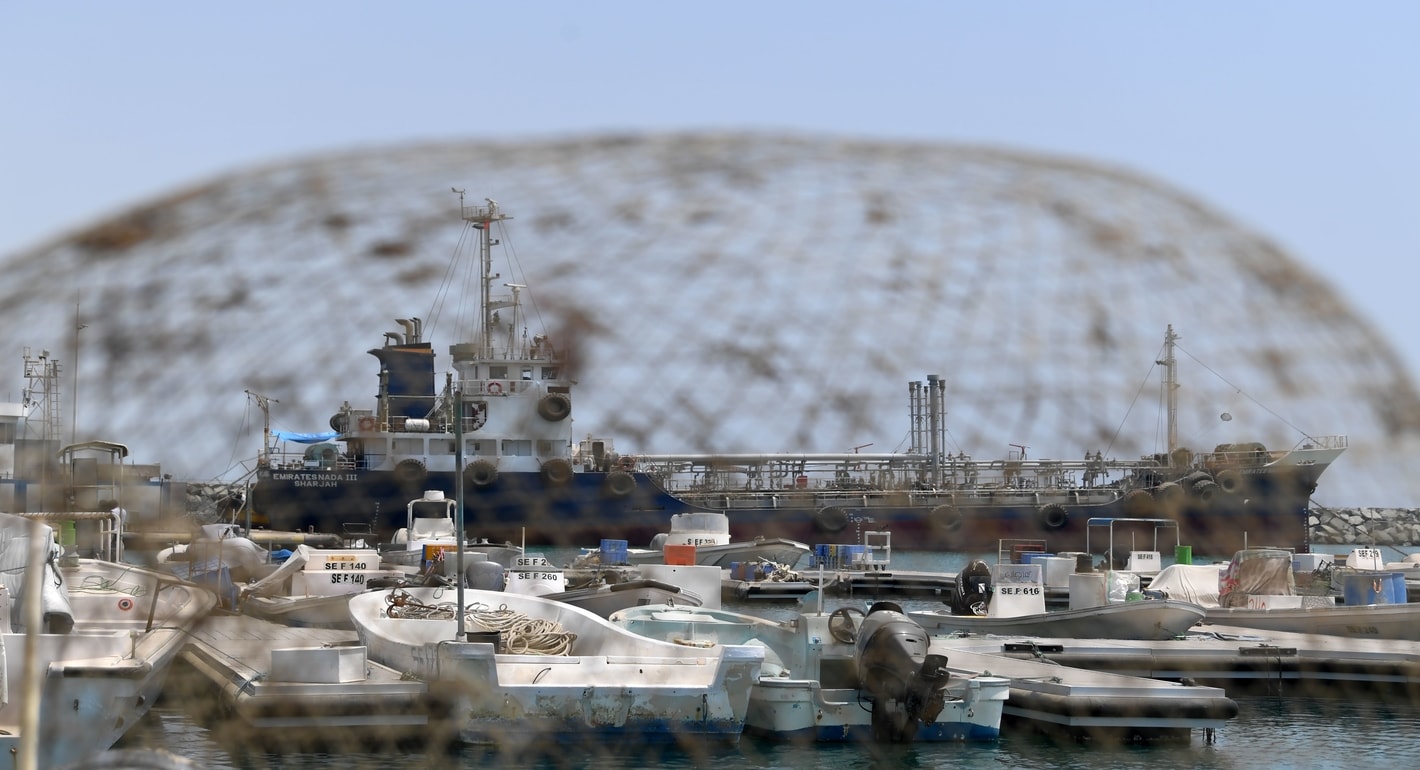
In July, the Islamic Republic of Iran took into custody a British flagged tanker. In June, Iran also shot down a $200 million American Global Hawk High Altitude surveillance drone, and six oil tankers laden with crude oil from Saudi Arabia and the United Arab Emirates (UAE) were sabotaged with limpet mines in May and June. This series of events highlights the changing nature of Gulf security. In response, Arab Gulf countries have either appealed to the U.S. administration and the international community to intervene or have sought to appease Iran. In contrast, Iran has been clear about the vitality of Gulf security to its interests and has focused on safeguarding its economic interests through security presence via its constant naval patrolling and missile deployment in the Gulf.
While in the short term the current insecurity has heightened risk premiums for their oil export industry, Arab Gulf countries are struggling to safeguard their interest given that the whole Gulf trade—valued at a combined $1.2 trillion1—is at stake. All Arab Gulf countries are primarily oil exporting countries. Oil comprises up to 80 percent of their national budgets— while Iran depends on oil exports for about 30 percent for its national budget. As such, the security of the oil export supply chain in the Gulf is vital, from production and export to facilities, storage, and transport.
Saudi Arabia is the largest oil exporter in the Gulf region with around 6.5 million barrels per day of crude and oil products. Approximately 80 percent of its oil exports is exported through the Ras Tanura Port, Ju’aymah Port, and King Fahd Industrial Port in Jubail. Iraq, the second largest oil exporter, exports around 3.8 million barrels of oil per day—approximately 90 percent of Iraq’s state revenue. It exports through Basra and Khawr Al’Amiya Oil Terminals, the smallest coastal access centers to the Gulf waters. Qatar, the largest global exporter of natural gas, generates its roughly $40 billion dollar per year income from shipping 77 million metric tons per annum (MTA) and around 2.1 million barrels of crude and condensates per day through the Strait of Hormuz. With an approximate 30 percent share of the global natural gas market, Qatar is also increasing its total gas exports to 110 MTA. Three quarters of these exports are already committed in long term supply contracts, all originating from the Gulf. Iran is the fourth largest oil exporter. Its main oil ports and terminals are all within the Gulf, which include Kharg, Lavan and Sirri Islands, Asalouyeh, Bandar Abbas and Bandar-e Emam Khomeyni, from which Iran exports around 2.5 million barrels per day of crude oil and condensates. Across the Strait from Iran, UAE exports around 1.7 million barrels per day, with an additional 800,000 barrels per day bypassing the Strait Hormuz through the Abu Dhabi Crude Oil Pipeline (ADCOP) to Fujairah port on the Indian Ocean.
Saudi Arabia, Iraq, and Iran have alternative export channels. While these states are able to bypass the Strait by exporting through the Rabigh terminals, Kirkuk-Ceyhan oil pipeline, and by land transport and pipelines through neighboring countries, respectively, in fact, the alternative export modes and routes would not even compensate more than 40 percent of current exports through Hormuz. On the other hand, Qatar, Kuwait and Bahrain do not have access to the limited alternative methods for exporting oil. Kuwait exports around 1.9 million barrels per day exclusively through Hormuz, accounting for around 90 percent of Kuwait’s export revenues. Bahrain is the smallest of oil exporters in the Gulf, with around 300,000 barrels per day of oil products. This lack of alternative export channels suggests that growing insecurity would disproportionally affect smaller Gulf countries.
History can be a guide on the impact of disruptions to the oil supply chain. In 1984, a tanker war ensued between Iran and Iraq that affected Kuwaiti tankers and dragged the U.S. Navy into protecting Gulf exporters and effectively policing the Gulf waters with the largest naval convoy since World War II. The tanker war threatened to disrupt global oil supplies. Iran suffered major damage in its oil exporting facilities on Kharg Island, Iraq lost shipments, and Kuwait and other exporters suffered from the collateral damage and increased costs of transportation. The total losses included damage to almost 450 oil transport vessels belonging to Iran, Iraq, Kuwait, Saudi Arabia, and international shipping companies sailing under the flags of Liberia, Greece, Cyprus, Malta. The tanker war resulted in over 320 casualties and the accidental shooting down of an Iranian passenger jet that killed 290 people.
The current oil security disruption in the Gulf has broad implications for the overall security and economy of the region. It is affecting other maritime shipment, as well as air transport, with many carriers diverting flights over the Strait of Hormuz. Dubai and Doha, which have marketed themselves as global hubs for transportation and logistics and financial centers, could also struggle. The total trade (import and export of all merchandise including oil) by all Gulf countries is worth around 1.2 trillion dollars annually. Without accounting for the potential outflow of foreign investment and local money—as well as Gulf equity and real estate depreciation—the economic stakes are undoubtedly high.
Motivated by tightened U.S. sanctions, Iran has been asserting its interests through naval presence in the Gulf. Meanwhile, most Arab Gulf countries have done little to safeguard their economic stakes in the Gulf economy, assuming that the U.S. will take the leading role, as it did in the past. However, Arab Gulf countries are facing the realization that U.S. geopolitical priorities have changed, and that the security of oil supplies through the Strait of Hormuz might no longer be a U.S. priority for U.S. The 35,000 U.S. troops and advisors housed in semi-permanent bases in the Gulf are not deployed for the purposes of ensuring oil security or the stability of Arab Gulf countries. Instead, their deployment is a result of security objectives related to China’s rise and global re-posturing.
Arab Gulf countries thus face an option of implementing deterrence as a policy, without antagonizing Iran. Additionally, establishing a policy of deterrence need not be in the form of expensive frigates and battleships or large fleets. Such a policy could look similar to the flexible and versatile Iranian maritime security apparatus, bolstered by cooperation for the common good.
Hadi Fathallah is Director for Levant and GCC at NAMEA Group, a fellow of the Cornell Institute for Public Affairs, and a Global Shaper, an initiative of the World Economic Forum. Follow him on Twitter @Hadi_FAO.
Notes
1. Import and export aggregates calculated by author, United Nations Conference on Trade and Development (UNCTAD) Merchandise Annual Total Trade Data, 2018.