

{
  "authors": [
    "Mona Jebril"
  ],
  "type": "commentary",
  "blog": "Sada",
  "centerAffiliationAll": "dc",
  "centers": [
    "Carnegie Endowment for International Peace"
  ],
  "collections": [],
  "englishNewsletterAll": "menaTransitions",
  "nonEnglishNewsletterAll": "",
  "primaryCenter": "Carnegie Endowment for International Peace",
  "programAffiliation": "MEP",
  "programs": [
    "Middle East"
  ],
  "projects": [],
  "regions": [],
  "topics": []
}
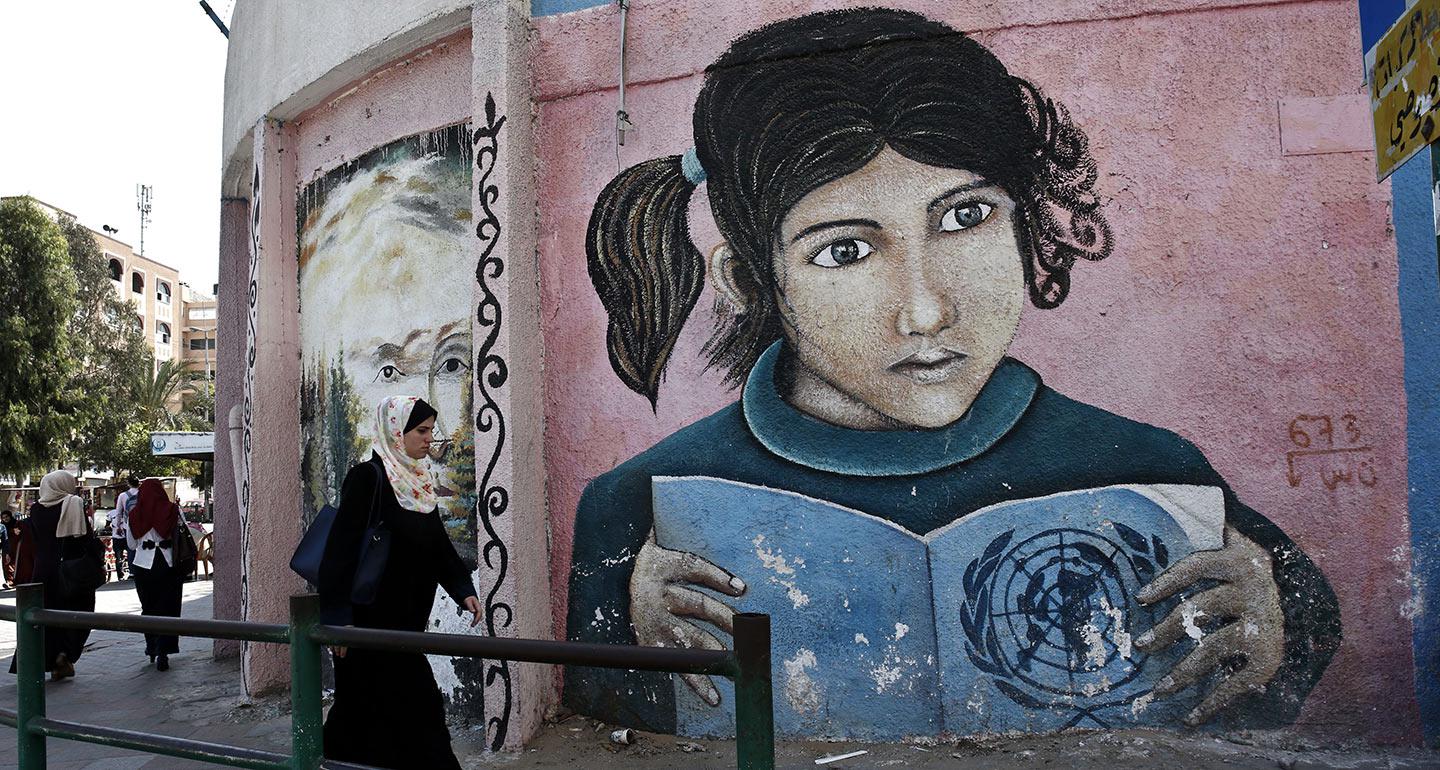
Source: Getty
UNRWA As A Proxy Site of Conflict? The Case of the Gaza Strip
Disrupting UNRWA is a deliberate strategy to undermine Palestinians’ protracted refugee status and impose normalization. But, in the Gaza Strip, does this also mean disempowering the Hamas government?
There has recently been growing pressure on UNRWA to close and transfer its operations to UNHCR, a move that would delegitimize the right of return for Palestinian refugees. This pressure is exercised through increased cuts to UNRWA’s budget, which are primarily based on claims regarding the agency’s institutional credibility and education programs. In the Gaza Strip, however, these financial cuts to UNRWA also appear to be a tactic to force the Hamas government into negotiating with Israel, and to weaken the group’s position ahead of prospective Palestinian elections.
In the Gaza Strip, UNRWA is irreplaceable as it offers lifesaving services for the besieged refugee population, but the double-edged position of UNRWA has simultaneously left Palestinian refugees in a “limbo state.” For a long time, Palestinians were distrustful of UNRWA, as they perceived the agency as facilitating their resettlement rather than repatriation. Furthermore, UNRWA’s attempts at neutrality and its limited protection mandate have meant a de facto depoliticization of the Palestinian cause, transforming it into a perpetual humanitarian crisis, and subsidizing the Israeli occupation of the Gaza Strip.
In 2020, four Arab countries—the UAE, Sudan, Morocco, and Bahrain—signed normalization agreements with Israel. Palestinians in the Gaza Strip consider these agreements—collectively termed the Abraham Accords—to be a breach of the previous historic consensus based on “land for peace.” These US-brokered normalization deals, along with the US-supported Netanyahu annexation plan, created an atmosphere of political frustration among people in Gaza. This frustration, combined with an enduring barrier to trust between Palestinians and UNRWA, means that “any change in UNRWA programs would raise. . .the bugaboo of a “liquidation plot” and contribute. . .to refugee paranoia and cynicism.” For example, UNRWA’s budget shortfall in 2020 forced the agency to defer the payment of full salaries for its employees and reduce some of its services. In response, Palestinian protestors in the Gaza Strip—including representatives of national and political committees—gathered in angry mass demonstrations in front of UNRWA’s headquarters and clinics. They demanded the restoration of usual services and held banners emblazoned with the words, “We are all refugees”— a slogan reflecting their anger towards UNRWA’s exclusion of unregistered Palestinian refugees during the Covid-19 health emergency. The protestors also carried messages of political condemnation, as they seem to have interpreted UNRWA’s reduction of services as part of a Trump administration “conspiracy” related to the broader normalization agenda.
UNRWA at a Turning Point in its History
With the normalization trend, a negative shift in some Arab countries’ positions towards UNRWA is evident. Calls to “fix” UNRWA are not new and have historically been rooted in a desire to delegitimize Palestinians’ right of return. Proposed reforms have included: “transferring UNRWA’s responsibilities to UNHCR,” “removing national citizens from UNRWA’s responsibility,” “limiting UNRWA’s public pronouncement,” “vetting area staff and refugees,” “moving to need-based provision of services,” “monitoring textbooks and teachers,” “rethinking ambulance services,” “refining relief and social services,” “expanding housing loans,” and “reviewing the microfinance and microenterprise program.” A more recent phenomenon, however, is the conditioning of funds to UNRWA based on monitoring the textbooks used to teach Palestinian students.
The true nature of these calls for reform was particularly evident during the previous U.S. administration; indeed, Trump’s era was considered “open season for critics of the organization.” The former president described UNRWA as "irredeemably flawed," and Jared Kushner, senior advisor to the president, called for a “sincere effort to disrupt UNRWA.” In the same exchange, Kushner also characterized the agency as “corrupt, inefficient, and unconducive to peace.” Against this backdrop, in 2018, UNRWA experienced unprecedented financial cuts by its largest single donor, the United States. To fill the funding gap, contributions from Gulf countries and the Europeans subsequently assisted UNRWA in dealing with the financial crisis caused by the Trump administration. After Biden assumed office, a portion of American funding to UNRWA (235 million USD) was restored.
Between 2018 and 2022, however, Gulf funding to UNRWA fell drastically, especially that offered by the UAE and Bahrain. Emirati donations to UNRWA totaled 20 million USD in 2018. However, two years later, Abu Dhabi’s contribution to UNRWA amounted to just 1 million USD. The UAE’s drastic cut in funding is perceived to be directly related to the Abraham Accords. The European Parliament, for the first time in its history, also decided to block 20 million EUR in aid to UNRWA if immediate changes were not made to Palestinian school textbooks. In addition, the UK has reduced its core grant to the agency by over 50 percent. In this context, the Commissioner-General of UNRWA, Philippe Lazzarini, has called for “shield[ing] the Agency from those who try to harm its reputation, integrity, and purpose.”
A Proxy Site of Conflict Against the Hamas Government?
The deliberate disruption to UNRWA’s work not only robs Palestinian refugees of the right of return, but also instrumentalizes the agency into a political pawn to disempower the Hamas government. For example, in the summer of 2021, the United States announced that it would contribute 135 million USD to UNRWA. However, receipt of this contribution was conditioned on signing a Framework for Cooperation, which states that “no part of the US contribution shall be used to furnish assistance to any refugee who is receiving military training as a member of the so-called Palestinian Liberation Army or any other guerrilla-type organization or has engaged in any act of terrorism.” The framework also stipulates a clause for “monitoring Palestinian [school] curriculum content.” Dozens of Palestinians protested the agreement, which they viewed as violating their rights, and essentially transforming UNRWA into an intelligence agency.
Despite already being resource-constrained, the Hamas government will now be pressured to fill the service provision gap caused by UNRWA’s budget cuts. Subsequently, this dire situation could coerce the government into negotiating with Israel and possibly weaken its position in future Palestinian elections, as Palestinians will perceive the movement as incapable of addressing their basic needs. Concurrently, as UNRWA continues to struggle financially, Israel has lifted a years-long ban on work permits for Palestinians for the first time since the Hamas government’s takeover of Gaza in 2007. This effectively transforms the Gaza Strip into an economic colony—a step supporting further normalization, not peace. This sudden change could also be used to numb resistance in the Gaza Strip and continue weakening UNRWA.
Is it Really a Problem of Textbooks?
Contrary to the barrage of accusations from critics, UNRWA has a robust review system of textbooks “according to the values and principles of the UN.” Additionally, in 2021, UNRWA won a British Council Award for excellence in global education. Therefore, conditioning UNRWA funding on “monitoring Palestinian [school] curriculum content” is unjustifiable. As Philippe Lazzarini pointed out, “It is not UNRWA that is perpetuating refugee statehood. Refugee statehood is perpetuated by the absence of a political solution.” UNRWA students learn about the UN values of freedom and human rights in classrooms while being surrounded by the sounds of shelling and bombardment, destroyed neighborhoods, and conditions of poverty at home. This is the true challenge that UNRWA faces in pursuit of its global education mission, and this challenge should be addressed with critical priority.
However, rather than providing critical support to UNRWA during the ongoing global health crisis, cuts to UNRWA’s budget have left the agency in a danger zone, threatening the lives of the vulnerable population living in the Gaza Strip. Unless the international community acknowledges the true cost of their strategies to disrupt UNRWA—evident in the harm these policies inflict on human life and essential development—the future of new generations in the Gaza Strip will be jeopardized, and prospects for achieving a just and durable peace in the region will remain mere political rhetoric.
Dr. Mona Jebril is a Research Associate at the University of Cambridge Centre for Business Research. She is an interdisciplinary social scientist focused on Gaza and conflict-affected areas in the Middle East. Follow her on Twitter @Mona_Jebril.
About the Author
Mona Jebril
Carnegie does not take institutional positions on public policy issues; the views represented herein are those of the author(s) and do not necessarily reflect the views of Carnegie, its staff, or its trustees.