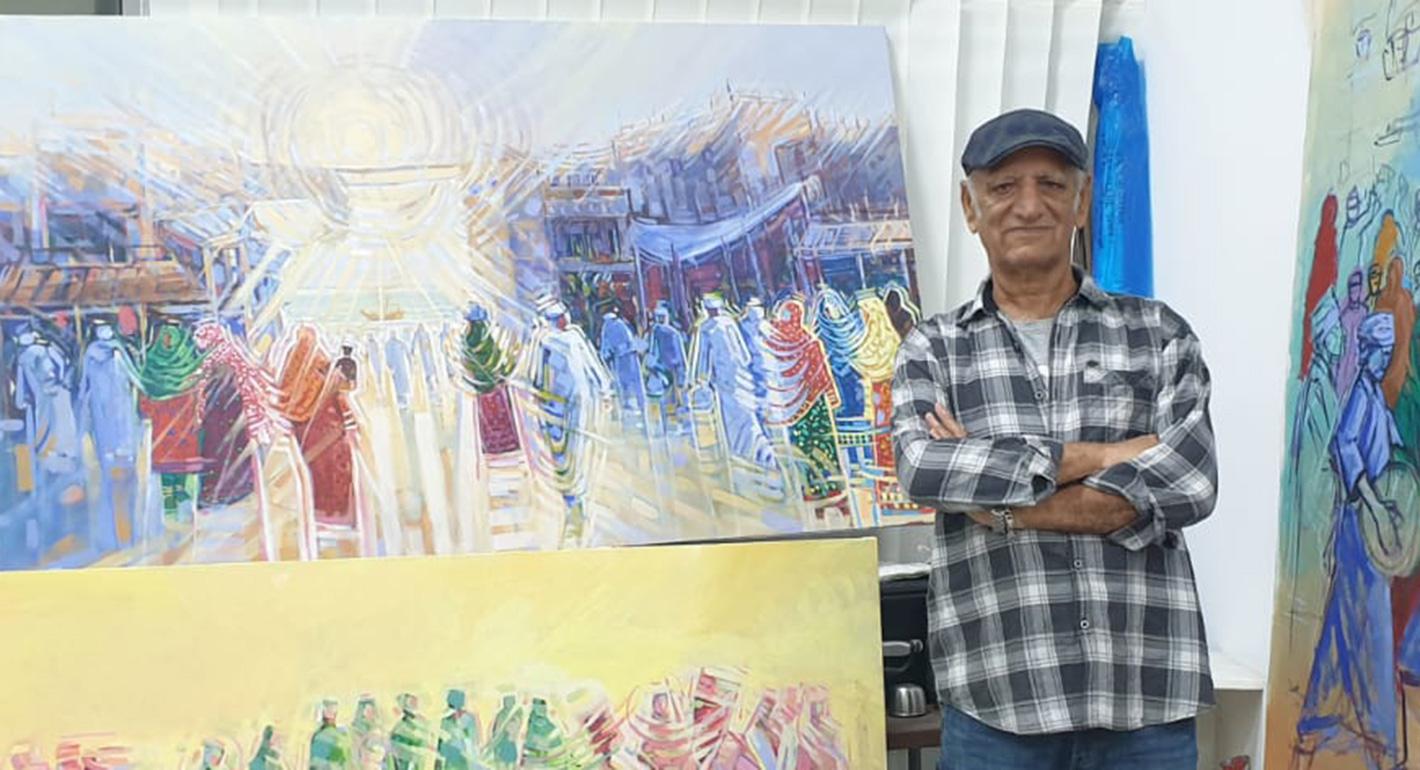
Known as the “Godfather of Modern Art” in Oman, Anwar Sonya is a pioneering visual artist who has played a significant role in shaping the modern Omani art scene. Born in Manama, Bahrain in 1948 to an immigrant Omani family, Sonya discovered his passion for art in Al-Qudaibiya School at the age of seven. As he grew up, his love for art grew with him, and he found community with creatives of various disciplines, including fellow Omani artist Hasan Borok, and Bahraini artists Ishaq Al-Koheji and Abdullah Al-Muharaqi. “We, the visual artists of the group, used to draw in neighborhoods and schools,” he recalled.1 Finding his calling in art, Sonya left high school to pursue his passion. “Every person in this world is bestowed a gift by Allah…and has to do whatever they can to nurture this God-given talent,” said Sonya. “I knew in my heart that I would be an artist of a high caliber, and I worked towards that.” His family, however, disagreed with his decision to leave school, which drove him to flee home, eventually returning to Oman in 1971.
The return to Oman proved pivotal to the artist, whose works—which have been described as a mix of impressionism, pointillism, and expressionism—are known today to center on the country. “I found Oman to be very different from Bahrain, from its natural topography (such as its mighty mountains) to its historical structures, down to its traditions, heritage, and folklore. All of these are inspirational to artists, and I have depicted them through my work,” described Sonya, who used to spend hours outdoors painting Oman’s natural landscapes. “If an artist does not depict their identity, then what is the point of their work?”

In Muscat, Sonya witnessed firsthand the quiet beginnings of the city’s art scene. In 1980, for example, he held his first solo exhibition in Al-Ahli Club. Though opening day saw some visitors, by the second day, he found himself all alone, a stark contrast to today’s art events, some of which are attended by thousands. Just last spring, queues formed at the entrance gates of the exhibition, Ahlam El Asr, which was held in Muttrah Fort. “Things were very different back then; you could count the number of artists on your fingers, but now there are hundreds of Omani artists,” he said. “Schooling and college played a role in these cultural changes.” As did societies such as the Youth Studio, the Cultural Club, and the Omani Society for Fine Arts, through which Sonya has mentored many artists, including notable Omani artist Hassan Meer, who went on to establish The Circle Group and Exhibition for Contemporary Art and now serves as the Director of Stal Gallery, Oman. “I’m always here for artists, anything they need, they can come to me for,” he mentioned.

Oman’s participation in the Venice Biennale for the first time earlier this year is a case in point. A firm believer in showing with young artists, Sonya took part in a collaborative installation with the late Omani artist Raiya Al-Rawahi titled Speed of Art. Al-Rawahi, who died in 2017 at the age of 30, was one of Oman’s most promising artists.
Today, despite his participation in international exhibitions, as well as the local and regional recognition he has received, Sonya still seeks to support the flourishing of the local art scene.
Sharifah Alhinai is the founder of Sekka and the Khaleeji Art Museum. She is a graduate of SOAS and the University of Oxford, and the recipient of the Arab Woman Award 2020. Follow her on Twitter: @sharifahalhinai.
Note:
1. The interview was conducted with the author by phone on November 9, 2022.