

{
  "authors": [
    "Ikram Ben Said"
  ],
  "type": "commentary",
  "blog": "Sada",
  "centerAffiliationAll": "dc",
  "centers": [
    "Carnegie Endowment for International Peace"
  ],
  "collections": [],
  "englishNewsletterAll": "menaTransitions",
  "nonEnglishNewsletterAll": "",
  "primaryCenter": "Carnegie Endowment for International Peace",
  "programAffiliation": "MEP",
  "programs": [
    "Middle East"
  ],
  "projects": [
    "Tunisia Monitor"
  ],
  "regions": [],
  "topics": []
}
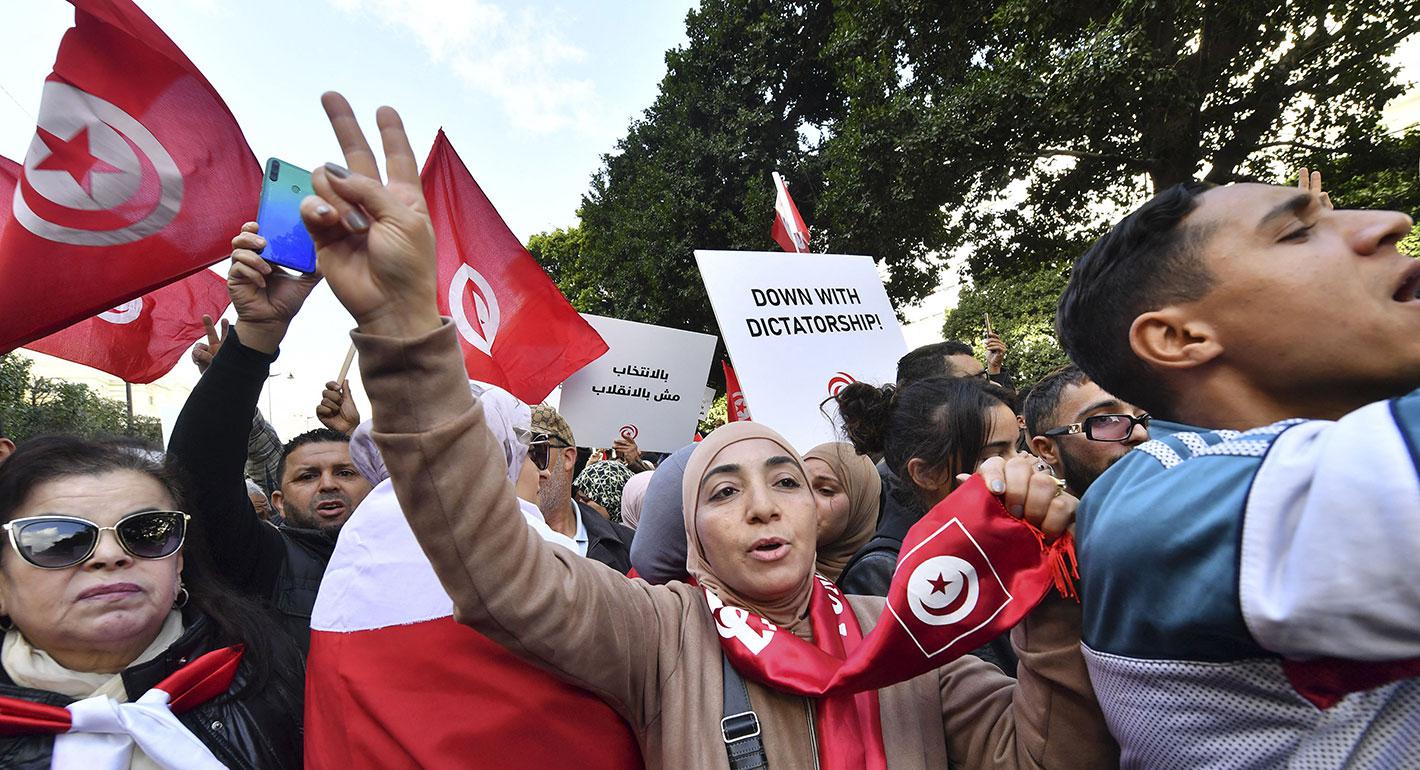
Source: Getty
Confronting an Assault on Democracy in Tunisia
This article presents an urgent call to action from a Tunisian feminist who sees the hard-fought legacy of generations of activists evaporate by the day.
Tunisia has become a hostage of President Kais Saied’s mission to consolidate power and destroy every democratic institution and achievement of the 2011 revolution. Women’s rights are no exception. In recent years, Tunisia has witnessed an unprecedented setback in women’s progress and freedoms.
Tunisia used to have one of the most progressive laws in the world regarding women’s equal political participation, as a 2011 electoral law mandated gender party in electoral lists. This law, the fruit of the feminist movement’s struggle, reflected the commitment of the state to achieve gender equality and social transformation through the equal representation of women’s interests.
However, the flawed 2022 constitution and subsequent removal of gender parity in an updated electoral law released before recent parliamentary elections—both overseen by Saied—resulted in the shocking figure of 16 percent representation for women in the new parliament, compared to 31 percent in 2014. This means approximately 50 percent less women with the opportunity to influence the legislative policy agenda.
Historically, Tunisia adopted state feminism. Despite their many flaws, all former presidents played the “women” card and contributed to advance women’s status. Yet, Saied’s departure from this model should not come as a surprise. Saied campaigned on a conservative platform, stating clearly that he would not amend Tunisia’s inheritance law, which grants women half of what their brothers are entitled to, despite women’s paid and unpaid contributions to the household and the state. To continue appealing to a conservative base, on the occasion of National Women’s Day in 2020, President Saied provocatively stated that the question of inequality in inheritance is already settled clearly in the Quran. This was a poorly timed political stance that squashed any remaining hope of dialogue between his government and the feminist movement.
All of this confirms that the 2021 appointment of Najla Bouden as the first-ever woman head of government in Tunisia—and in the Arab world—is plain façade and pure tokenism. Ms. Bouden has shown us that she is more loyal to Saied’s patriarchal regime than to the women’s rights agenda. Shortly after her nomination, Ms. Bouden infamously repealed Circular N.20, a public administrative policy that guaranteed gender parity in appointments of senior government officials.
Further, Ms. Bouden’s failure to deploy government resources to execute Law 58 on gender-based violence has resulted in an uptick in the reported number of women victims of domestic violence, including an increase in the number of recorded femicides. This systematic rollback of women’s rights is a continuation and reflection of state violence and misogyny. By abdicating its responsibility to protect women, Saied’s government has given a green light to violence in the private sphere.
Moreover, Saied is proving to be a racist autocrat. In his recent hate speech targeting undocumented Black migrants, Saied gave carte blanche to violent and xenophobic acts. Black migrants, especially women, were left in an extremely vulnerable situation, with many fired from their jobs, kicked out of their homes, and exposed to physical violence.
As we witness the abandonment of the revolution’s promises of “freedom, dignity, and justice,” we must remember that there is no democracy without women’s rights and no women’s rights without democracy. Tunisian civil society has no choice but to resist this misogynistic and racist dictatorship.
To the international community, this is the moment to be on the right side of history. Tunisians still remember the West’s complicity with the Ben Ali regime. Do not repeat the same mistake by turning a blind eye to human rights violations and attacks on democracy for the illusion of economic growth, migration control, and geopolitical stability.
To Tunisian civil society, this is the moment to reunite in diversity, to work in solidarity, and to organize and mobilize for early elections. Saied must be defeated peacefully and democratically.
Ikram Ben Said is a Tunisian feminist activist. She is the founder of Aswat Nisaa, an organization that focuses on women’s political participation and gender-sensitive public policy.
About the Author
Ikram Ben Said
Carnegie does not take institutional positions on public policy issues; the views represented herein are those of the author(s) and do not necessarily reflect the views of Carnegie, its staff, or its trustees.