

{
  "authors": [
    "Amal Habani"
  ],
  "type": "commentary",
  "blog": "Sada",
  "centerAffiliationAll": "dc",
  "centers": [
    "Carnegie Endowment for International Peace"
  ],
  "collections": [],
  "englishNewsletterAll": "menaTransitions",
  "nonEnglishNewsletterAll": "",
  "primaryCenter": "Carnegie Endowment for International Peace",
  "programAffiliation": "MEP",
  "programs": [
    "Middle East"
  ],
  "projects": [],
  "regions": [],
  "topics": []
}
Source: Getty
Sudanese Women’s Bodies: Not Battlefields for Political Conflicts
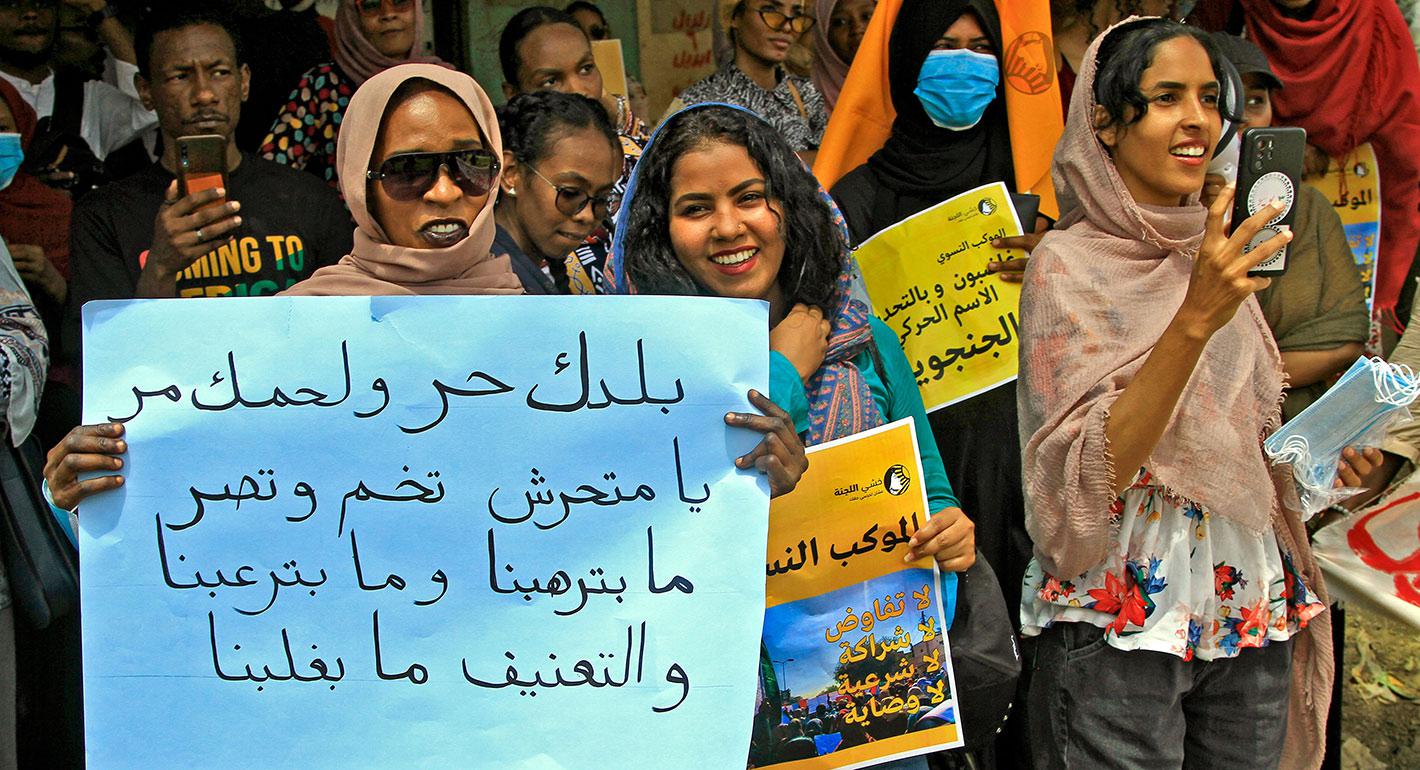
Sudanese women are rallying together against the weaponization of sexual violence to settle political conflicts.
Following the Sudanese revolution which was launched in December 2018, sexual violence against women has been used repeatedly to settle political conflicts in Sudan. This terrible situation reached its peak during the violent dispersal of the peaceful sit-in of June 30, 2019, which called for a civilian-majority government, and took place in front of the General Command. The Rapid Support Forces (RSF), accompanied by other regular forces, dispersed the peaceful demonstrators with extreme brutality that resulted in the death and injury of dozens of people. Following this violent attack, it emerged that more than seventy women (and several men) were sexually assaulted and raped. The RSF was led by Mohamed Hamdan Dagalo, known as Hemedti, Vice President of the Sudanese Sovereignty Council.
Since then, women’s determination to resist sexual abuse has been demonstrated in various incidents that clearly indicate their resistance to all forms of sexual assault.
Assaulting Daughters to Settle Political Scores
Last January, the Secretary-General of Sudan’s Committee for the Removal of Empowerment and Corruption and Recovery of Public Funds (ERC), Al-Tayeb Youssef, accused unnamed political parties of abducting and sexually assaulting his daughter to deliver a message of intimidation. The former secretary general of the suspended ERC said that the assault was meant to punish him for his work in the committee that was entrusted with recovering Sudanese funds from the al-Bashir regime, which was overthrown in the revolution of April 2019.
The incident sparked widespread rage among women in Sudan, who took to the streets in angry demonstrations to condemn the use of women’s bodies to settle political conflicts, demanding that the perpetrators be revealed and brought to justice.
This was not the first nor the only time that women have overcome their fears to speak out against sexual violence. In December 2021, Salima Ishaq, head of the Sudanese government’s Combating Violence Against Women Unit (CVAW), documented nine cases of rape and gang rape in the vicinity of the presidential palace during demonstrations against the military coup. Following this revelation, Sudanese women turned out to condemn this horrid crime in protests that spread across a number of neighborhoods in the capital.
The fact that women engaged in these demonstrations sent a brave message aimed at the perpetrators, and society in general, showing that Sudanese women are not afraid to start a war against gender-based sexual violence.
Rape of Women in Tabit
Rape as a political weapon was used in the most heinous ways in many of the armed conflicts that took place in Sudan, especially in Darfur, where the Janjaweed forces, supported by the former regime, engaged in sexual violence on a large scale. Their goal was to humiliate traditional communities that regard women as the bearers of family and tribal honor. In total, thousands of women and girls were sexually assaulted and raped by government forces and Janjaweed militias.
In just one startling case, in November 2014, Human Rights Watch accused the Sudanese military of raping more than 200 women in the village of Tabit, North Darfur. Their report indicated that the victims were reluctant to come forward with their testimony out of fear of the government’s retaliation.
Women’s Bodies Are Not Battlefields
Sexual violence is an attempt to break women’s power. Yet, women’s resistance to sexual abuse from those with political power cannot be understood in isolation from women’s activism and their role in the December Revolution. During the revolution, women have risen valiantly and courageously in support of the rights and freedoms they have been denied for so many years. To this day, women continue to advocate for their rights to feminist justice, security, safety, and participation in public life, despite the many frustrations they encounter while trying to build and promote a feminist agenda that denounces state-sanctioned violence. They also continue to call for laws that ensure that perpetrators of gender-based violence do not escape punishment, and that survivors receive their full human rights.
Unfortunately, however, these just calls are not being met with the appropriate attention, even on the part of fellow male activists. All of the agreements that were made with the transitional government—which the military overthrew in October 2021—were devoid of any reference to prosecuting the perpetrators of sexual assault crimes, and the Framework Agreement (the document signed by the military component and the civilian forces last December) did not stipulate any provisions that ensure the provision of justice for victims of sexual violence, whether in areas of armed conflict or in the capital and other governorates.
For more than four years, women have played a massive role in peaceful demonstrations demanding freedom, peace, and justice. Their dream of a state that offers abundant human rights and dignity needs to become reality.
Amal Habani is a journalist and one of the leaders of change in Sudan. She has won several international awards for defending rights and freedoms, including the 2018 ICJ Award and the Amnesty America Award for Women and Children's Rights Defenders (Ginetta Sagan 2015).
About the Author
Amal Habani
Carnegie does not take institutional positions on public policy issues; the views represented herein are those of the author(s) and do not necessarily reflect the views of Carnegie, its staff, or its trustees.