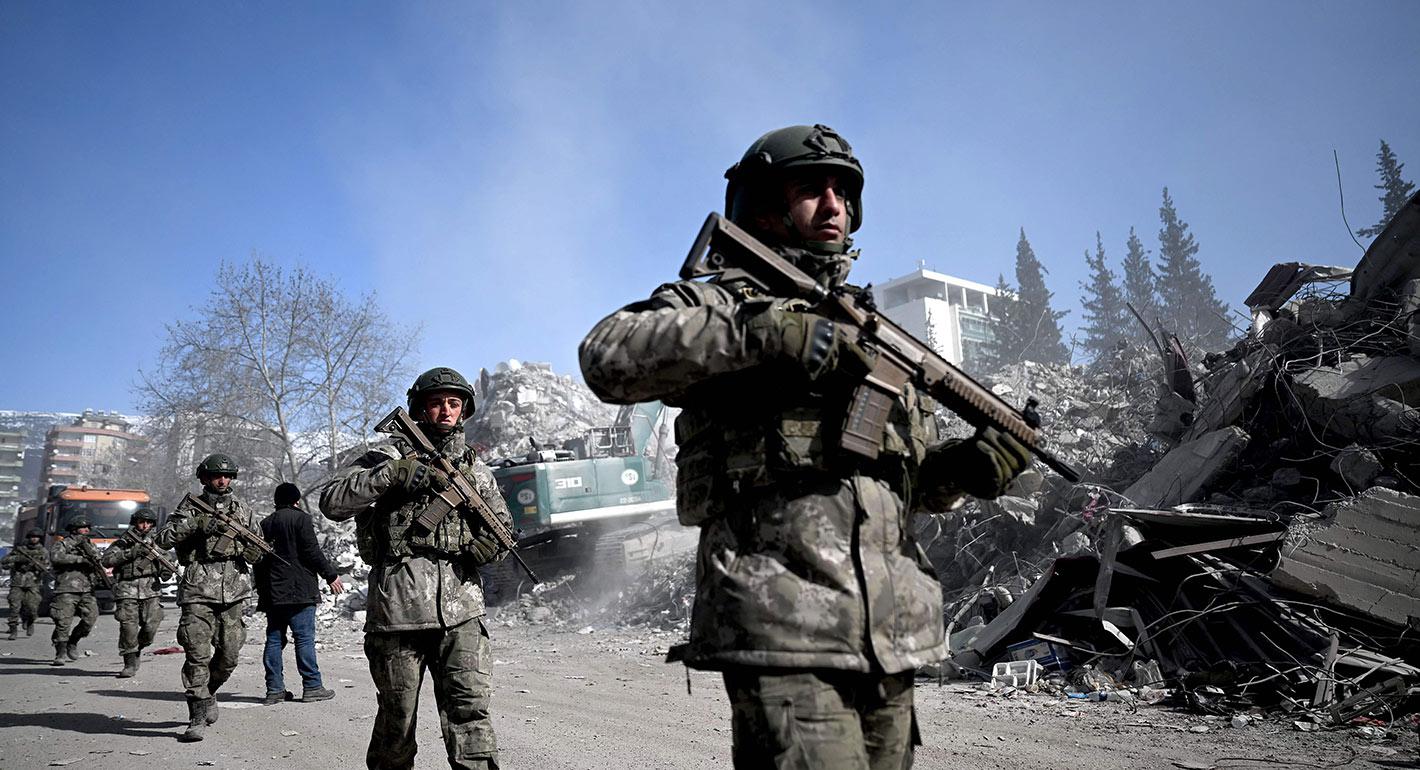
On February 7, Turkish President Recep Tayyip Erdogan announced a three-month state of emergency (SoE) in southern Türkiye after the February 6 and 20 earthquakes. Shortly afterwards, he deployed a 141,000-person civilian relief corps and consented to aid transfer through the Bab As-Salam and Al-Rai border crossings to northern Syria.
The earthquakes were an unquestionable crisis and horrific tragedy. Yet left unsaid in Erdogan’s announcement was that Türkiye’s border emergency is only the latest in a long line of similar emergencies, which have dramatically reconfigured Türkiye’s sociopolitical space since the Justice and Development Party (AKP)’s rise to power in the early 2000s.
In fact, the urge to secure the border with Syria—the “first circle of [Erdogan's] strategic depth”—has resonated through decades of Turkish politics, fully 43 years of which unfolded during SoEs. It emerged in the 1980s during Türkiye’s first major confrontations with the Kurdistan Workers’ Party (PKK). This occasioned an SoE lasting from 1987 to 2002, during which time the government developed “deep state” political ideology, positing the existence of a fifth column of internal enemies. Rooting them out became imperative to state survival.
These forces motivated Erdogan’s unprecedented crackdown on public officials, and particularly Kurdish officials, after the 2016 coup attempt. In its wake, every subsequent SoE has enlarged military presence along the southern border. Erdogan declared a three-month SoE in July 2016 that carried into Operation Euphrates Shield, Türkiye’s first military intervention in Syria. Although Erdogan’s stated rationale for the incursion was taking out the PKK and Islamic State, Euphrates Shield also succeeded in reconstituting the Turkish army after post-coup purges dismissed 45 percent of its top brass.
Erdogan extended this SoE for two years. During this time, he passed permanent amendments to hundreds of articles of laws. Then, three days before Operation Olive Branch, Ankara’s second Syria invasion, it was extended a sixth time due to “the threat of terrorism.” Finally, Erdogan billed Operation Peace Spring, Türkiye’s 2019 offensive in Syria, as “preventing the creation of a terror corridor across our southern border.” And although no SoE was declared, Erdogan’s attitude towards the Kurdish-led Syrian Democratic Forces (SDF), whom he has branded PKK militants, raises the specter of yet another border debacle.
To wit, Türkiye’s constitution authorizes SoEs under two conditions. They address either external events, such as epidemics and earthquakes, or “indications of widespread acts of violence,” effectively handing the ruling elite broad authority to define these indications.
Consequently, their imposition has polarized Turkish civil society by creating an opening for Erdogan to rule perpetually by decree—and, with army support, by executive fiat. Moreover, SoEs permit the state to take out its opponents on the pretext of being anti-government and, therefore, terroristic. This type of charge suggests a perverse, zero-sum paradigm of domestic politics in which critiquing Ankara is tantamount to sheltering the terrorists.
But this makes no difference to Erdogan. In fact, it is key to state messaging, which conflates Syrian and Turkish Kurds with Kurdish terrorists of old, implicating the SDF directly in PKK-led attacks. As such, SoEs have recast the rhetorical sphere as an extension of the security sphere—in which snuffing out critics becomes not just a political plus, but a civic duty.
The earthquakes are putting that duty to the test. As the SDF warns of a fourth Turkish operation, and Turkish forces again bombard the north, the latest border emergency could mushroom into a flashpoint of local, regional, and global significance. Already, Erdogan has used it to concentrate vast human capital and state authority in southern Türkiye.
The SoE is set to expire May 7. With his May 14 election prospects in jeopardy over earthquake preparedness—the very issue that helped bring him to power—Erdogan may yet exploit the crisis to suspend voting, enter Syria, or recalibrate his options. In light of past precedents, though, it is worth asking: has the emergency ever truly left?
Gabriel Davis is a 2022-2023 Fulbright Scholar in Jordan and Non-Resident Fellow at the New Lines Institute. You can follow him on Twitter: @gabrielssdavis.