

{
  "authors": [
    "Hind Al Ansari"
  ],
  "type": "commentary",
  "blog": "Sada",
  "centerAffiliationAll": "dc",
  "centers": [
    "Carnegie Endowment for International Peace"
  ],
  "collections": [],
  "englishNewsletterAll": "menaTransitions",
  "nonEnglishNewsletterAll": "",
  "primaryCenter": "Carnegie Endowment for International Peace",
  "programAffiliation": "MEP",
  "programs": [
    "Middle East"
  ],
  "projects": [],
  "regions": [],
  "topics": []
}
Source: Getty
This Barbie Can’t Go to Kuwait
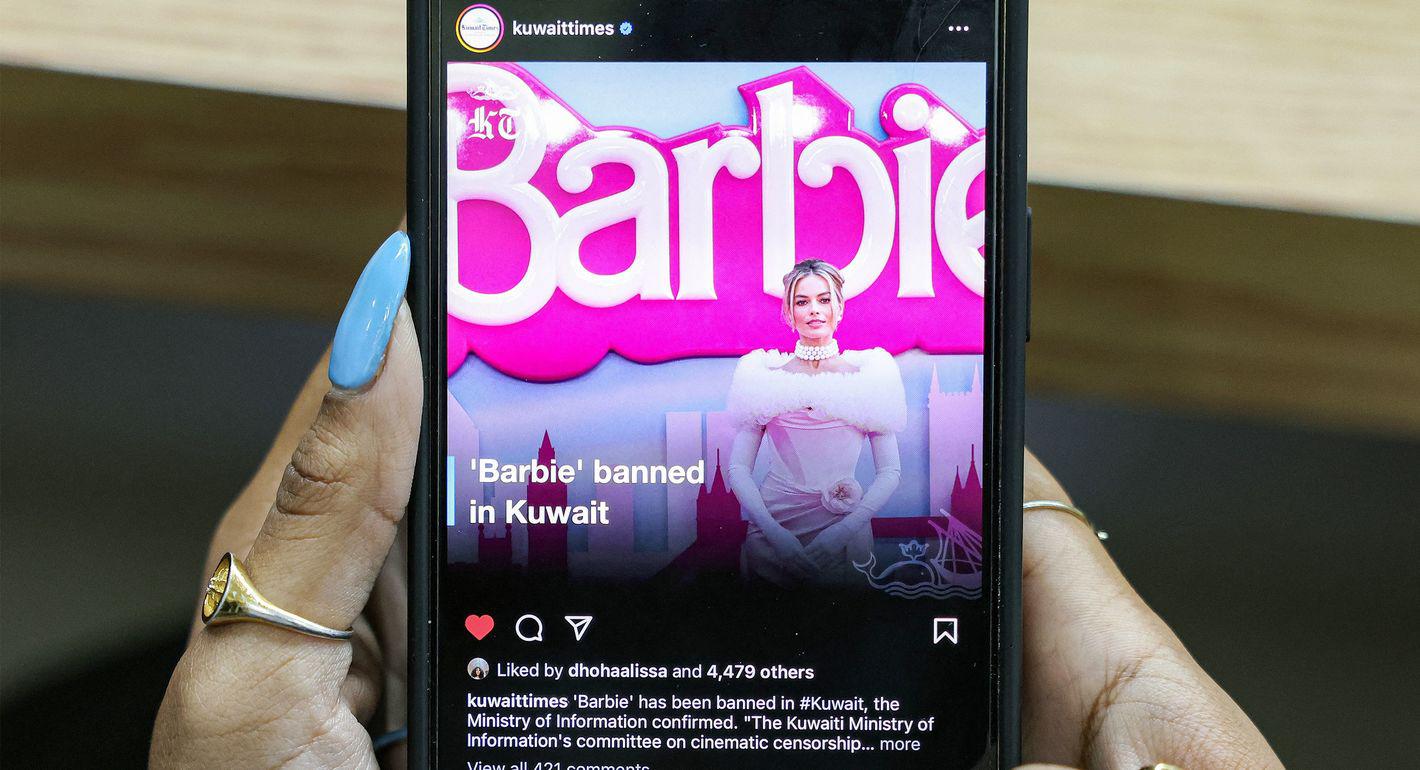
The recent ban of the Barbie film is part of a growing crackdown on feminism and freedom of expression in Kuwait.
In August, the Kuwaiti government’s decision to ban Barbie received widespread international attention. Kuwait is generally considered to be one of the more progressive Gulf countries, with an elected parliament, a constitutional court, and a vibrant civil society. Yet in this instance, Kuwait took the most conservative position among its neighbors—while audiences in Saudi Arabia flocked to see the American film. Several Western news outlets, including the Los Angeles Times and USA Today, attributed the decision to the presence of LGBTQ characters and themes in the film. But while Lebanon temporarily banned Barbie for “promoting homosexuality,” in Kuwait, the crux of the matter might lie elsewhere.
Barbie, the film’s main character, is shaped by a version of contemporary Western feminism, which even conservatives in the U.S. have vilified on the news and social media. The film humorously calls for female empowerment and emancipation from the patriarchy, represented by negative masculine stereotypes. These are ideas that have been vocally opposed in recent years by conservative Kuwaitis—including members of the National Assembly—who have targeted local feminist initiatives that they find contradictory to traditional and religious values. It is thus worth exploring whether this anti-feminist current in Kuwaiti politics is the central impetus behind the ban.
Crucially, the ban comes alongside measures Islamist politicians have taken to curtail women’s rights. In May 2022, for example, Islamist MP Fayez Al-Jamhour raised suspicion about the Women and Gender Studies Research Unit at Kuwait University and its objectives. Its founder, the feminist scholar Reem Al-Rudainy, and other faculty members were subsequently berated by public figures and community members. And alongside the ban of Barbie in August, some members of the National Assembly celebrated the amendment of Article 16 of the General Election Commission law, which now mandates that women adhere to principles of Sharia law in order to vote or run for office. Several Kuwaiti NGOs have expressed opposition to this amendment, insisting that it violates constitutional rights.
Banning Barbie should thus be understood, in part, within the context of the growing presence of Islamism in Kuwaiti politics. Saad bin Tefla, a former Minister of Information and Culture in Kuwait, presumes the ban might have occurred after the movie was denounced by what he mockingly dubbed the “Kandaharis”—a label assigned to Islamist MPs for their fundamentalist views.
While the ban represents the government’s official position, Kuwaitis themselves have been predictably divided. Those who praise the ban echo the Undersecretary of the Ministry of Press and Publication Lafy Al-Subei’e, who claimed that the movie “promulgates ideas and beliefs that are alien to the Kuwaiti society and public order.” Dahem Al-Qahtani, a Kuwaiti journalist and TV anchor, shared a video of the fundamentalist Christian media critic Ted Baehr critiquing Barbie, and suggested that the film promotes “ugly feminist ideas.” While it is uncommon for Kuwaiti politicians to highlight common views with conservative figures in the West, posting a video of an American who labeled the movie “hardcore propaganda” serves to reinforce the ban’s legitimacy.
Other Kuwaiti critics denounced the decision, arguing that it infringes on freedom of choice. In a BBC interview discussing the ban, Kuwaiti Director Najaf Jamal stresses the inefficacy of the measure. In his words, “the screen remains accessible to all,” implying that viewers will find alternative ways to access films prohibited by their governments. Moreover, days after the ban, the Kuwaiti theater director and actor Mohammed Al-Hamli announced the debut of a Barbie-themed play with a highly-produced promotional video.
Ultimately, the controversy over Barbie in Kuwait points to a wider problem. When the state assumes the role of a custodian of social norms and religious beliefs, it aligns with some groups while marginalizing others, creating new avenues for conflict and social polarization. Instead, the government should focus on developing spaces for open dialogue, where Kuwaitis can exchange ideas about the media and the content they consume.
Hind Al Ansari is a researcher and policy analyst. Her work focuses on social and educational developments in the Gulf Cooperation Council states and the broader Muslim world.
About the Author
Hind Al Ansari
Carnegie does not take institutional positions on public policy issues; the views represented herein are those of the author(s) and do not necessarily reflect the views of Carnegie, its staff, or its trustees.