

{
  "authors": [
    "Yasir Kuoti"
  ],
  "type": "commentary",
  "blog": "Sada",
  "centerAffiliationAll": "dc",
  "centers": [
    "Carnegie Endowment for International Peace"
  ],
  "collections": [],
  "englishNewsletterAll": "menaTransitions",
  "nonEnglishNewsletterAll": "",
  "primaryCenter": "Carnegie Endowment for International Peace",
  "programAffiliation": "MEP",
  "programs": [
    "Middle East"
  ],
  "projects": [],
  "regions": [],
  "topics": []
}
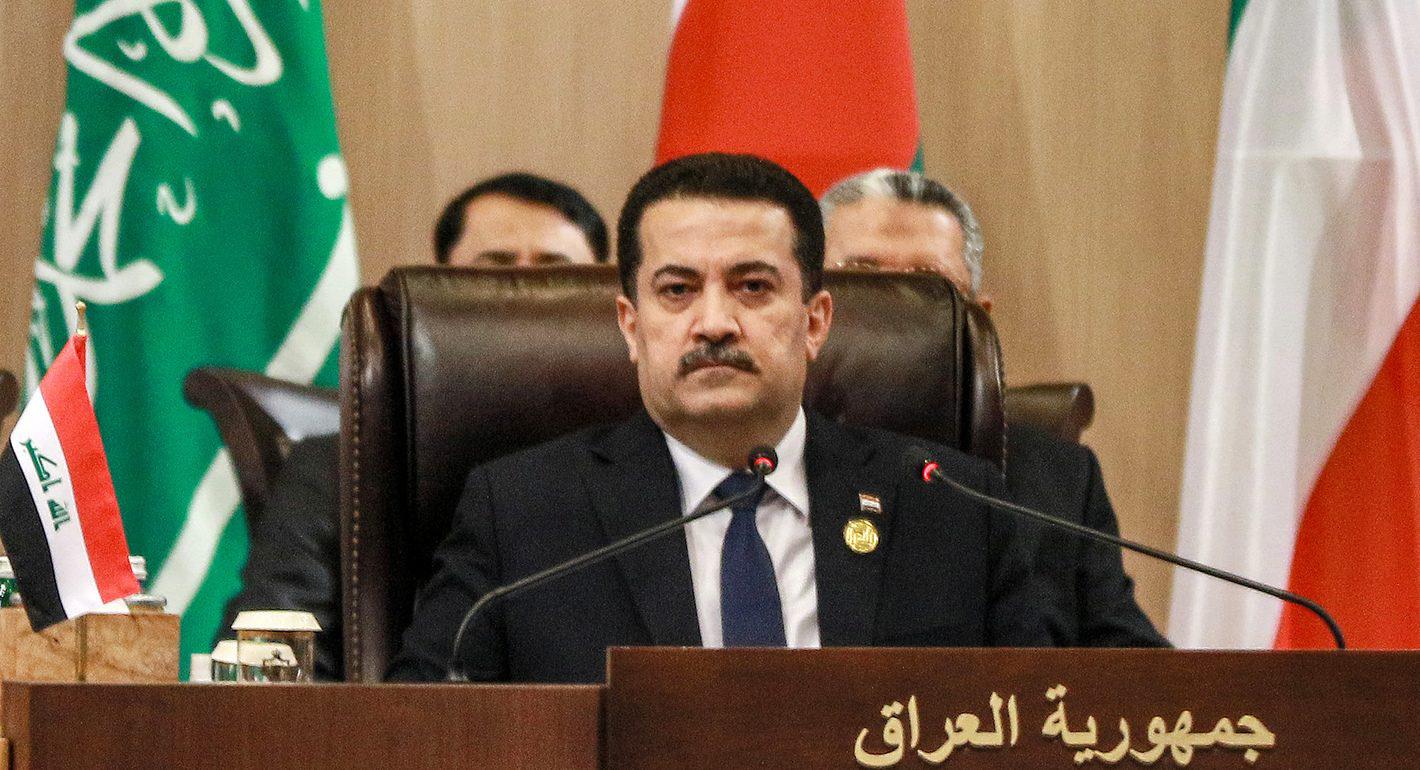
Source: Getty
Iraqi Governance Under Al-Sudani: Beyond Service Delivery?
Without addressing the corruption endemic to Iraq’s muhasasa political system, the prime minister will fare no better than his predecessors.
Since taking office in October 2022, Iraqi Prime Minister Mohammed Shia al-Sudani has compiled a record of policy accomplishments. The “service government” he leads has delivered on a range of issues: building roads, highways, and hospitals, signing massive deals to ensure energy independence, completing a gas-for-oil barter deal with Tehran to spare Iraqis the 50-degree heat of summer, and working with Parliament to pass a three-year federal budget.
Service delivery has long been a weakness of successive Iraqi governments since 2003, perpetuated by corruption, fraud, inefficient institutions, and the absence of political will. Iraqi leaders wasted funding for thousands of projects that were only partially completed or never existed. Unlike previous prime ministers, Al-Sudani has taken a hands-on approach, establishing the Government Service Delivery Team to monitor progress, and making field visits to project sites to help expedite delivery.
Although praised by members of the public, these efforts to improve public services have yet to address the underlying faults of the system—the politics that generates poor services and the corruption that allows it to flourish.
There is a common perception in Iraq that al-Sudani is an honest leader with the nation’s interests at heart, but who is ultimately no different than his predecessors when it comes to playing by the rules of the game: subcontracting his agenda to elites who proceed to practice muhasasa, the quota-based political system introduced in 2003 to provide proportional government representation for the various ethnic and sectarian groups in the country.
Muhasasa has tainted policymaking in Iraq at all levels, providing kleptocrats the cover to manipulate state resources for their own benefit. The system has especially corrupted the process of recruiting the leaders of Iraqi institutions. Al-Sudani has long stated his intention to reshuffle his cabinet and replace underperforming officials, but this has yet to materialize, likely due to elites’ pressure. Even it does, the premier will likely be forced to replace outgoing officials with others from the same party.
When activists took to the streets across Iraq in 2019, chanting “we want a homeland”, their protests signaled a vehement rejection of the muhasasa system, which continues to create a stark divide between elites and the rest of society. Bridging this divide would take more than service delivery: it would require a plausible policy agenda that challenges how politics is done, including how officials are recruited and how funding for services is distributed.
Even minor reforms, such as the automation of services including tax collections—which improve services and reduce corruption—could boost the economy and prove to be popular. Combating corruption would also likely increase the prospects for cooperation between the premier and the public, especially those who were initially inclined to move in his direction by virtue of his character and reputation. No other win could offset for genuine domestic reforms; former Prime Minister Mustafa al-Kadhimi’s failed anti-corruption drive, despite foreign policy successes, provides a case in point.
Al-Sudani is well-placed to take on contentious political issues given his acceptability and the lack of agreement among elites on any alternate leader. While overhauling muhasasa remains a distant prospect given deeply-entrenched elite interests, addressing governance challenges that affect all Iraqis—restructuring public sectors via public-private partnerships, for instance—remains doable. Al-Sudani could try to persuade elites to accept reforms in exchange for legal and political amnesty. But if they refuse, he must hold steady in the face of their threats and escalations, a tactic they use to abort potential political change. Moreover, these threats are of little practical consequence, as elites are themselves cognizant that they would be blamed for another government collapse. Such a turn of events would galvanize widespread national anger, including from the religious authority in Najaf, and likely trigger a public reaction much larger than the 2019 protests.
Yasir Kuoti is a Baghdad-based analyst with over a decade of experience working in and on Iraq. Follow him on X @YasirKuoti.
About the Author
Yasir Kuoti
Carnegie does not take institutional positions on public policy issues; the views represented herein are those of the author(s) and do not necessarily reflect the views of Carnegie, its staff, or its trustees.