• Research
  • Emissary
  • About
  • Experts
Carnegie Global logoCarnegie lettermark logo
Democracy
  • Donate
{
  "authors": [
    "Heba F El-Shazli"
  ],
  "type": "commentary",
  "blog": "Sada",
  "centerAffiliationAll": "",
  "centers": [
    "Carnegie Endowment for International Peace",
    "Malcolm H. Kerr Carnegie Middle East Center"
  ],
  "englishNewsletterAll": "",
  "nonEnglishNewsletterAll": "",
  "primaryCenter": "Carnegie Endowment for International Peace",
  "programAffiliation": "",
  "programs": [
    "Middle East"
  ],
  "projects": [],
  "regions": [
    "Middle East",
    "Tunisia",
    "North Africa"
  ],
  "topics": [
    "Civil Society",
    "Democracy"
  ]
}
Attribution logo
Commentary
Sada

Tunisian Trade Union Women: Agents of Change

As members, organizers, and leaders, women continue to play an important role in the General Union of Tunisian Workers and advance its political advocacy.

Link Copied
By Heba F El-Shazli
Published on May 16, 2024
Sada

Blog

Sada

Sada is an online journal rooted in Carnegie’s Middle East Program that seeks to foster and enrich debate about key political, economic, and social issues in the Arab world and provides a venue for new and established voices to deliver reflective analysis on these issues.

Learn More
Program mobile hero image

Program

Middle East

The Middle East Program in Washington combines in-depth regional knowledge with incisive comparative analysis to provide deeply informed recommendations. With expertise in the Gulf, North Africa, Iran, and Israel/Palestine, we examine crosscutting themes of political, economic, and social change in both English and Arabic.

Learn More

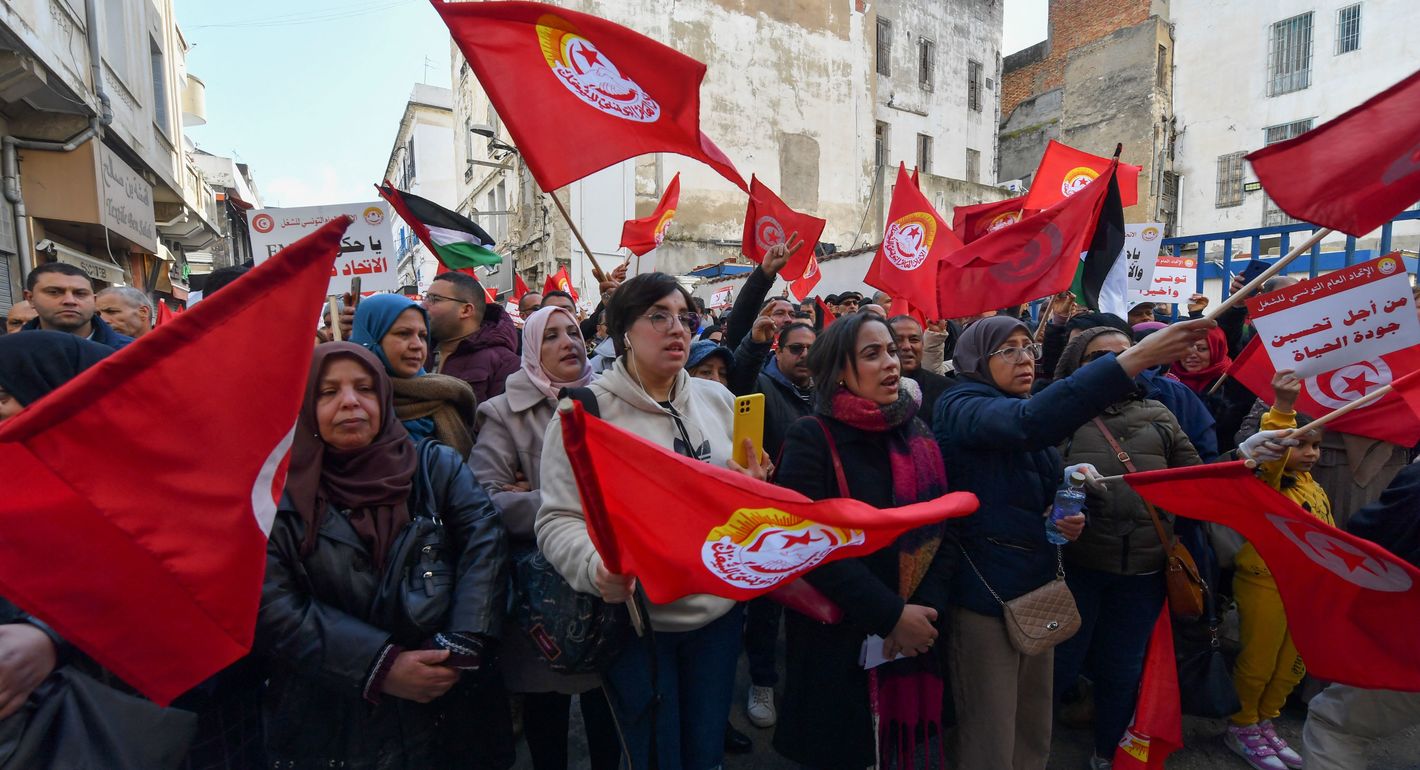
In January 2011, Tunisia’s anti-regime protests helped spark the Arab Uprisings, and Tunisia was the only country where the labor movement played a credible leadership role both during and after the revolution. The General Union of Tunisian Workers (UGTT) worked with other civil society organizations to defend basic civil liberties and protect the country’s economic development and its workers, and in 2015, the UGTT was part of a group of Tunisian organizations that was awarded a Nobel Peace Prize. What has often been overlooked, however, is the instrumental role that women trade unionists played during the revolution and its aftermath.

 Since its founding in 1946, the UGTT has been an integral part of the Tunisian social fabric—first in the fight against colonialism, and then during the long periods of authoritarian rule after 1956, where participation in trade unions served as the only outlet for political expression. After the events in Sidi Bouzid in late December 2010, UGTT rank-and-file members began organizing in villages, towns, and cities throughout the country to protest the Ben Ali regime. According to a woman leader in the education workers’ union, organizing was done incrementally, slowly building support among Tunisians of all backgrounds, and women trade unionists were involved in every step. In preparation for a national strike on January 14, 2011, for instance, UGTT women unionists visited a textile factory outside of Tunis, where women workers crammed into small meeting rooms to learn about and join the UGTT’s efforts.

 Elected leadership positions in the UGTT did not come easily for women, and only after decades of activism. The women’s committee, founded in 1982, became a constituent body of the UGTT leadership in 1991, and in January 2017, the UGTT introduced quotas for women at all levels of the hierarchy. For the first time, the union elected a female member to its executive board and soon after two additional women integrated in the UGTT’s governance structures. Today, there are women in leadership positions at every level, and women represent 55 percent of the UGTT’s membership. These women have recruited new members, organized protests, held training workshops, coordinated activities with Tunisian women’s organizations, and much more.

 As a leading voice in the political arena, advocating for economic improvement and public policy reform, the UGTT has become a target of Tunisia’s ruling regime. The UGTT has firmly opposed the government’s severe austerity measures, including cuts to social services and subsidies for the poor, diminished public sector salaries, and rising costs of drinking water and fuel, which will only worsen living standards for ordinary Tunisians. In January 2023, alongside other Tunisian NGOs, the UGTT launched a National Salvation Initiative to address the country’s economic, political, and social crises. Yet the government’s response has been to  arrest and harass trade union leaders and members, and to refuse any engagement with such initiatives.

 Amid this crackdown, women trade unionists have reflected on their involvement in Tunisia’s revolution. Many believe that the effort to draft a new constitution was a waste of time and effort, raising deep questions about national identity and religion and delaying the political transition. Now, as a woman union leader from Gafsa noted, political organizing is hampered by widespread feelings of apathy among Tunisians. “In general, people are exhausted, tired, hungry, unemployed, and going to protest is just not useful or effective,” she said.

 Yet Tunisian union women are far from giving up. As active members of the UGTT, they believe they can make changes from within the union and continue to ensure that their voices are heard—striving for a better future for all Tunisians.

Note: Interviews with women union members were conducted by the author between January 29 and February 1, 2024, in Gafsa, Tunis, Silana, Beja, and Monastir.

Heba F El-Shazli

Heba F. El-Shazli is an Associate Professor at the Schar School of Policy and Government, George Mason University, and a Visiting Academic at the Middle East Centre, St Antony’s College, Oxford University for the 2023-23 academic year.

Civil SocietyDemocracyMiddle EastTunisiaNorth Africa

Carnegie does not take institutional positions on public policy issues; the views represented herein are those of the author(s) and do not necessarily reflect the views of Carnegie, its staff, or its trustees.

More Work from Sada

  • Commentary
    Sada
    A House Divided: How Internal Power Struggles Shape Iraq’s Foreign Policy

    Iraq’s foreign policy is being shaped by its own internal battles—fractured elites, competing militias, and a state struggling to speak with one voice. The article asks: How do these divisions affect Iraq’s ability to balance between the U.S. and Iran? Can Baghdad use its “good neighbor” approach to reduce regional tensions? And what will it take for Iraq to turn regional investments into real stability at home? It explores potential solutions, including strengthening state institutions, curbing rogue militias, improving governance, and using regional partnerships to address core economic and security weaknesses so Iraq can finally build a unified and sustainable foreign policy.

      Mike Fleet

  • Commentary
    Sada
    The Role of E-commerce in Empowering Women in Saudi Arabia: Assessing the Policy Potential

    How can Saudi Arabia turn its booming e-commerce sector into a real engine of economic empowerment for women amid persistent gaps in capital access, digital training, and workplace inclusion? This piece explores the policy fixes, from data-center integration to gender-responsive regulation, that could unlock women’s full potential in the kingdom’s digital economy.

      Hannan Hussain

  • Commentary
    Sada
    A War Fueled by Hate Speech: Sudan’s Fall into Fragmentation

    Hate speech has spread across Sudan and become a key factor in worsening the war between the army and the Rapid Support Forces. The article provides expert analysis and historical background to show how hateful rhetoric has fueled violence, justified atrocities, and weakened national unity, while also suggesting ways to counter it through justice, education, and promoting a culture of peace.

      Samar Sulaiman

  • Commentary
    Sada
    Disarming Palestinian Factions in Lebanon: Can a Security Experiment Evolve into Sovereign Policy?

    The August 2025 government decision to restrict weapons to the Lebanese state, starting with Palestinian arms in the camps, marked a major test of Lebanon’s ability to turn a long-standing slogan into practical policy. Yet the experiment quickly exposed political hesitation, social gaps, and factional divisions, raising the question of whether it can become a model for addressing more sensitive files such as Hezbollah’s weapons.

      Souhayb Jawhar

  • Commentary
    Sada
    Kuwait’s Bureaucracy at a Crossroads: Why Government Innovation Stalls and How Analytics Can Reignite Reform

    Kuwait’s government has repeatedly launched ambitious reforms under Kuwait Vision 2035, yet bureaucratic inefficiency, siloed institutions, and weak feedback mechanisms continue to stall progress. Adopting government analytics—real-time monitoring and evidence-based decision-making—can transform reform from repetitive announcements into measurable outcomes.

      Dalal A. Marafie

Get more news and analysis from
Carnegie Endowment for International Peace
Carnegie global logo, stacked
1779 Massachusetts Avenue NWWashington, DC, 20036-2103Phone: 202 483 7600Fax: 202 483 1840
  • Research
  • Emissary
  • About
  • Experts
  • Donate
  • Programs
  • Events
  • Blogs
  • Podcasts
  • Contact
  • Annual Reports
  • Careers
  • Privacy
  • For Media
  • Government Resources
Get more news and analysis from
Carnegie Endowment for International Peace
© 2026 Carnegie Endowment for International Peace. All rights reserved.