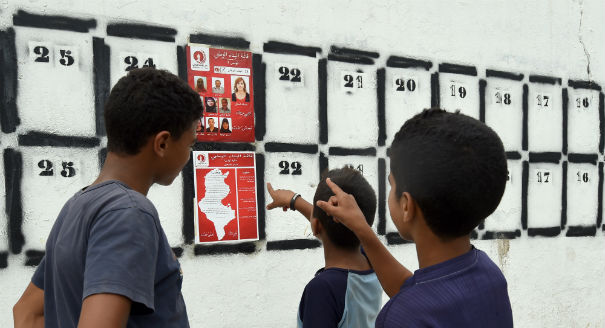
When asking people around Tunisia if they have already made a choice for whom to vote in the upcoming parliamentary and presidential elections, shrugs are the typical response. Many voters struggle to decide whether to even cast a ballot, disappointed by the deputies they had elected to the Constituent Assembly in 2011. Given the overwhelming focus on individual candidates and the proliferation of political parties in most election discussions, there has been little focus on the issues at stake. Not only does this worsen voter frustration, but it may lead to a stronger showing for figures associated with the former regime of Zine El Abidine Ben Ali.
The proliferation of parties, thought to be a temporary phenomenon due to the sudden acquirement of political freedoms, still persists. The Independent High Authority for Elections (French acronym, ISIE) counts more than 1300 lists—for parties, alliances, and independent candidates—running in parliamentary elections this year. These are spread across 33 constituencies (27 in Tunisia and 6 outside of the country) for the 217 seat assembly in the first regular parliamentary elections since the overthrow of former president Ben Ali. More than five million Tunisians have registered as voters, though many struggle to make their choice, especially where the number of lists reaches 69, as in the constituency of Kasserine, a town in central Tunisia.
Because opinion polls are not allowed in the run up to elections and as politicians are constantly changing parties, there is little more than speculation as to which party could gain the most seats in the new assembly. Certainly Ennahda, which came first in 2011, is likely to be one of the leading forces, as is center-right Nidaa Tounes, which has positioned itself as a secular alternative to Ennahda. Though Nidaa Tounes has a wide spectrum of members from unionists to liberals and conservatives, it has recently been shaken by internal divisions regarding the party’s political orientation. The left wing of the party criticized the increase in members coming from the Constitutional Democratic Rally (RCD), the ruling party under Ben Ali, which was dissolved just after the revolution. In summer 2013, Mohamed Ghariani, former secretary general of RCD, joined the party as an advisor to the leader of Nidaa Tounes, Beji Caid Essebsi, only weeks after leaving prison where he was held for corruption charges. Party sources say that it is Ghariani who is actually running the party behind the scenes.1
While the leader of Nidaa Tounes, Beji Caid Essebsi, is running for presidency, Ennahda promotes the idea of having a consensual candidate. It is instead focusing its campaign on the legislative elections, reasoning that parliament will be making the essential decisions unlike the future Tunisian president, who will have a largely representative role. A division of power between the executive and legislative branches among these two large rival parties would surprise few in Tunisia and has long been discussed as the most likely outcome. Although Ennahda’s conservative base is uneasy with this possible de facto alliance, the party’s leadership has learned its lesson from the 2013 political crisis and wants to win back lost confidence.
The two other parties of the former government coalition under Ennahda, the Congress for the Republic and Ettakatol, have steadily been losing both members and positions in opinion surveys over the past couple years. However, other actors are emerging on the scene and trying to provide a third way in the polarized Tunisian political landscape.
Afek Tounes, a business-oriented liberal party which had joined the Republican Party in 2012 before becoming independent again in summer 2013, has steadily worked its way up in Tunisian public opinion, even though they are still far away from having wide support. The communist alliance Popular Front is expecting strong results especially in the mining region in the south-west of the country, whereas the Union for Tunisia (UTP) coalition contains the remains of what was once a much larger union of secular political forces before the assassination of Mohamed Brahmi in July 2013. But soon larger parties such as Nidaa Tounes, the Republican (Joumhouri) Party, and the Popular Front left it to enter elections on their own, fearing that their sway might be diminished in a larger alliance. What is left of the UTP is largely al-Massar (formerly known as Attajdid under Ben Ali and the Pole Democratique Moderne in 2011), along with the Democratic Patriotic Workers’ Party, and some independent candidates as allies. While al-Massar is widely respected for being honest and straightforward, the party has a reputation as the party of the urban elite with a lifestyle different than most Tunisians, causing the party to have limited appeal to the majority of voters, especially outside the coastal towns.
Former members and sympathizers of Ben Ali’s RCD are the biggest unknown factor in the elections. They are presenting themselves in different forms and with varying regional strongholds. Kamel Morjane, Ben Ali’s last minister of foreign affairs and president of the Moubadara Party, is running for president, as are the independent candidate Mondher Zenaidi and the Destourian Movement’s Abderrahim Zouari, all also former ministers under Ben Ali. So is Mustapha Kamel Nabli, economist at the World Bank and the former governor of the Central Bank of Tunisia, who was a minister in the 1990s but is largely seen as an independent technocrat today. This “old crowd,” as people in Tunisia call them, might profit from the general sense of insecurity that many Tunisians feel.
Moreover, as Tunisia’s economy struggles to get back on its feet after the revolution and the ongoing security threats in the region continue, nostalgia for the old days has grown and some Tunisians wish for a strong man to put the country back on track. And while these politicians do not have as strong a base among the population as they did before, they maintain the firm backing of the business community. While the most prominent figures that upheld and profited from the Ben Ali regime have been targeted by corruption cases, large parts of the underlying structures are still there and keep the system intact. The Tunisian business class has little interest in seeing this system changed, and as such are likely to seek a strong presence of old regime forces in the government.
The presidential elections, scheduled for November 23, overshadow the parliamentary ones on October 26 and take the focus away from the legislative election, which is more important for Tunisia’s future. This, along with the proliferation of parties that has divided Tunisia’s electorate, the lack of focus on programs and issues, and the business community’s likely support for former RCD members, is creating an atmosphere of uncertainty and voter frustration.
Sarah Mersch is a Tunis-based freelance journalist.
1. Based on interviews with the author.