• Research
  • Emissary
  • About
  • Experts
Carnegie Global logoCarnegie lettermark logo
DemocracyIran
  • Donate
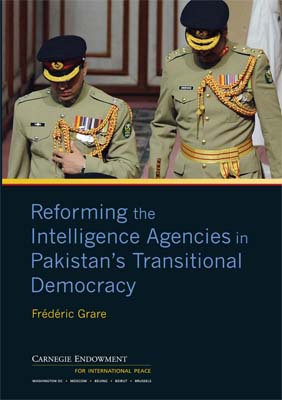
Reforming the Intelligence Agencies in Pakistan’s Transitional Democracy
Report

Reforming the Intelligence Agencies in Pakistan’s Transitional Democracy

Previous abuses of power by Pakistani regimes and intelligence agencies make reforms imperative. With patience, resolve, and assistance from the international community, Pakistan’s government can reassert civilian control over the intelligence community.

Link Copied
By Frederic Grare
Published on Mar 6, 2009

Additional Links

Full Text
Program mobile hero image

Program

South Asia

The South Asia Program informs policy debates relating to the region’s security, economy, and political development. From strategic competition in the Indo-Pacific to India’s internal dynamics and U.S. engagement with the region, the program offers in-depth, rigorous research and analysis on South Asia’s most critical challenges.

Learn More

Pakistan’s new and fragile government must reform the country’s intelligence agencies to counter their influence on civil society and politics. The army remains the dominant actor in Pakistan’s political life, despite some improvements in civil-military relations in recent years. Previous abuses of power by both Pakistani regimes and the intelligence agencies—particularly Inter-Services Intelligence (ISI)—make reforms imperative before Pakistan can continue its democratic transition.

Through interviews with Pakistani officials and case studies in Indonesia and Chile, Grare argues that with patience, resolve, and assistance from the international community, Pakistan’s government can successfully reassert civilian control over the intelligence community. 
 
Key recommendations for the international community:

  • Work through the Pakistani government, not the intelligence services. The current double standard of demanding that the government end support for regional extremists within its agencies, yet still maintaining working relations with those agencies, undermines the government and vindicates intelligence actors.
     
  • Pursue alternate supply routes to Afghanistan to diminish the importance of Pakistan and its agencies to the NATO mission. The international community should seek routes through China and Iran to reduce Islamabad’s leverage over Western countries fighting in Afghanistan. The newly opened Russia route isn’t a stable solution, given ongoing tensions over NATO.
     
  • Condition aid to the Pakistani military on improved control of the intelligence agencies and counterterrorism cooperation. Pakistani intelligence agencies are losing their base of support and are increasingly targeted by terrorists. Previous resistance to cooperate in counterterrorism is likely diminishing, and the international community should capitalize on the opportunity. 

 Recommendations for the Pakistani government:

  • Restore the Supreme Court and prosecute ISI violations of legality. Reestablishing judicial preeminence is critical to intelligence reform and democratization, so amnesty for past violations should not be used as a political bargaining tool.
     
  • Reinforce the separation between civilian and military intelligence agencies. The integration of former ISI agents into other civilian bodies—particularly the Intelligence Bureau (IB)—should be limited or stopped.  Cross-recruitment prevents organizations from becoming independent.
     
  • Strengthen the police force. A better-trained and equipped police can take over some of the counterterrorism work currently used by the intelligence agencies to legitimize their control.
     
  • Build public support, but manage expectations. Public support is essential to advance reforms, but raising public expectations beyond reasonable objectives could enflame social tensions.  Public intolerance of intelligence agencies abuses is often the best guarantee against a return to corruption after reforms have taken place.

Grare concludes:
 
“Pakistan’s civilian government would be wrong to ignore the need to decisively establish its supremacy over the intelligence community. Reducing the role of the military in intelligence should be a priority not only because it will help the government consolidate itself domestically but also because the perception abroad of Pakistan’s emerging democracy and consequent foreign support will be shaped by its capacity to impose its authority on the intelligence agencies’ activities on issues ranging from domestic terrorism to foreign policy.”

About the Author

Frederic Grare

Former Nonresident Senior Fellow, South Asia Program

Frédéric Grare was a nonresident senior fellow at the Carnegie Endowment for International Peace, where his research focuses on Indo-Pacific dynamics, the search for a security architecture, and South Asia Security issues.

    Recent Work

  • Article
    France, the Other Indo-Pacific Power

      Frederic Grare

  • Article
    What Sri Lanka’s Presidential Election Means for Foreign Policy

      Frederic Grare

Frederic Grare
Former Nonresident Senior Fellow, South Asia Program
Frederic Grare
South AsiaPakistanPolitical ReformDemocracySecurityMilitaryForeign Policy

Carnegie does not take institutional positions on public policy issues; the views represented herein are those of the author(s) and do not necessarily reflect the views of Carnegie, its staff, or its trustees.

More Work from Carnegie Endowment for International Peace

  • Commentary
    Deciphering Europe’s Relationship with Turkey

    Debate is heating up on how Turkey could be integrated into a common European defense framework. Commercial and industrial deals offer a better chance at alignment than sweeping political efforts.

      Marc Pierini

  • Commentary
    Emerging From the “Zombie State” of Trade Agreements: The India-EU FTA

    The India–EU Free Trade Agreement (FTA) is shaping up to be one of the most consequential trade negotiations, both economically and strategically. But, what’s in the agreement, what’s missing, and what will determine its success in the years ahead

      Vrinda Sahai, Nicolas Köhler-Suzuki

  • Construction site
    Commentary
    Emissary
    The Iran War Isn’t the Only Challenge Facing Saudi Arabia’s Vision 2030

    As the monarchy appears to question its grandest projects, the state could do with more critical debate than rote cheerleading.

      • Andrew Leber

      Andrew Leber

  • Commentary
    Strategic Europe
    Taking the Pulse: Is it Worth it for Europeans to Placate Trump?

    After spending much of 2025 trying to placate Donald Trump, some European leaders are starting to change posture. But is even a hostile Washington still so important to Europe that the U.S. president’s outbursts are worth putting up with?

      • Rym Momtaz

      Rym Momtaz, ed.

  • Commentary
    Carnegie Politika
    In Russia, the Public Mood Is Souring

    The Russian regime is now visibly motivated by fear.

      Alexander Baunov

Get more news and analysis from
Carnegie Endowment for International Peace
Carnegie global logo, stacked
1779 Massachusetts Avenue NWWashington, DC, 20036-2103Phone: 202 483 7600
  • Research
  • Emissary
  • About
  • Experts
  • Donate
  • Programs
  • Events
  • Blogs
  • Podcasts
  • Contact
  • Annual Reports
  • Careers
  • Privacy
  • For Media
  • Government Resources
Get more news and analysis from
Carnegie Endowment for International Peace
© 2026 Carnegie Endowment for International Peace. All rights reserved.