

In The Media
Minxin Pei
{
  "authors": [
    "Minxin Pei"
  ],
  "type": "legacyinthemedia",
  "centerAffiliationAll": "dc",
  "centers": [
    "Carnegie Endowment for International Peace"
  ],
  "collections": [],
  "englishNewsletterAll": "asia",
  "nonEnglishNewsletterAll": "",
  "primaryCenter": "Carnegie Endowment for International Peace",
  "programAffiliation": "AP",
  "programs": [
    "Asia"
  ],
  "projects": [],
  "regions": [
    "East Asia",
    "China"
  ],
  "topics": [
    "Political Reform",
    "Economy"
  ]
}
Source: Getty
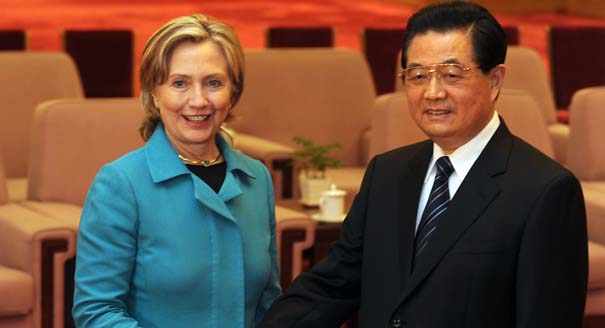
Rather than talking about building mutual trust, China should take concrete steps in order to inaugurate a positive cycle of reciprocal cooperation in U.S.-China relations.
Source: South China Morning Post

Such mutual suspicion permeates the paradoxical US-China relationship: economic interdependence coupled with geopolitical competition. Two key questions flow from this relationship. First, can the two countries work harder to build mutual trust? Second, if gaining trust should prove impossible, can this paradoxical relationship be sustained?
Chinese officials tell us that building mutual trust is not only vital to elevating US-China ties to a new level, but also possible. Unfortunately, they offer few concrete steps in that direction except for urging the Americans to abandon their “cold war mindset” (whatever that means).
The lack of trust does not seem to bother American officials as much. In fact, Washington is far more interested in solving specific issues that periodically disrupt its relations with Beijing (such as China’s surging trade surpluses, sanctions against North Korea and Iran, and human rights abuses in China).
Why is there such a disconnect between the Americans and the Chinese on the issue of mutual trust? The most plausible answer is that both sides, deep in their hearts, believe that building genuine mutual trust is a fool’s errand. As long as China and the US are governed by two opposing political systems, with each symbolising the apex of power of its respective political model (one-party regime vs multiparty democracy), mutual trust is all but impossible.
There is an obvious difference between how the Chinese and the Americans handle this harsh reality: the Chinese keep talking about trust as if it can be obtained, while the Americans do not.
So, in the short to medium term, barring a dramatic transition to democracy in China (it is harder to imagine a transition to autocracy in Washington), we are perhaps better off forgetting about the trust issue.
In that case, what about the sustainability of the co-operative-competitive relationship between Beijing and Washington? While it seems natural to worry that co-operation is difficult without underlying trust, in reality trust is not necessary for co-operation. Academic research and historical experience both suggest that what sustains co-operation is not the elusive variable of trust, but reciprocal acts of co-operation.
In a classic study of co-operation based on computer simulation, The Evolution of Co-operation, Professor Robert Axelrod of the University of Michigan demonstrated that the most effective winning strategy for inducing co-operation is one that offers cooperation first and then sticks to tit-for-tat – or in other words, strict – reciprocity. By applying this strategy, players (or countries) that want to cement mutually co-operative relationships normally make a co-operative first move and then respond positively to acts of co-operation, and retaliate against cheating with cheating.
More encouragingly, such a strategy can be applied to situations where both sides are apparently deadlocked in non-co-operative positions. Bilateral deadlocks can be broken if one side pushes the “reset” button and starts the game anew by offering concessions first.
This powerful academic insight is particularly useful in the context of Sino- American relations. If trust is impossible, then the focus must be on reciprocity.
More importantly, to sustain a mutually beneficial relationship, it is vitally important for one side to take a first step that is concessionary and co-operative in nature. China may currently be in the more favourable position to take such steps to inject more constructive dynamics into its ties with the US.
Take the exchange rate issue, for example. China’s undervalued currency and huge current account surpluses have bedevilled Beijing-Washington ties. Political pressures are now rapidly building in the US for President Barack Obama to take retaliatory measures against China.
Given that China is doing much better than the US economically, Beijing can most certainly absorb the adjustment costs of a rising yuan. Needless to say, taking such a step would do a great deal to defuse bilateral trade tensions (and accelerate China’s economic rebalancing).
Another case is sanctions against North Korea. Compared with the US, China is in a much stronger position to make Pyongyang honour its commitments on nuclear disarmament.
A concrete step taken by China in demonstrating that it is serious about regional stability and nuclear nonproliferation should be well received in the US, as well.
To be sure, both are tough decisions for Beijing. But they are worth taking, to put Sino-American ties on a more solid and cooperative footing.

Former Adjunct Senior Associate, Asia Program
Pei is Tom and Margot Pritzker ‘72 Professor of Government and the director of the Keck Center for International and Strategic Studies at Claremont McKenna College.
Recent Work
Minxin Pei
Minxin Pei
Carnegie does not take institutional positions on public policy issues; the views represented herein are those of the author(s) and do not necessarily reflect the views of Carnegie, its staff, or its trustees.
AI could hollow out jobs, reshape them gradually, create entirely new ones—or do all three at once. The case for starting to act now doesn’t depend on knowing which.

Teddy Tawil

The Russian state has opted for complete ideological control of the internet and is prepared to bear the associated costs.

Maria Kolomychenko

Powerful lobbyists and inertia led to Russia’s coal-mining sector missing an excellent opportunity to solve its structural problems.
Alexey Gusev

After four years of war, there is no one who can stand up to the security establishment, and President Vladimir Putin is increasingly passive.

Tatiana Stanovaya

Five problems—and solutions—to make it actually work as a tool of great power competition.

Afreen Akhter