

Paper
Renée DiResta, Rachel Kleinfeld, Margot Treadwell
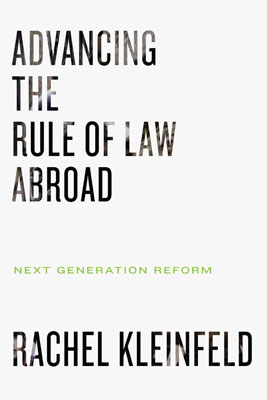
A growing movement of second-generation reformers view the rule of law not as a collection of institutions and laws that can be built by outsiders, but as a relationship between the state and society that must be shaped by those inside the country.
Source: Washington, DC: Carnegie Endowment for International Peace, 2012

In Advancing the Rule of Law Abroad, Rachel Kleinfeld describes the history and current state of reform efforts and the growing movement of second-generation reformers who view the rule of law not as a collection of institutions and laws that can be built by outsiders, but as a relationship between the state and society that must be shaped by those inside the country. Based on research in countries from Indonesia to Albania, Kleinfeld makes a compelling case for new methods of reform that can have greater chances of success at helping these internal reformers and improving the rule of law.
“Rachel Kleinfeld not only assesses past efforts to support the rule of law abroad, but offers innovative approaches for future assistance. The work of scholars and practitioners alike will benefit measurably from her insights.”
—Kenneth Wollack, President, National Democratic Institute
“While policymakers increasingly recognize the risks to U.S. national security when the rule of law breaks down abroad, there is far less consensus on what to do about it. Advancing the Rule of Law Abroad tackles this question head-on with timely and powerful insight. Full of careful analysis and accessible prose, Kleinfeld brings conceptual clarity to an emerging field.”
—Jeremy Weinstein, Stanford University, Former Director for Development and Democracy, National Security Council
“This book is impressive, thoughtful, and full of practical wisdom. Kleinfeld analyzes many of the challenges we faced in helping civilian rule-of-law development experts in Iraq and Afghanistan. This should be on the reading list of anyone preparing to perform rule-of-law work in a post-conflict setting.”
—Brigadier General Mark Martins, U.S. Army
Advancing the Rule of Law Abroad was named by Foreign Affairs as one of the best books of 2012 on political and legal topics. “Kleinfeld brings together a good grasp of the scholarship on law and society with the sensibilities and hard-earned experience of a field practitioner. The result is essential reading for the foreign policy community.”
—G. John Ikenberry, Foreign Affairs

Senior Fellow, Democracy, Conflict, and Governance Program
Rachel Kleinfeld is a senior fellow in Carnegie’s Democracy, Conflict, and Governance Program, where she focuses on issues of rule of law, security, and governance in democracies experiencing polarization, violence, and other governance problems.
Recent Work
Renée DiResta, Rachel Kleinfeld, Margot Treadwell
Political Violence Researchers, Rachel Kleinfeld, ed., Dalya Berkowitz, ed.
Carnegie does not take institutional positions on public policy issues; the views represented herein are those of the author(s) and do not necessarily reflect the views of Carnegie, its staff, or its trustees.

China’s political future will be shaped between now and next October. As the Communist Party enters its intense “campaign season” to prepare for a major political transition in 2027, reading Beijing's actions and responses may become more difficult as domestic politics weigh on its behavior more than usual.

Damien Ma

The EU can impose sanctions but struggles to enforce them without the United States. With Washington increasingly disinterested in backing European interests, the bloc must now fend for itself.


Nicu Popescu, Tiago Antunes

Global and rising powers will need to engage with Africa’s priorities and agency in order to secure the continent’s increasingly attractive partnerships.

Fonteh Akum

Rubio’s recent visit brought welcome attention, but more capital requires governance changes that may be a hard sell for regional governments.

Jennifer B. Murtazashvili

America’s foreign-policy objectives have grown more demanding while Americans have demanded greater focus on their own affairs.

Stephen Wertheim