

Paper
Lora Saalman
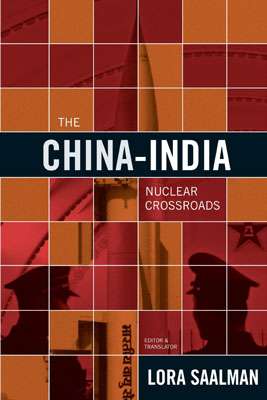
Leading Chinese and Indian experts examine the political, military, and technical factors that affect Sino-Indian nuclear relations, providing a comprehensive framework through which China and India can pursue enhanced cooperation.
Source: Washington

Despite these trends, The China-India Nuclear Crossroads is the first serious book by leading Chinese and Indian experts to examine the political, military, and technical factors that affect Sino-Indian nuclear relations. In this book, editor and translator Lora Saalman presents a comprehensive framework through which China and India can pursue enhanced cooperation and minimize the unintended consequences of their security dilemmas. | 中文
“The place to start for anyone interested in the atomic dimension of the China-India relationship and its profound impact on Asian security and the global nuclear order.”
—C. Raja Mohan, Member of India’s National Security Advisory Board and Distinguished Fellow at the Observer Research Foundation
“A first and crucial attempt to comprehensively compare Chinese and Indian nuclear perspectives.”
—Shen Dingli, Executive Dean of the Institute of International Studies and Director of the Center for American Studies at Fudan University
“Provides a better understanding of the security perceptions driving China and India’s nuclear strategies...a must read.”
—Shyam Saran, Senior Fellow at the Center for Policy Research and former counselor in the Embassy of India in Beijing, China
“Serves as a communication bridge between Chinese and Indian scholars.”
—Zheng Ruixiang, Senior Researcher at the China Institute of International Studies and China’s former consul general in Mumbai, India

Former Nonresident Associate, Nuclear Policy Program
Saalman was a nonresident associate in the Nuclear Policy Program at the Carnegie Endowment for International Peace. Her research focuses on China’s nuclear and strategic policies toward India, Russia, and arms control.
Recent Work
Lora Saalman
Lora Saalman
Carnegie does not take institutional positions on public policy issues; the views represented herein are those of the author(s) and do not necessarily reflect the views of Carnegie, its staff, or its trustees.
A leak of Russian gas price data helps establish that China is paying Russia far less than Central Asian countries and Gazprom’s former European customers.

Sergey Vakulenko

China’s political future will be shaped between now and next October. As the Communist Party enters its intense “campaign season” to prepare for a major political transition in 2027, reading Beijing's actions and responses may become more difficult as domestic politics weigh on its behavior more than usual.

Damien Ma

Japan’s long-term security policy is driven by concerns about China, and there is little appetite for (or interest in) pursuing a confrontation with Moscow.

James D.J. Brown

Russia is testing the waters of NATO’s mutual defense clause. What do strikes in Romanian territorial waters mean for the alliance’s posture toward Moscow?

Dimitar Bechev

China has showcased its engineering prowess with small modular reactor demonstration projects. But turning these technological achievements into commercial success will be a greater challenge.

Tong Zhao