Article
Muthiah Alagappa
{
  "authors": [
    "Muthiah Alagappa"
  ],
  "type": "legacyinthemedia",
  "centerAffiliationAll": "dc",
  "centers": [
    "Carnegie Endowment for International Peace"
  ],
  "collections": [],
  "englishNewsletterAll": "asia",
  "nonEnglishNewsletterAll": "",
  "primaryCenter": "Carnegie Endowment for International Peace",
  "programAffiliation": "AP",
  "programs": [
    "Asia"
  ],
  "projects": [],
  "regions": [
    "Southeast Asia",
    "Indonesia"
  ],
  "topics": [
    "Economy",
    "Trade",
    "Security"
  ]
}
Source: Getty
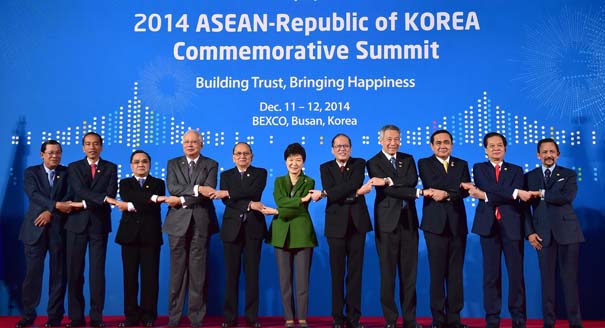
ASEAN should not force itself to become a single community by a certain date but instead focus its resources and attention on strengthening capacity and effectiveness in immediately relevant roles.
Source: Pacific Forum CSIS PacNet
With 2015 targeted as the year in which it becomes a single political-security and economic community, ASEAN has become the subject of numerous commentaries. In a recent S. Rajaratnam School of International Studies (RSIS) commentary and PacNet #17, for example, Barry Desker (senior Singapore diplomat and former dean of RSIS) asks if ASEAN integration is a growing reality or an aspiration that remains unfulfilled. Asserting that ASEAN integration remains an illusion, he bemoans the lack of path breaking measures to realize the goal of a single ASEAN community. Likewise Raman Letchumanan (a former ASEAN official), bemoaning “the lack of a clear coherent messaging,” asserts “ASEAN must make a concerted effort to convey in specific … terms what it has planned to achieve and how well it is doing.”
The goal of an ASEAN community advanced by certain scholars in academia and think tanks and subsequently embraced by the Association’s leaders and bureaucrats has become a millstone for the Association of Southeast Asian Nations. ASEAN’s success is now increasingly measured in terms of progress made or the lack of progress in realizing its self-declared objectives of becoming a single community by 2015 in the economic, political-security, and socio-cultural domains.
There is little doubt that despite pro-community public pronouncements by political leaders and bureaucrats at the regional and national levels, and papering over of shortfalls and important national differences on some key issues, ASEAN is unlikely to become a single community (in the real meaning of that term) any time soon. In my view, it is preferable for ASEAN integration and community building to remain ongoing long-term aspirations that may or may not be fulfilled in the decades to come. ASEAN should rid itself of straitjacketing objectives like becoming a single community by a certain date and focus its limited resources and attention on strengthening its capacity and effectiveness in immediately relevant roles.Community implies a body politic that shares a common history, culture, sense of belonging and identity, willingness to live together in harmony under a common political-legal framework, and belief in a shared destiny. A community usually has a central authority that can make binding decisions for all its peoples. Clearly ASEAN is far from this definition and it is unclear if it will ever become such a community. Some may argue that ASEAN envisions a more limited community. Based on the three-pillared ASEAN community chartered in ASEAN documents, ASEAN envisions integration and community building which in several cases seeks to go beyond the nation-state. The purpose or goal of the ASEAN Economic Community to be achieved by 2015, for example, is for “the AEC [to] transform ASEAN into a region with free movement of goods, services, investments, skilled labor and freer movement of capital.” Even if one were to accept the idea of a more limited community (whatever that means), the key point is that ASEAN appears unlikely to meet its self-declared objectives within the stipulated timeframe.
In formulating ASEAN community-building objectives, it appears that political leaders, officials, and regionally minded scholars have lost touch with reality arising from the fact that all ASEAN countries with the exception of Thailand became independent countries only in the post-World War II period. Most are still engaged in contested processes of making national communities and states. Nation-making is a long and unending conflict-prone process. Several ASEAN countries confront challenges from so-called minorities that demand redefinition of the nation, greater devolution of state power, or separate nation-states. Likewise state-making in many ASEAN countries faces challenges. Most states in Southeast Asia do not command monopoly over the legitimate use of violence within their territorial boundaries and authority is not centralized in the state. Further, political systems in many ASEAN countries are in the midst of contestation and change, at times through violent means. Suffering challenges and contestations at home and abroad, the priority for “national” leaders has continued to be making preferred national communities and states as well as preserving their own hold on political power. Regional integration and community building will not only be lower priority but may also not be feasible despite the ambitions of certain regionally minded political leaders, officials, and scholars.
Regional cooperation in Southeast Asia as elsewhere in the developing world has been governed by considerations relating to national community and state making. Rather than being regressive or demonstrating lack of political will, norms like noninterference in domestic affairs and decision-making by consensus are a necessity. They reflect the high priority attached by Southeast Asian leaders to nation-state making and protection of incumbent government. Accorded the highest priority, national community and state-making have been the primary drivers of domestic and international politics in Southeast Asia as in other developing regions. Ignoring or down playing this reality, as often done by regionalism enthusiasts, carries severe risks.
Persisting with regional ambitions that outstrip reality risks not only demonstrating that the emperor has no clothes but it may also subject ASEAN to ridicule. Instead of being admired as a successful example of regional cooperation in the developing world, it will be criticized for not meeting self-declared objectives.
It is time for ASEAN to focus on what it is and what it is good at, and rid itself of unrealistic ambitions. ASEAN is basically an intergovernmental organization that is good amongst others in strengthening the diplomatic voice of ASEAN countries, legitimizing the Southeast Asian political map, facilitating bilateral and multilateral cooperation among member states in certain areas, enhancing security of member countries, and constructing orders in the region. Even in these roles ASEAN suffers limitations. Hence the tendency to overplay the economic, security, and order constructing roles of ASEAN by overstating its achievements should be avoided. Coincidence is not causation. With due recognition of its possibilities and limits, political leaders and officials should take necessary measures to strengthen these roles of ASEAN and its intergovernmental nature. ASEAN does not have to become a single community to strengthen the Association as an intergovernmental organization or further develop these roles.
Biting off more than it can chew will be detrimental to the organization. This does not mean that ASEAN should not have long-range ambitions or constantly push the envelope. However, these must be calibrated to be realized when circumstances become appropriate. Setting unrealistic goals and deadlines will more likely hurt than help.
ASEAN should delicately sidestep the goals of integration and community building, designating them as long-term objectives to be realized under appropriate circumstances. It appears that some ASEAN leaders and officials have already come to realize that regional community-building is a long-term continuous process. However, official pronouncements of the Association, especially those of the chairs of ASEAN, persist with community-building objectives that have become mantras in their own right. It is easier for leaders and officials to persist with previously set community building objectives, produce grandiose summit declarations, and enumerate papered over achievements to celebrate their year of chairmanship. It is more difficult to admit shortcomings and go back to the drawing board to recalibrate objectives and timeframes. To improve its health and relevance, ASEAN must now begin to focus its attention and limited resources on what is immediately relevant and possible, and prevent unrealistic bench marking.
The foremost priority for ASEAN national leaders in the foreseeable future will be making strong nations and states at home to preserve their hold on power. Regional community building will be lower priority and likely to succeed only when it can contribute to or does not hinder realization of the primary national objectives of incumbent leaders. Regional aspirations and targets not grounded in that reality will meander and ultimately flounder.
This commentary originally appeared in the Pacific Forum CSIS PacNet newsletter.

Former Nonresident Senior Fellow, Asia Program
Alagappa, formerly a nonresident senior fellow in the Asia Program, was the first holder of the Tun Hussein Onn Chair in international studies at the Institute of Strategic and International Studies in Kuala Lumpur, Malaysia. His research focuses primarily on Asian security, the political legitimacy of governments, civil society and political change, and the political role of the military in Asia.
Recent Work
Muthiah Alagappa
Muthiah Alagappa
Carnegie does not take institutional positions on public policy issues; the views represented herein are those of the author(s) and do not necessarily reflect the views of Carnegie, its staff, or its trustees.

This piece argues that the present Indian strategy, based on opportunistic diversification and utilization of limited strategic reserves, remains inadequate when confronting supply disruptions. It evaluates India’s options in the short, medium, and long terms.

Vrinda Sahai

Its reinstatement should be celebrated, but it retains some major shortcomings.

Leonardo Martinez-Diaz

Despite long-standing differences, China and Vietnam are reinforcing common ground for collaboration, especially in public security. This internal security–centered diplomacy offers a strengthened road map for how China moves forward with Southeast Asia.
Sophie Zhuang

As the war between the United States, Israel, and Iran continues, Carnegie scholars contribute cutting-edge analysis on the events of the war and their wide-reaching implications. From the impact on Iran and its immediate neighbors to the responses from Gulf states to fuel and fertilizer shortages caused by the effective shutdown of the Strait of Hormuz, the war is reshaping Middle East alliances and creating shockwaves around the world. Carnegie experts analyze it all.
Donald Trump has repeatedly bashed NATO and European allies, threatening to annex Canada and Greenland and deploring their lack of enthusiasm for his war of choice in Iran. Is this latest round of abuse the final straw?

Rym Momtaz, ed.