

Paper
Ashley J. Tellis
{
  "authors": [
    "Ashley J. Tellis"
  ],
  "type": "legacyinthemedia",
  "centerAffiliationAll": "dc",
  "centers": [
    "Carnegie Endowment for International Peace"
  ],
  "collections": [],
  "englishNewsletterAll": "ctw",
  "nonEnglishNewsletterAll": "",
  "primaryCenter": "Carnegie Endowment for International Peace",
  "programAffiliation": "SAP",
  "programs": [
    "South Asia"
  ],
  "projects": [],
  "regions": [
    "South Asia",
    "India"
  ],
  "topics": [
    "Foreign Policy"
  ]
}
Source: Getty
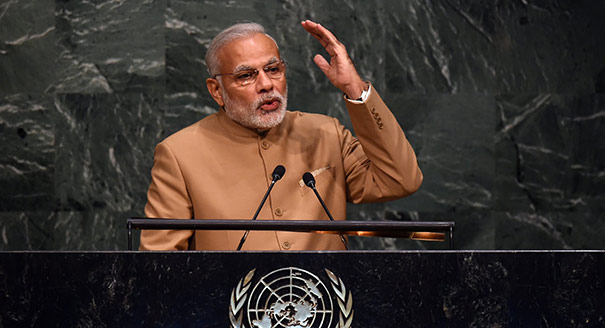
Modi’s engagements abroad are anchored in the astute recognition that India’s domestic success is inextricably linked to how it can shape its external environment to national advantage.
Source: Hindustan Times
Exactly two years ago, Prime Minister Narendra Modi surprised both Indian and foreign observers by inviting the South Asian heads of government to his swearing-in. For a leader who had barely uttered a word about foreign policy during his election campaign, this dramatic and welcome gesture presaged the first of many foreign policy surprises that Modi would unveil.
His emphasis on strengthening ties with India’s immediate neighbours, his redoubled investment in protecting Indian interests in the larger Indian Ocean region, his remarkable outreach to the United States despite past personal irritants, his intensification of the emerging partnership with Japan, his success in preserving balanced ties with both China and Russia, and his nurturing of important partners in Western Europe, Central and Southeast Asia, and in the Persian Gulf (where he demonstrated a geopolitical adroitness unusual in Indian foreign policy) have all been complemented by an unanticipated investment in building personal ties with Pakistan’s Prime Minister Nawaz Sharif and in energising a diaspora that stretches from Canada to Fiji.
Because these efforts have involved much globetrotting, they have often become objects of controversy within India. His critics have charged that his peripateticism betrays an addiction to the glamour of world travel to the neglect of his domestic responsibilities. Such criticism, however, is churlish: Modi’s engagements abroad are in fact anchored in the astute recognition that India’s domestic success is inextricably linked to how it can shape its external environment to national advantage. All Indian leaders since Jawaharlal Nehru have understood this fully, though their ability to play a winning hand was often hampered by political and economic weaknesses at home.Thankfully today, Modi is less constrained on both these counts: He enjoys a lofty standing within the country, while the economy steadily recovers despite an unfavourable international environment. For all these assets, however, Modi recognises that, in an era of deepening globalisation, what happens abroad impacts India’s strategic and developmental goals. His efforts at shaping international developments long before they actually affect India are thus completely warranted.
It is not surprising, therefore, that of the 40-odd trips Modi has undertaken since June 2014, the vast majority have arguably been focused on moulding the global environment to India’s benefit. Whether this has involved shoring up ties with key neighbours such as Afghanistan, Bhutan or Bangladesh, or reaching out to states historically neglected by India, such as Mongolia, or strengthening links with nations that are critical for Indian economic success, such as Germany, or renewing ties with those Asian countries important for India’s strategic interests, such as Australia, Japan or Singapore, and the “-stans,” or further transforming relations with the United States, Modi has invested time and attention not merely in building personal ties with their leaders but also in persuading them to engage with India in ways that redound to its gain.
Beyond these geostrategic aims, Modi has focused at least a third of his foreign travels on advancing Indian economic aims. For the most part, these have concentrated on attracting foreign investment to India. By addressing complaints about the ease of doing business and by removing obstacles to investments, Modi has attempted to woo investors in countries as disparate as China, Japan, the United Arab Emirates, the United Kingdom, Ireland, Canada, and the US — not to mention the myriad middle powers in continental Europe.
Pursuing closer foreign economic relations is no longer optional for New Delhi, as Modi fully realises: India simply does not save enough domestically to generate high single-digit growth rates consistently over a long horizon. This constraint, which affects everything from employment to investment, can be mitigated by external investment.
Finally, Modi has attempted to use a small but growing proportion of his time abroad to highlight India’s desire to contribute to the production of global public goods as well as to spotlight the contributions of peoples of Indian origin. Benefiting from India’s new ascendency as one of the world’s fastest growing major economies and consistent with his own vision of India as a “leading power”, Modi has sought to burnish India’s reputation as a good international citizen by increasing its contributions to everything from mitigating climate change to supporting nation- and State-building activities (especially in its neighbourhood) to promoting nuclear security to enhancing peace and stability in the Indian Ocean.
While these benefactions remain modest relative to India’s potential, Modi’s emphasis on them as a means of realising the Upanishadic ideal of Vasudhaiva Kutumbakam (the entire world is one family) bodes well for their persistence, as both idealism and realism promise to take India in the same direction. The fact that individuals of Indian origin have widely succeeded in their adopted countries further incarnates this promise.
Viewed at the two-year mark of his term in office, Modi’s foreign policy achievements have been outstanding. Some of his initiatives have admittedly fallen short, the attempted rapprochement with Pakistan being a conspicuous example. But even this exception does not besmirch the larger record. More than anything else, it signals India’s return to a sensible activism in fashioning the world about it and, just as importantly, is driven boldly by the imperative of securing India’s interests first.
This article was originally published in the Hindustan Times.
Former Senior Fellow
Ashley J. Tellis was a senior fellow at the Carnegie Endowment for International Peace.
Recent Work
Ashley J. Tellis
Ashley J. Tellis
Carnegie does not take institutional positions on public policy issues; the views represented herein are those of the author(s) and do not necessarily reflect the views of Carnegie, its staff, or its trustees.

The real test may come after the leaders leave the room.



Sheena Chestnut Greitens, Oriana Skylar Mastro, Yukon Huang, …

The Horn of Africa countries are among those facing a new security calculus.


Andrew Leber, Lesley Anne Warner

The new U.S.–Denmark–Greenland agreement will help Washington exert political, economic, and financial dominance under the guise of security. Yet, it acknowledged Copenhagen’s and Nuuk’s sovereignty on the island.

Marc Pierini
Washington needs to recognize that influence in the Western Hemisphere comes from presence, delivery, and reliability. It also must recognize that while the United States remains the key external actor, it no longer operates in a permissive environment and cannot presume deference from regional players who have other options, namely China.
Juan S. Gonzalez

Minsk clearly expected the dialogue with Washington to yield more results, in particular the lifting of EU sanctions and permission to export potash.

Artyom Shraibman