

Research
- +4
Milan Vaishnav, Rahul Verma, Rukmini S., …
{
  "authors": [
    "Christophe Jaffrelot"
  ],
  "type": "legacyinthemedia",
  "centerAffiliationAll": "dc",
  "centers": [
    "Carnegie Endowment for International Peace"
  ],
  "collections": [],
  "englishNewsletterAll": "ctw",
  "nonEnglishNewsletterAll": "",
  "primaryCenter": "Carnegie Endowment for International Peace",
  "programAffiliation": "SAP",
  "programs": [
    "South Asia"
  ],
  "projects": [],
  "regions": [
    "South Asia",
    "India"
  ],
  "topics": [
    "Political Reform"
  ]
}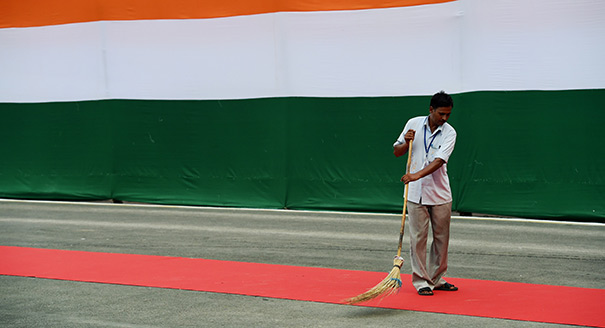
Source: Getty
The party’s aversion to Nehru draws from its notion of India and Indian citizenship.
Source: Indian Express
In early May, The Indian Express reported that references to Jawaharlal Nehru have been deleted from the new social science textbook for Class VIII. There was no longer any mention of who India’s first prime minister was.
The rewriting of history textbooks is an old priority of the Hindu nationalist movement. In the 1970s, former Jana Sangh members in the Janata Party and the Morarji Desai government had asked for changes in text books. In May 1977, Desai was presented a memorandum that sought the withdrawal of four history books — of which three were intended for use in teaching — from public circulation. The books in question were Medieval India by Romila Thapar, Modern India by Bipan Chandra, Freedom Struggle by A. Tripathi, Barun De and Bipan Chandra, and Communalism and the Writing of Indian History by Romila Thapar, Harbans Mukhia and Bipan Chandra. The memorandum criticised these works above all for not condemning forcefully enough certain Muslim rulers — including Aurangzeb — and emphasising that freedom struggle leaders such as Bala Gangadhar Tilak and Aurobindo were partly responsible for the antagonism between Hindus and Muslims. The RSS campaigned separately for the withdrawal of these textbooks (Organiser, July 23, 1978). The attempt failed because sections within the Janata Party opposed the demands in the memorandum.However, the BJP succeeded in changing parts of textbooks in the state they formed a government in the 1990s. After BJP leader Keshubhai Patel took over as chief minister in 1995, the Gujarat State Board of School Textbooks published a Class IX social studies textbook in which Muslims, Christians and Parsis were presented as “foreigners”. It was also written that “in most of the states, the Hindus are a minority and the Muslims, Christians and Sikhs are in a majority”. A Class VIII social studies textbook also included a highly derogatory description of Christian priests: “The accumulation of power and wealth in the hands of the priests resulted in a perversion of the religion. Some of the priests became pleasure-loving and badly behaved.”
In the early 2000s, another social science textbook for Class X described Adolf Hitler in the following terms: “Hitler lent dignity and prestige to the German government within a short time by establishing a strong administrative set up. He created the vast state of Greater Germany. He adopted the policy of opposition towards the Jewish people and advocated the supremacy of the German race. He adopted a new economic policy and brought prosperity to Germany. He began efforts for the eradication of unemployment. He started constructing public buildings, providing irrigation facilities, building railways, roads and production of war materials. He made untiring efforts to make Germany self-reliant within one decade. Hitler discarded the Treaty of Versailles by calling it just ‘a piece of paper’ and stopped paying the war penalty. He instilled the spirit of adventure in the common people, but in doing so it led to extreme nationalism and caused the Second World War.” Sylvie Guichard in The Construction of History and Nationalism in India points out that the textbook was withdrawn after the general consul of Israel visited Gujarat in October 2005.
However, most of the states where textbooks were rewritten have concentrated on Indian history. There is a clear distinction between “bad” and “good” Muslims in these textbooks. Aurangzeb, who re-imposed the jiziya over non-Muslims belonged to the first category, whereas Akbar, who had abolished the jiziya and who was known for his syncretic religion, Din-i-Ilahi, belonged to the latter. But even this view of history is changing.
Following the renaming of Aurangzeb Road after A.P.J. Abdul Kalam in 2015, Minister of State for External Affairs V. K. Singh recently suggested that another street of New Delhi should be renamed Maharana Pratap Singh Road, after the Sisodia ruler of Mewar, who was defeated by Akbar’s forces in 1576 at the Battle of Haldighati. This idea has been supported by BJP chief minister of Haryana, Rajya Sabha member Subramanian Swamy and the BJP’s national spokesperson, Shaina Chudasama. Chudasama tweeted: #Akbar Road should be renamed to Maharana#Pratap Marg. Imagine #Hitler Road in #Israel! No country honours its oppressors like we do!!.
What is at stake in history is an idea of the nation and a definition of citizenship. Earlier this month, Rajasthan’s school education minister, Vasudev Devnani, explained that the government was re-designing textbooks to ensure that “no Kanhaiya Kumar was born in the state”. He also said that he wanted the curriculum to have a three-pronged effect: Teach the child about the “veer” and “veerangana” of Rajasthan; make the child proud of Indian culture; and, create an ideal citizen and a patriot. For these reasons, the youth of Rajasthan may not be told how Nehru built — and then let develop — the main institutions of the “world’s largest democracy”, ranging from the Supreme Court to the Election Commission. He may not even know that Nehru’s cabinet included some of the most virulent critiques of the Congress, including Babasaheb Ambedkar and Syama Prasad Mookerjee, the founder of the Jana Sangh. These men had been made Union ministers in order to represent different streams of the nation in the government. This decision, inspired by Mahatma Gandhi, was an exercise in nation-building — the nation as it was conceived then.
Former Nonresident Scholar, South Asia Program
Jaffrelot’s core research focuses on theories of nationalism and democracy, mobilization of the lower castes and Dalits (ex-untouchables) in India, the Hindu nationalist movement, and ethnic conflicts in Pakistan.
Recent Work

Milan Vaishnav, Rahul Verma, Rukmini S., …
Christophe Jaffrelot
Carnegie does not take institutional positions on public policy issues; the views represented herein are those of the author(s) and do not necessarily reflect the views of Carnegie, its staff, or its trustees.

Despite public disputes over trade and immigration, the strategic partnership’s foundations remain sturdy.

Sameer Lalwani

Putin’s conservative staffing policies and search for ever greater control have cemented parliament’s transformation into a bureaucratic appendage of the executive branch.

Andrey Pertsev

Ex-president Gurbanguly Berdimuhamedov remains interested in politics, but his son Serdar, Turkmenistan’s current president, is becoming increasingly independent and willing to break with his father’s legacy. If their covert rivalry goes too far, both risk losing power.

Galiya Ibragimova

A notable degree of participative democracy has firmly arrived in Europe. But to have more far-reaching impact, democratic deliberation needs to move into a radically new phase.

Richard Youngs
Economic recovery has brought Sri Lanka a modicum of stability, but domestic strains and great-power rivalry could test how long it lasts.
Avinash Paliwal