

Paper
Ashley J. Tellis
{
  "authors": [
    "Ashley J. Tellis"
  ],
  "type": "legacyinthemedia",
  "centerAffiliationAll": "dc",
  "centers": [
    "Carnegie Endowment for International Peace",
    "Carnegie India"
  ],
  "collections": [],
  "englishNewsletterAll": "ctw",
  "nonEnglishNewsletterAll": "",
  "primaryCenter": "Carnegie Endowment for International Peace",
  "programAffiliation": "SAP",
  "programs": [
    "South Asia"
  ],
  "projects": [],
  "regions": [
    "North America",
    "United States",
    "South Asia",
    "India"
  ],
  "topics": [
    "Foreign Policy"
  ]
}
Source: Getty
Despite the current uncertainty surrounding bilateral ties, India ought to approach the United States with confidence, assured that the evolving competition in Asia makes a strong partnership between Washington and New Delhi destined for success.
Source: Economic Times
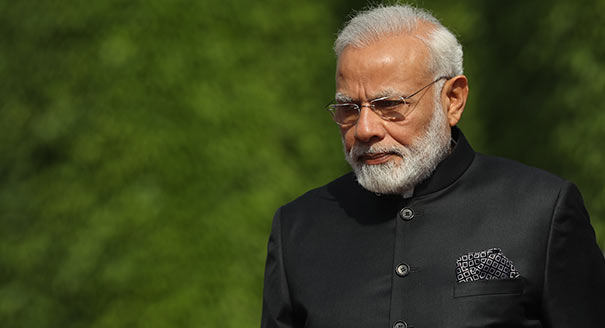
Prime Minister Narendra Modi’s meeting with President Donald Trump today will perhaps be his most important encounter with an American leader in recent years. This meeting matters greatly because unlike Trump’s recent predecessors, who valued the strategic partnership with New Delhi both for its own sake and because of its importance for larger American geopolitical interests, Trump’s commitment to preserving the US-led order in Asia and the unique American affiliation with India are both uncertain.
Modi, following in the footsteps of his predecessors, Atal Bihari Vajpayee and Manmohan Singh, doubled down on deepening ties with the United States. Casting aside decades of animus and uncertainty, he boldly announced to the US Congress in June 2016 that the bilateral relationship had indeed “overcome the hesitations of history.” It was a bet that made sense at the time because the US was both the world’s strongest power and determined to protect the international order it had built in its own image. That was then.
This is now. The US is still the world’s strongest nation. But under Trump it seems to be hesitant about whether protecting the global balance of power that favours freedom is worth the cost. As a consequence, its partnership with India, which was intended to be a lynchpin of that effort, is now buffeted by uncertainty.
In these circumstances, Modi must have one overriding objective in his meeting with Trump: to convince the president through his commitments, utterances, and personal touch that India still remains a fabulous opportunity for the US — and not the problem that Trump claimed it was during his election campaign.
Whether Trump views India as critical for parochial ‘America First’ interests or because of India’s significance in the international order is less important. What is imperative is that the Modi-Trump meeting ends with the president convinced that India is the worth the time, attention, and investment of his administration.
By all accounts, Trump appears to grasp India’s relevance — that he will accord to Modi a reception he has extended to just a few other foreign leaders exemplifies the point. But he needs to perceive India’s value palpably, as his predecessors had, if the relationship is to bear its fullest fruit. On this count, the prime minister has his work cut out for him.
Modi can inspire this realisation by seeking to build the closest personal relationship possible with Trump. Strong private ties are obviously not a substitute for robust official engagement with India, but they can advance the prospects of the latter at a time when Trump’s view of New Delhi has not yet solidified.
This will require that Modi not give up on the US just yet. Forsaking India’s investment in the US simply because of fears that Trump might approach India as cavalierly as he has done some others would produce a vicious cycle that is neither in Delhi’s nor Washington’s interest.
Trump might, in fact, surprise Modi by putting on the table more than might be expected of him. By offering to India advanced technologies in defence and energy that it has long sought, he will convey his administration’s interest in India, even if this is not anchored in a larger vision of the international order or global geopolitics. There are a few senior officials on his team who understand these issues. And there are others who view Modi favourably as the precursor of the global revolution against elitist politics that Trump exploited to win his election.
Modi does not know these ‘influentials’ directly, but they could advance his aim of getting the president to commit to deepening the US-India relationship. Hopefully, Modi will bring something of interest to the table himself.
But even if he does not, he needs to leave Trump in no doubt that India values the US as its most important global partner; that India supports the objective of increasing American prosperity and will demonstrate the same over time; and that India remains willing, in cooperation with Washington, to bear the burden of contributing more towards regional security to enhance the safety of both countries. Even as Modi reiterates these themes, he must reach out to other audiences such as the US Congress and the business and policy worlds to drive the message home.
Despite the uncertainty that currently surrounds bilateral ties, India ought to approach the US with confidence, not diffidence, assured that the evolving competition in Asia makes a strong partnership between Washington and New Delhi inevitably destined for success. Even if American leaders do not always perceive this clearly or consistently, India ought to be patient because strategic realities have an uncomfortable habit of intruding.
In betting on the US thus far, Prime Minister Modi, like his predecessors, has made a wise investment. Now he needs only to protect it by showing Trump how India can be a strategic success for him, or in words the property mogul-turned-president might better understand, the ‘real deal’.
This article was originally published in the Economic Times.
Former Senior Fellow
Ashley J. Tellis was a senior fellow at the Carnegie Endowment for International Peace.
Recent Work
Ashley J. Tellis
Ashley J. Tellis
Carnegie does not take institutional positions on public policy issues; the views represented herein are those of the author(s) and do not necessarily reflect the views of Carnegie, its staff, or its trustees.

Despite public disputes over trade and immigration, the strategic partnership’s foundations remain sturdy.

Sameer Lalwani
It signals a new era of tech diffusion and warfare.

Steve Feldstein

With its public finances in shambles, the far right polling at 35 percent ahead of the 2027 presidential election, and a growing protest movement, is France’s crisis a threat to the EU’s geopolitical awakening?

Rym Momtaz, ed.

Ahead of a tough winter for Ukraine, Donald Trump’s swing back toward Russia bodes ill. But instead of panicking, Kyiv’s European allies are focusing on action.
Rym Momtaz

Without a ceasefire with Ukraine on attacking each other’s energy infrastructure—to which the Kremlin is unlikely to agree—the diesel agreement between Putin and Trump is largely for show, rather than representing a genuine increase in the volumes of Russian diesel on the global market.

Sergey Vakulenko