

Commentary
H. A. Hellyer
{
  "authors": [
    "H. A. Hellyer"
  ],
  "type": "legacyinthemedia",
  "centerAffiliationAll": "dc",
  "centers": [
    "Carnegie Endowment for International Peace",
    "Malcolm H. Kerr Carnegie Middle East Center"
  ],
  "collections": [],
  "englishNewsletterAll": "menaTransitions",
  "nonEnglishNewsletterAll": "",
  "primaryCenter": "Carnegie Endowment for International Peace",
  "programAffiliation": "MEP",
  "programs": [
    "Middle East"
  ],
  "projects": [],
  "regions": [
    "North Africa",
    "Egypt"
  ],
  "topics": [
    "Political Reform",
    "Democracy"
  ]
}
Source: Getty
The international community has hitherto broadly considered the government in Cairo to be stable for the long term. These protests, however, confirm that there is dissent beneath the surface that is likely to deepen, not dissipate.
Source: Center for Global Policy
Last week, sporadic protests broke out in different parts of Egypt following the release of videos that provided evidence of government corruption. More questions than answers exist in trying to understand the demonstrations, which makes the future somewhat difficult to predict with any degree of certainty. Nevertheless, some things are evident.
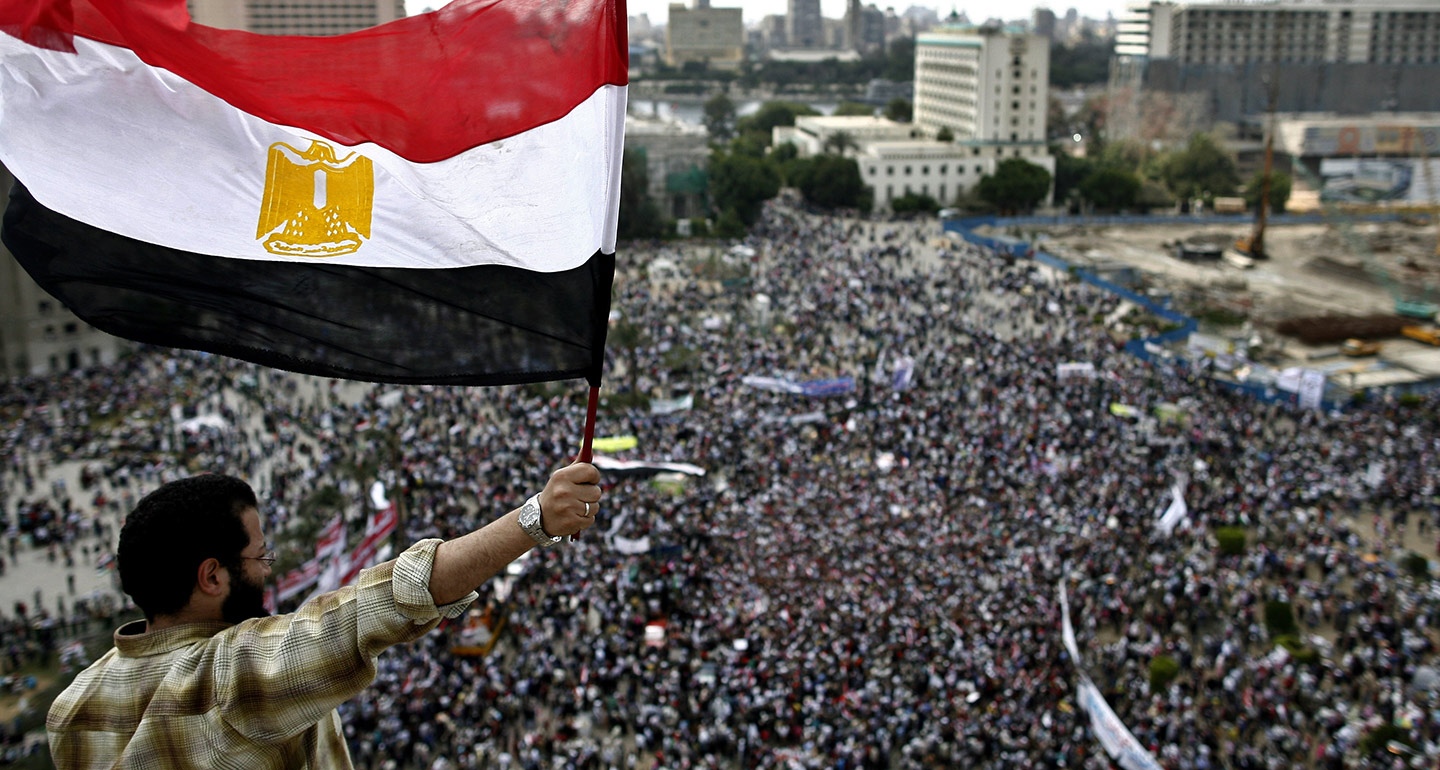
Before analyzing the actual protests, it is important to note the underlying grievances in the country, where more than eight years ago mass protests led to the ouster of then-President Hosni Mubarak. The January 25 uprising created an opening of political space, as well as upheaval, until opponents of the Muslim Brotherhood demonstrated against then-President Mohammed Morsi. The minister of defense at the time, Abdel Fattah al-Sisi, forcibly removed Morsi and became president himself the following year. The authorities ensured a far more closed political space by cracking down heavily on dissent and instituted a variety of austerity measures that have led to economic hardship for many Egyptians. While Egypt’s macroeconomic indicators have been promising, Bloomberg reports the poverty rate climbed to 32% in 2018 from 28% in 2015, and real incomes, adjusted for inflation, fell compared to 2015 levels.
Whistle-blower Mohammed Ali, who claims he owned a construction company that engaged heavily with the Egyptian military, released videos showing evidence of corruption. He alleged that billions of dollars were spent on the president’s family or his backers. Few expected that Ali’s call to protest, made in self-imposed exile in Spain, would be given much attention. But on Friday and Saturday, significant numbers of demonstrators gathered in groups — some numbering in the hundreds, some in the thousands — in the streets. Goldman Sachs Group Inc. on Monday said the protests “serve as a reminder of the potential risks to social stability emanating from the decline in living standards among a large proportion of Egyptians in recent years, combined with widely reported allegations of corruption in the ruling political and military elite.
Many analysts are speculating that the demonstrations are being coordinated somehow, but to date there is no evidence of that. The Muslim Brotherhood has been fragmented to unprecedented levels, and it is dubious the organization is responsible for the protests, particularly since some within the group are seeking reconciliation with the authorities following the extraordinary crackdown. If there is a central organizing structure behind the protests, there is little to no indication of who or what that might be.
Human rights organizations reported that hundreds of people have been arrested in the aftermath of the protest, with a disproportionate number being between the ages of 18 and 25. Most Egyptians are under the age of 35, and if the profile is to be relied on, many of these protesters would have been too young to participate in the mass protests of 2011. It is doubtful that they find Ali, who worked with the authorities until recently, a leader – rather, his videos confirmed their suspicions about financial corruption in a country facing economic hardship for the majority of its citizens. They would have been spurred into action by those blatant revelations, rather than following Ali’s lead.
However, the question remains as to why protests materialized at this particular moment. Reports from Cairo indicate the usual protest sites, such as the highly symbolic Tahrir Square, were not heavily manned by the police as they were when other actors called for protests recently. It is unclear as to why this was the case, and why the protests continued, unchallenged, for a short time before the police eventually broke them up. Theories abound, but with little evidence, and even less certainty.
Whether further protests are likely depends heavily on whether or not the security apparatuses reinforce the appearance that Egypt is under heavy security and that any protests will be broken up forcefully and swiftly. The mass arrests would indicate that authorities intend to promote that message robustly. It remains to be seen if protesters will challenge that narrative.
Al-Sisi has made it clear he does not feel threatened by the protests; he left the country for a scheduled trip to the United States for the U.N. General Assembly and meetings with the likes of U.S. President Donald Trump, German Chancellor Angela Merkel, and British Prime Minister Boris Johnson. Trump, predictably, offered al-Sisi his complete support in a press conference.
Are there internal fissures within the state, against al-Sisi, that led to a relatively more permissive security atmosphere, if only temporarily? That also remains ambiguous. Al-Sisi does not seem to think so, as he probably would have remained in Cairo if he did. There have been rumors of dissent within the establishment for some time, particularly as former senior figures such as Ahmad Shafiq and Sami Anan, both drawn from the ranks of the armed forces, planned to run against al-Sisi for the presidency in the last presidential election. Anan was arrested, and Shafiq rescinded his decision.
Where things progress from here is unclear. The demographics of the Egyptian population indicate that substantial microeconomic improvements for the vast majority of the population – not simply macroeconomic indicators – are needed to assuage economically motivated dissent. Without a more open political environment, it is plausible that dissent rooted in both politics and economics will manifest in different ways, such as protests.
The international community has hitherto broadly considered the government in Cairo to be stable for the long term. These protests, however, confirm that there is dissent beneath the surface that is likely to deepen, not dissipate. It is thus advisable for all friends of Egypt to advocate for deep reform of the Egyptian state as a necessity to build comprehensive human security for the long term. International allies, including the United States, ought to encourage Cairo to engage in genuine structural reforms, while respecting fundamental freedoms. That is all in accordance not only with Egyptian law, but with various international conventions that the Egyptian state has signed over many years. To do otherwise is to invite further vulnerability, not less.
This is article was originally published by the Center for Global Policy.

Former Nonresident Scholar, Middle East Program
Dr. H.A. Hellyer was a nonresident scholar at the Carnegie Endowment for International Peace. He serves as a senior associate fellow at the Royal United Services Institute for Defence and Security Studies in London, and as a Cambridge University fellow.
Recent Work
H. A. Hellyer
H. A. Hellyer
Carnegie does not take institutional positions on public policy issues; the views represented herein are those of the author(s) and do not necessarily reflect the views of Carnegie, its staff, or its trustees.

China’s political future will be shaped between now and next October. As the Communist Party enters its intense “campaign season” to prepare for a major political transition in 2027, reading Beijing's actions and responses may become more difficult as domestic politics weigh on its behavior more than usual.

Damien Ma

Putin’s conservative staffing policies and search for ever greater control have cemented parliament’s transformation into a bureaucratic appendage of the executive branch.

Andrey Pertsev

Ex-president Gurbanguly Berdimuhamedov remains interested in politics, but his son Serdar, Turkmenistan’s current president, is becoming increasingly independent and willing to break with his father’s legacy. If their covert rivalry goes too far, both risk losing power.

Galiya Ibragimova

A notable degree of participative democracy has firmly arrived in Europe. But to have more far-reaching impact, democratic deliberation needs to move into a radically new phase.

Richard Youngs
Today’s global democratic recession is partly rooted in a common perception that democracies have a delivery problem, with many citizens in both autocracies and democracies alike now believing that strongmen can achieve better governance outcomes. But a study of four countries in Africa reveals that democratic-leaning governments have demonstrated better governance performance than autocratic governments.


Sarah Yerkes, Natalie Triche, Amr Hamzawy