

Commentary
Russian strikes are weakening the economy sustaining Ukraine’s war effort. Closing the growing funding gap will require more European support and politically contentious reforms in Kyiv.
Balázs Jarábik
{
  "authors": [
    "Temur Umarov",
    "Nargis Kassenova"
  ],
  "type": "commentary",
  "centerAffiliationAll": "",
  "centers": [
    "Carnegie Endowment for International Peace",
    "Carnegie China"
  ],
  "collections": [
    "Carnegie China Commentaries"
  ],
  "englishNewsletterAll": "",
  "nonEnglishNewsletterAll": "",
  "primaryCenter": "Carnegie Endowment for International Peace",
  "programAffiliation": "",
  "programs": [],
  "projects": [],
  "regions": [
    "East Asia",
    "China",
    "Central Asia",
    "Russia"
  ],
  "topics": []
}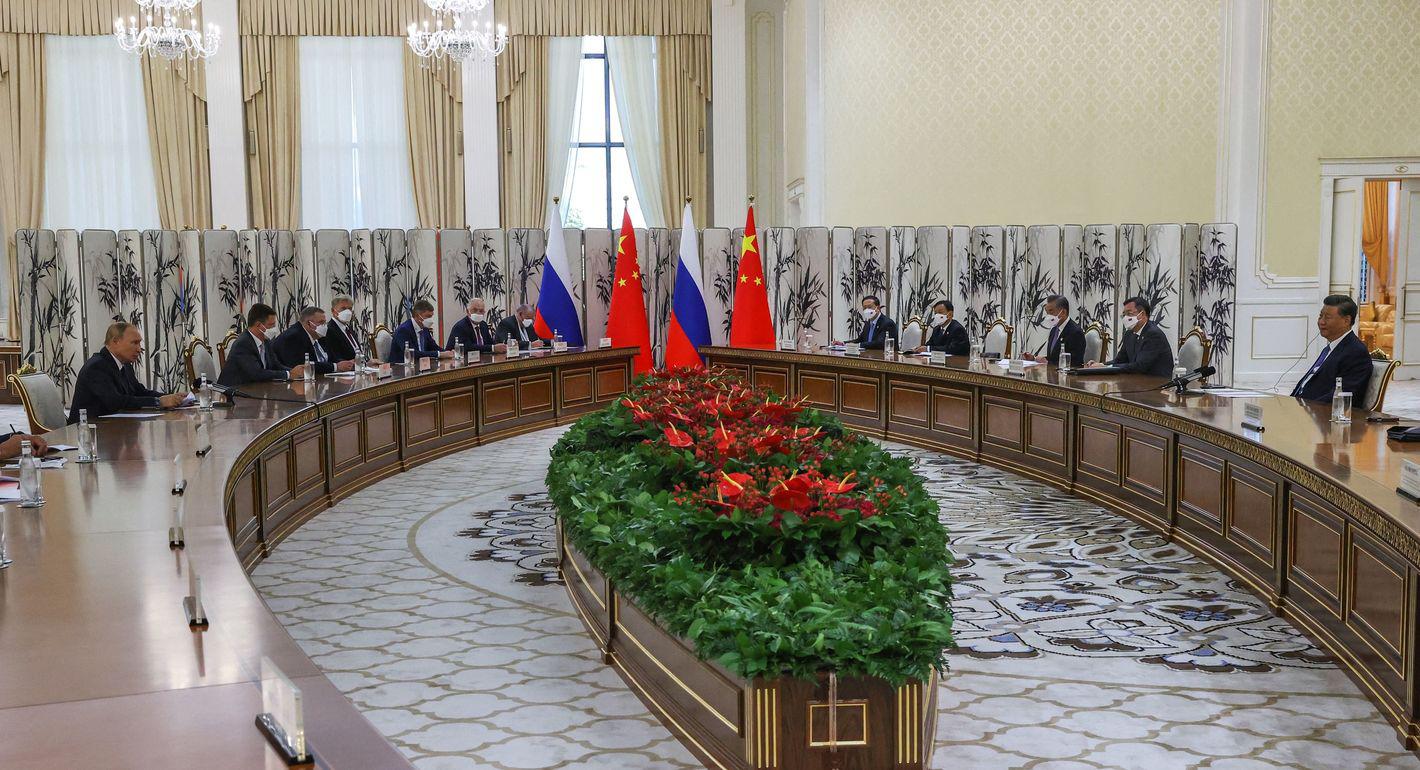
Source: Getty
Russia has its Eurasian Economic Union, and China has its Belt and Road Initiative. For both projects, Central Asia is important.
This Q&A was adapted from a Carnegie China live event assessing China–Central Asian relations. It has been edited for clarity.
Temur Umarov: It has become clearer in the past two years that Russia is a priority for China. But many experts say that Central Asia may be a weak point in the partnership between Beijing and Moscow. One day, the thinking goes, there could be some kind of conflict, because both Russia and China have overlapping interests in the region. Do you agree with this perception, or do you think that the level of regional cooperation between China and Russia is underestimated? Nargis Kassenova: The reality is more subtle and murky than either competition and rivalry or cooperation. It is a mix of the two. China and Russia cooperate where their interests overlap or partially overlap, and they compete where they don’t overlap. In terms of overlapping interests, at least up until now, both countries were interested in stability in the region. Both were interested in the development of the Shanghai Cooperation Organization as an international, multilateral organization that is an alternative to the Western-led order.On the other hand, their interests didn’t quite overlap in the areas of economic development and trade. Russia has its Eurasian Economic Union, and China has its Belt and Road Initiative. For both projects, Central Asia is important.
In the aftermath of the 2014 annexation of Crimea and the sanctions imposed by the West, Russia expressed interest in linking its project with China’s, but not much happened on the ground. So now, with the change in the balance of power, as China is becoming stronger and Russia is losing its position, we will see whether China becomes more assertive in the region. But Chinese policymakers are quite patient. They know that time is on their side and the region is gravitating more and more toward China for various reasons.
Of course, China is an attractive partner. It has a dynamic economy. While China may have difficulties now, the Chinese economy is still incredibly important for Central Asian economies. And politically, the more Central Asia fears Russia, the more it could cling to China. For China, Central Asia is an important neighborhood. China is interested in the territorial integrity and sovereignty of Central Asian states.
If we compare the two joint statement made by [Russian President Vladimir] Putin and [Chinese President] Xi [Jinping] in March last year, with the declaration made by Xi and Central Asian presidents in Xi’an in May, we see two very different documents. The China-Russia document is very short and comprised primarily of Beijing’s priorities. If you look at the Xi’an declaration, it is much more comprehensive. Compared to China’s offerings to Russia, Beijing is giving a lot more to its Central Asian neighbors.
This may have something to do with the hierarchies. For China, Central Asian states are small states on its periphery. China positions itself as a big, benevolent power vis-à-vis Central Asians. But Russia is on par with China. And you don’t need to be benevolent to someone in your weight category, so it is a tougher relationship.

Fellow, Carnegie Russia Eurasia Center
Temur Umarov is an expert on China and Central Asia, and a fellow at the Carnegie Russia Eurasia Center.

Senior fellow, Harvard Davis Center for Russian and Eurasian Studies
Nargis Kassenova is a senior fellow and director of the Program on Central Asia at Harvard University's Davis Center.
Carnegie does not take institutional positions on public policy issues; the views represented herein are those of the author(s) and do not necessarily reflect the views of Carnegie, its staff, or its trustees.

Russian strikes are weakening the economy sustaining Ukraine’s war effort. Closing the growing funding gap will require more European support and politically contentious reforms in Kyiv.

Balázs Jarábik

While the EU and European governments are embracing the much-lauded middle-power moment, this entails three difficult conundrums.

Richard Youngs

Ex-president Gurbanguly Berdimuhamedov remains interested in politics, but his son Serdar, Turkmenistan’s current president, is becoming increasingly independent and willing to break with his father’s legacy. If their covert rivalry goes too far, both risk losing power.

Galiya Ibragimova

Europe is facing rising populism internally as well as external pressures from Russia, China, Turkey, and the United States.

Dimitar Bechev

Despite a new textbook, an influx of Russian teachers and managers, and an end to the teaching of Ukrainian, the Kremlin is unlikely to have “reprogrammed” locals.

Konstantin Skorkin