

Q&A
Eugene Rumer
{
  "authors": [
    "Eugene Rumer"
  ],
  "type": "commentary",
  "blog": "Emissary",
  "centerAffiliationAll": "dc",
  "centers": [
    "Carnegie Endowment for International Peace"
  ],
  "collections": [],
  "englishNewsletterAll": "ctw",
  "nonEnglishNewsletterAll": "",
  "primaryCenter": "Carnegie Endowment for International Peace",
  "programAffiliation": "russia",
  "programs": [
    "Russia and Eurasia"
  ],
  "projects": [
    "Ukraine Initiative"
  ],
  "regions": [
    "North America",
    "United States",
    "Russia",
    "Eastern Europe",
    "Ukraine"
  ],
  "topics": [
    "Security"
  ]
}
Source: Getty
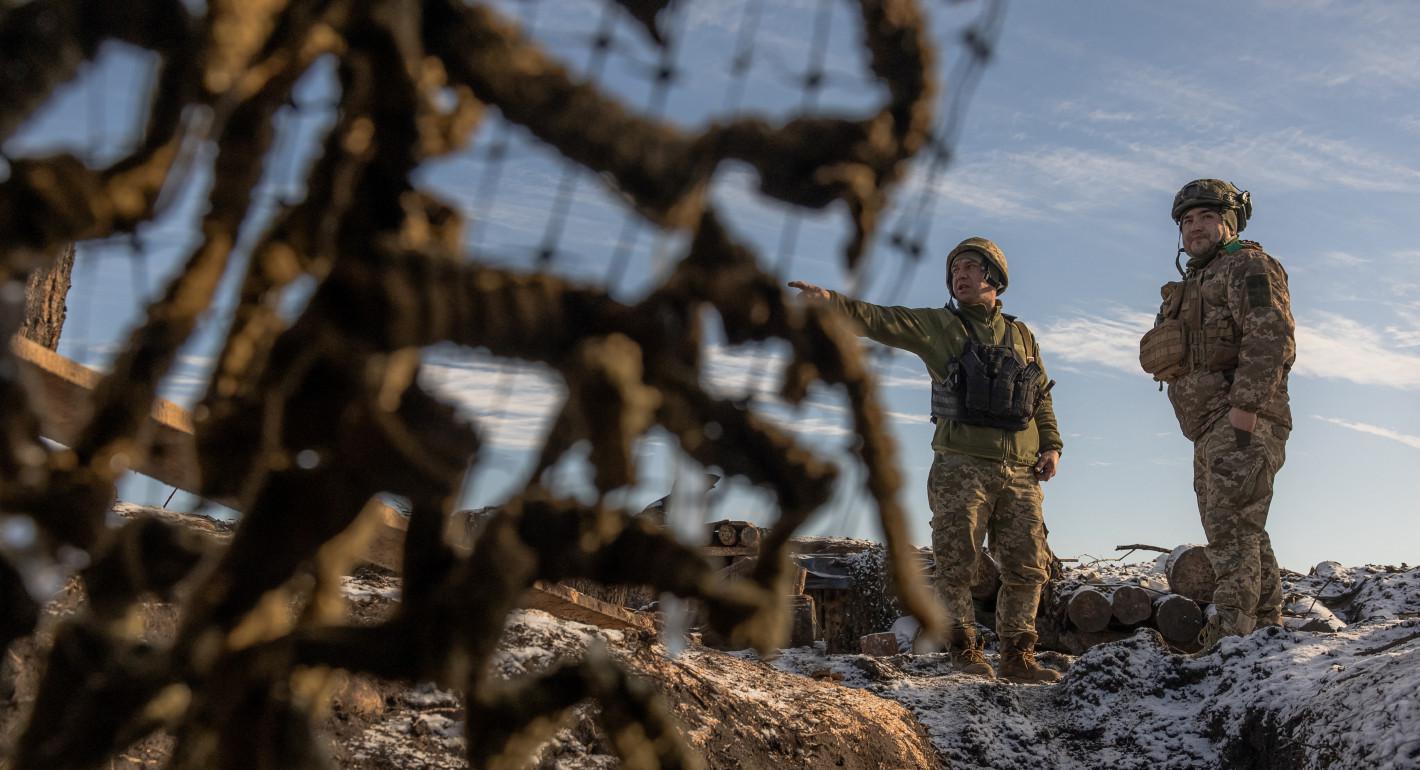
Washington and its allies must position Kyiv and themselves for what promises to be a long confrontation with a powerful, dangerous adversary.
As the second anniversary of Russia’s all-out war against Ukraine approaches, the time is right to take stock of the past year and look ahead to the third year of the war. This is not an abstract exercise, but an essential task Ukraine and its supporters face as they prepare to make critical policy decisions in 2024.
A year ago, after the dire predictions of the Russian assault and the optimism of the unexpected Ukrainian victories at Kharkiv and Kherson, the word “stalemate” was already widely in use to describe the state of the war. The massive rearmament and training effort of Ukraine by its allies and partners was designed to prepare its armed forces for the summer offensive. The aim of that offensive was to achieve a strategic breakthrough in the south, put Russia’s hold on Crimea at risk, and force Russian President Vladimir Putin into negotiations on terms favorable to Ukraine.
That theory of quick victory on the battlefield and at the negotiating table did not come to fruition. On the ground, the state of the war at the two-year mark is effectively the same as it was at the one-year mark. Both sides suffered massive losses in 2023. Military experts now judge that neither side has what it takes to radically change the situation on the battlefield. With both sides resolved to achieve their vision of victory, just as they were a year ago, nothing suggests that the war will end soon.
After 2023—the year of unrealized offensive expectation—Ukraine has adopted “active defense” as its strategy for 2024. The underlying logic of this change is that the inherent advantages of defense that is less manpower- and matériel-intensive will give Ukrainian armed forces the necessary breathing room to reconstitute, reequip, retrain, and prepare to resume large-scale offensive operations in 2025 to liberate the Russian-occupied territories. The “active” portion of this strategy entails a campaign of high-profile, long-range strikes inside Russia proper and the occupied territories, as well as limited offensive operations at the front to tie down Russian forces and keep them from launching offensive operations.
There is no doubt that after a season of heavy fighting Ukrainian armed forces need a break. The real question at this juncture is what comes after that. After a year of active defense, how realistic will it be for Ukraine to resume large-scale offensive operations in 2025 with the aim of liberating Russian-occupied territories and forcing Putin to negotiate an end to the war in earnest?
Russia too is preparing for the next phase of the war. Russian defense factories are ramping up their output even as they are criticized for not producing more hardware for the army fast enough. The Ukrainian army is suffering from chronic ammunition shortages. After its disastrous performance during the first phase of the war, the Russian military has adapted and incorporated new technologies and countermeasures to deny Ukraine major battlefield advantages it was able to gain previously. It remains unclear whether Russia will need to announce another mobilization after Putin’s virtually certain reelection in March. In the meantime, the Russian military apparently has adequate manpower to carry on despite draconian retention policies to cope with shortfalls and other labor shortages elsewhere in Russia. Its prewar three-to-one population advantage over Ukraine translates into a much larger pool of potential conscripts now.
Ukraine is critically dependent on its allies and partners. The uncertainty surrounding the next phase of U.S. assistance to Ukraine underscores the tenuous nature of its plans to go on the offensive in 2025. The EU has struggled but eventually was able to come up with a 50 billion euro long-term assistance package to enable the Ukrainian government to function and support its economy. The $64 billion U.S. supplemental budget request contains the bulk of what Ukraine needs to keep waging this war. Even if this package is approved—which is hardly certain—it is nearly a foregone conclusion that another assistance package for Ukraine will be required for the next fiscal year. Betting on that outcome is a very uncertain proposition. European diplomats and officials admit that Europe alone, without the United States, will not be able to sustain Ukraine’s war effort.
Without Western military aid, the odds of Ukraine successfully resuming large-scale offensive operations to liberate its Russian-occupied territories in 2025 are at the outer end of the optimistic range. That in turn calls for a different long-term strategy for Ukraine and for its allies and partners.
With Putin’s murderous ambitions unchanged, and with Russia possessing superior military capabilities, Ukraine has little choice but to adopt the “active defense” strategy not only for 2024 but for the long run. The goal of liberating all of its occupied territory will remain its objective, but with the correlation of forces favoring Russia decidedly, it is likely unattainable for the foreseeable future. Much of what the new defensive strategy calls for is already being done—including building up defensive installations along the line of contact, as well as air defenses and countermeasures to protect troops and Ukrainian cities, towns, and critical infrastructure; reconstituting and retraining units for active defense; and acquiring long-range precision strike capabilities. But Ukraine needs more of all of that.
And that is not enough. Ukraine’s allies and partners also need to prepare for a long war. That means transitioning from the annual cycle of ad hoc attempts to lock in support for Ukraine to a long-term commitment to its security and defense. Ukraine is the fulcrum of the new, extended East-West confrontation.
Some European countries are already moving in that direction. On a recent visit to Kyiv, UK Prime Minister Rishi Sunak announced a new UK-Ukraine security cooperation agreement. French President Emmanuel Macron has announced plans to travel to Kyiv in February to sign a bilateral security agreement with Ukraine. Other countries reportedly are initiating discussions with Ukraine about security agreements. The place and time to bring it all together into a coordinated, long-term security framework for Ukraine, and for the United States to step up to its leadership role, is NATO’s seventy-fifth anniversary summit, scheduled to take place in July in Washington.
At last year’s summit in Vilnius, Lithuania, Ukrainians were disappointed that they did not get a clear road map, let alone an outright invitation to join the alliance. Friends of Ukraine have already begun to advocate for Ukraine to get a road map, if not an invitation to join NATO, in July. That advocacy is a recipe for at best yet another disappointment and at worst a wasted opportunity to accomplish tangible, long-term commitments to Ukrainian security from the allies. The United States and its European allies are not ready to extend NATO’s security guarantees to Ukraine. To promise Ukraine membership in the alliance—especially after the unfulfilled promise made at the Bucharest summit of NATO in 2008, at the insistence of former U.S. president George W. Bush’s administration—is a sure way to undermine NATO’s credibility and disappoint Ukraine.
Although still quite strong, U.S. public support for Ukraine has been eroding. Increasing numbers of Americans believe that the United States is doing “too much” to support Ukraine. Against this backdrop, there is virtually no chance of obtaining Senate ratification for Ukrainian membership in NATO in the foreseeable future. Instead of making unfulfillable promises while support for helping Ukraine is still strong, the Washington summit should strive for a long-term program of security assistance for Ukraine backed by allied pledges and a U.S. commitment enshrined into law.
Year one of the war produced unrealistic expectations. Year two rendered those expectations unrealized. Year three is the year to learn the lessons of the first two and position Ukraine and NATO for what promises to be a long confrontation with a powerful, dangerous, and implacable adversary. What is the alternative to that?
Director and Senior Fellow, Russia and Eurasia Program
Rumer, a former national intelligence officer for Russia and Eurasia at the U.S. National Intelligence Council, is a senior fellow and the director of Carnegie’s Russia and Eurasia Program.
Recent Work
Eugene Rumer
Eugene Rumer
Carnegie does not take institutional positions on public policy issues; the views represented herein are those of the author(s) and do not necessarily reflect the views of Carnegie, its staff, or its trustees.

The books, podcasts, and films that explain the world it made.

Andrew Leber
U.S. trading partners in Asia are closely watching the dispute for signs of how it may affect their own interests.

Barbara Weisel
Congress should ask tough questions about the agreement’s more unique features and whether they advance U.S. interests or compromise them.

Jane Darby Menton

Amid celebrations of bilateral ties was a deeper focus on stability in the Middle East.

Amr Hamzawy

Xi, Putin, and other regional leaders are back-slapping in Bishkek, but the SCO has yet to answer the most serious questions about continental Asia's economic future.

Evan A. Feigenbaum