

Article
Rupert Barrett-Taylor, Gavin Wilde
{
  "authors": [
    "Gavin Wilde"
  ],
  "type": "commentary",
  "blog": "Emissary",
  "centerAffiliationAll": "dc",
  "centers": [
    "Carnegie Endowment for International Peace"
  ],
  "collections": [],
  "englishNewsletterAll": "ctw",
  "nonEnglishNewsletterAll": "",
  "primaryCenter": "Carnegie Endowment for International Peace",
  "programAffiliation": "TIA",
  "programs": [
    "Technology and International Affairs"
  ],
  "projects": [],
  "regions": [
    "Russia"
  ],
  "topics": [
    "Security",
    "Technology"
  ]
}
Source: Getty
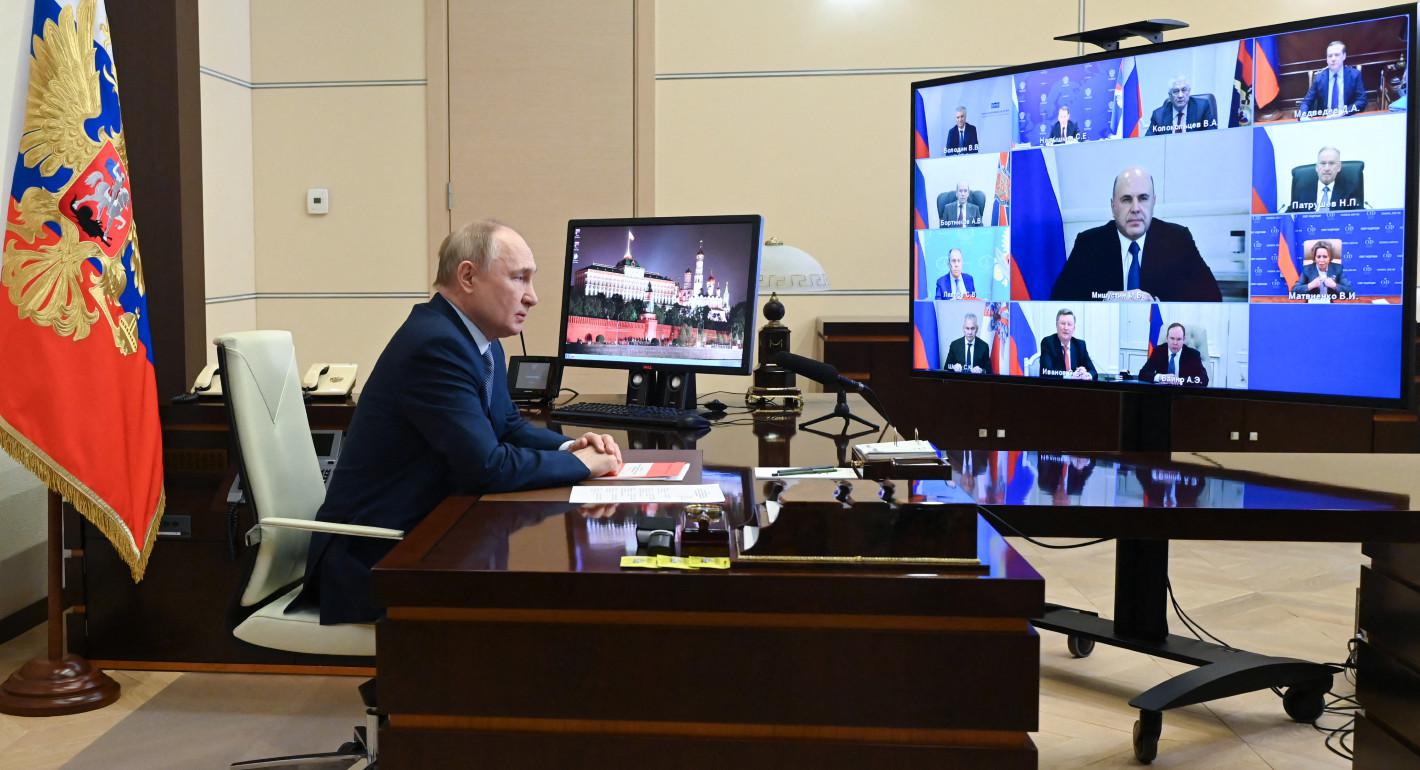
The Kremlin’s response to the Crocus City Hall terrorist attack demonstrates the risks when political leaders prize loyalty over competence from their national security bureaucracies.
Washington has long puzzled over the rationale behind Moscow’s aggressive behavior. In more recent years, it has grappled with incidents ranging from botched assassination attempts and election interference to doomsday weapons and cyber attacks to “little green men” in Ukraine. But in the past two decades, Moscow’s subterfuge has increasingly bordered on cartoonish, as have the half-winking denials that have routinely poured from its officials. Prioritizing these crises—and even seeking ways to constructively engage with Moscow about them—routinely prompts a deeper philosophical question: what drives Moscow to act in this way?
In a single word, it likely boils down to perfidy—a persistent disregard for truth or facts. Perfidy is threatening enough in bilateral relations between nuclear powers, but those concerns often overshadow the real dangers that stem from Moscow’s habit of lying to itself.
The Kremlin’s response to a brutal act of terrorism last weekend—the deadliest attack on Russian soil in two decades that killed 137 people—drives home this crucial point. As in previous crises, Russian officials and propagandists clamored over one other attempting to tie the perpetrators to the most politically convenient scapegoats. This time it was Ukraine, the West, the CIA—all despite ISIS-K, an Islamic State affiliate, claiming responsibility, as well as an apparent good-faith attempt by the United States to warn Moscow that such an attack might be imminent in the weeks prior. Even as Russian President Vladimir Putin finally acknowledged that “radical Islamists” were behind the attack, he and his circle continued to suggest that Kyiv played a role.
Aside from the obvious wartime incentives for Putin to grasp for a Ukraine angle to this tragedy, the deflections are also necessary to stave off difficult questions about his own governance. Foremost among them is how a state currently spending a massive portion of its budget on domestic security could fail so dismally at preventing and responding to such an attack.
Of course, the answer lies in Putin’s long tenure as Russia’s leader and the culture he has fostered. From his earliest experience with terrorist attacks in 1999 to his blatant lies about the invasion of Ukraine in 2022, Putin has demonstrated—and long demanded from his subordinates—a commitment to facts and accuracy only insofar as they serve to cement his grip on power. From one early case when the truth was inescapable and no scapegoat could be found—the sinking of the Kursk submarine and the death of its 118 crewmembers in August 2000—Putin drew clear lessons. Most prominently, if he couldn’t remain silent, the media would have to. At the time, Russia’s independently owned television channels were less willing to dutifully parrot his attempts to blame the disaster on his predecessor’s economic policies. Within a few years, however, the Kremlin had (sometimes ruthlessly) subordinated television broadcasting to the state.
This fealty to narrative over substance has been particularly catastrophic for Russia’s domestic security agency, the Federal Security Service (FSB)—one of the largest intelligence agencies in the world by head count, boasting a border guard service of roughly 200,000. For instance, despite an ostensibly robust ability to spy on its neighbors and a notorious counterintelligence arm, the FSB bungled its assessments about the ease of toppling Kyiv in 2022, while U.S. intelligence was clearly well-informed about the Kremlin’s internal calculus. Moreover, despite maintaining a digital surveillance panopticon, the ability to net political dissidents at its borders, and a clear emphasis on the purported “extremism” of LGBTQ groups, the FSB continues to be caught flat-footed against actual threats of extremism when it counts most.
In other words, the FSB has become so preoccupied with sustaining a political façade that it has become catastrophically inept at much else. For as often as Russian propagandists claim foreign origins of cunning plots against their country, the logical implication of these conspiracies is inescapably the FSB’s repeated failure to disrupt them.
In this regard, one cannot help but see echoes of a similarly tragic episode from almost four decades ago: the meltdown at the Chernobyl nuclear power plant in 1986. In much the same way, a domino effect of lies and dissembling—from the local level all the way up to the Soviet premier, Mikhail Gorbachev—wasted precious time and cost countless lives before Moscow finally copped to what was glaringly obvious to European capitals. Ukrainian historian Serhii Plokhy recounts that, Kremlin attempts notwithstanding, the disaster was harder to blame on any specific set of individuals or their discrete choices, but was rather a product of the Soviet system itself. One that had accumulated over decades. One that prized the successes of the Communist Party over all else. One that, as author Masha Gessen notes, relied on censorship and propaganda less to advance any particular message and more “for the purpose of making learning impossible, replacing facts with mush, and handing the faceless state a monopoly on defining an ever-shifting reality.”
Putin and his circle are hardly the first to willfully conflate regime security with national security. Political leaders and bureaucracies of all stripes—including in the United States—engage in perfidy, cynicism, spin, and demagoguery all the time. Unfortunately, these seem to have become features, rather than bugs, of modern statecraft. However, Moscow’s experience these past several days illustrates a much deeper point about the consequences of such impulses when left unchecked. When national leaders (or aspirants to such positions) conflate compliance with competence, or patronage for proficiency, it is not just political discourse that suffers.
The loss of life at Crocus City Hall is heartbreaking. It is impossible to know, of course, if it was ultimately avoidable. However, the Kremlin’s reflexive turn to the machinery of smoke and mirrors with every crisis suggests that little else in the mechanics of government is functioning. For all the attention paid to Moscow’s propaganda and deceitfulness on the international stage, the Kremlin’s perfidy continues to exact a cost on its domestic institutions. Those failures inevitably bring a human toll as well.
Former Nonresident Fellow, Technology and International Affairs
Gavin Wilde was a nonresident fellow in the Technology and International Affairs Program at the Carnegie Endowment for International Peace. He applies his expertise on Russia and information warfare to examine the strategic challenges posed by cyber and information operations, propaganda, and emerging technologies.
Recent Work
Rupert Barrett-Taylor, Gavin Wilde
Gavin Wilde
Carnegie does not take institutional positions on public policy issues; the views represented herein are those of the author(s) and do not necessarily reflect the views of Carnegie, its staff, or its trustees.
The summit may be remembered as a fatal blunder, when Washington, Beijing, and the AI industry collectively chose ceremony over action.

Jeffrey Prescott

The Horn of Africa countries are among those facing a new security calculus.


Andrew Leber, Lesley Anne Warner
Why governance of rapidly evolving technology will be distributed and complex.


Stewart Patrick, Scott Singer
AI capabilities are moving fast. Most institutions—including governments—can’t keep up.

Anton Leicht, Scott Singer
They face an uphill climb, but they could draw on a strategy that other diplomats have used in the past.


Shana Tabak, Alejandro Martin Rodriguez