

Commentary
Fatima El Mansouri is the country’s first female prime minister. She’s also a privileged insider in a largely ceremonial position.
Sarah Yerkes
{
  "authors": [
    "Alper Coşkun",
    "Sinan Ülgen"
  ],
  "type": "commentary",
  "blog": "Emissary",
  "centerAffiliationAll": "dc",
  "centers": [
    "Carnegie Endowment for International Peace",
    "Carnegie Europe"
  ],
  "collections": [
    "European Politics"
  ],
  "englishNewsletterAll": "ctw",
  "nonEnglishNewsletterAll": "",
  "primaryCenter": "Carnegie Endowment for International Peace",
  "programAffiliation": "EP",
  "programs": [
    "Europe"
  ],
  "projects": [],
  "regions": [
    "Türkiye"
  ],
  "topics": [
    "Domestic Politics",
    "Security"
  ]
}
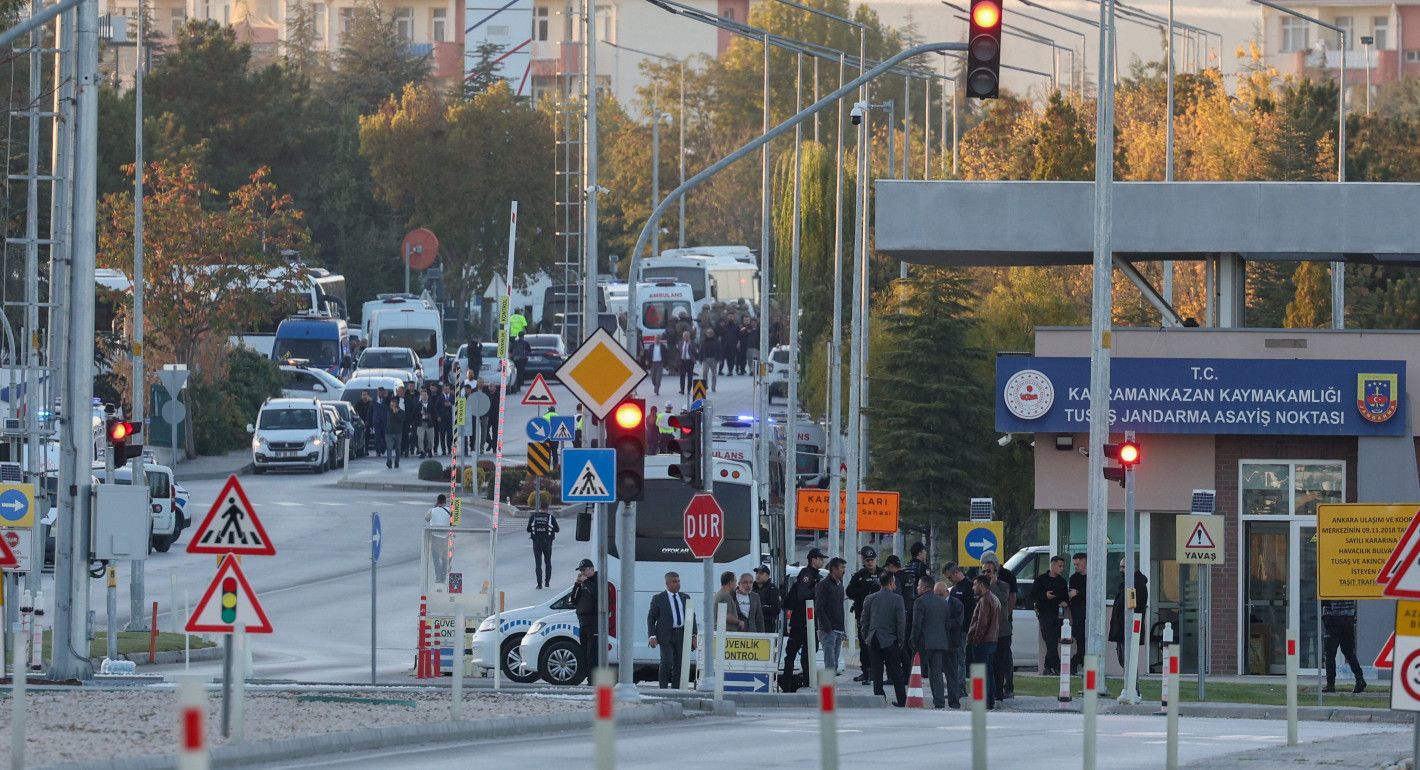
Police and emergency services gather outside the Turkish Aerospace Industries facility following an attack on October 23 in Ankara. (Photo by Serdar Ozsoy/Getty Images)
But what are the chances of its success, especially amid new terrorism threats?
In an unexpected move on Tuesday, Turkish far-right Nationalist Movement Party (MHP) leader Devlet Bahçeli called on Abdullah Öcalan, the imprisoned chief of the separatist Kurdistan Workers’ Party’s (PKK), to renounce terrorism and declare the dissolution of the PKK at the Turkish parliament. Bahçeli, who has previously called for the reintroduction of the death penalty so that Öcalan can be “properly” sentenced, said such a renouncement could open the path to Öcalan’s parole.
The following day, a terrorist attack on a leading Turkish defense industry company killed at least five people and injured twenty-two. Officials say the attack bears the hallmarks of the PKK, but no one has claimed responsibility.
Though shocking, this roller coaster is familiar territory to citizens, policymakers, and analysts of Türkiye. For decades, the PKK’s quest for an independent Kurdish state—and its deadly campaign—has been central to Turkish politics. In order to unpack what might come next, understanding Bahçeli’s motivations and the larger political picture is crucial.
Since April 2015, the ruling Justice and Development Party (AKP) lost its parliamentary majority, and the MHP essentially became its junior partner. This put MHP in a position of inflated influence, enabling it to advance its priorities and worldview, which are largely framed around hypernationalism and security concerns.
Two major factors likely compelled Bahçeli to fundamentally and brusquely shift his position. The first has to do with presidential politics. President Recep Tayyip Erdoğan is currently serving his second term, which is the limit under the revised constitution. The exception to the rule is a scenario in which parliament calls for early elections, granting the president the right to run regardless. But such an exception requires 360 votes out of a total of 600 in the country’s parliament. At present, the two political allies fall considerably short of this threshold.
Enter the Peoples’ Equality and Democracy (DEM) Party. Until this week, the MHP’s sole brandmark in Turkish politics was its unwavering stance not only against the PKK, but also the pro-Kurdish DEM Party. Now, the two allies may be angling to obtain the backing of the DEM Party in parliament to write up a new constitution that would enable Erdoğan to run again. Or, if that fails, this new alliance would try to pass a parliamentary decision for early elections before the end of Erdoğan’s mandate in 2028. Both options serve the same purpose. Extending Erdoğan’s mandate would likely also extend the MHP’s position of privilege. In return, the government would start a process of “democratization” that would address the grievances of the country’s Kurdish population, and thereby appeal to the expectations of the DEM Party. That is the political tradeoff that is now on the table.
The second trigger could well be related to geopolitical developments and the widening instability in the Middle East. Turkish officials have been voicing concern over the probability of the conflict becoming a regional war that encompasses Israel, Iran, Lebanon, and Syria, and they are presumably considering how best to insulate their country from any fallout. They also may see an opportunity at the moment.
Turkey has long been concerned about the U.S. policy of support in Syria to the PKK-linked Democratic Union Party (PYD) and its military wing, the People’s Protection Units (YPG), in the fight against the Islamic State. As a result of heightened security concerns for U.S. forces in the region, Ankara may be anticipating a hastened U.S. withdrawal from Syria and the end of its policy of support to these PKK-linked Kurdish elements. This would essentially undermine the position of hostile Kurdish elements in Syria and, as they know all too well, expose them to a potential Turkish cross-border operation. This may be seen as a moment to capitalize on in Ankara, particularly before any unforeseen contingencies possibly alter the dynamics.
About a decade ago, the AKP government tried to address this same problem by launching a “peace process” with the PKK. But this era of calm was used by the PKK to consolidate its strength inside the country and reassemble its stocks of weaponry. Ultimately, the failure of the process in 2015 was followed by days of urban warfare in Türkiye’s southeast, with the government eventually overwhelming the PKK.
One of the major shortcomings of that opening was its opaqueness. The dialogue was restricted to the government and some representatives of the Kurdish political movement. Parliament was not involved. What was being negotiated was not clear. The MHP was among the political stakeholders that had heavily criticized this initiative, and the experience remains engrained in the public mindset, creating a major hurdle against this rekindled initiative.
This time around, the government may contemplate running this effort from within Parliament. This might include the creation of a special commission for “democratization,” where measures to enhance democratic rights and fundamental freedoms would be discussed. The Republican People’s Party (CHP), the main opposition to the AKP coalition, has also assiduously supported the prospect of this “peace” initiative and the idea of doing this in parliament.
That being said, the AKP is nonetheless set to face substantial resistance from the electorate. During the past decade, both the AKP and MHP conditioned their bases with a heavily anti-Kurdish platform. In the 2023 presidential election, the most egregiously influential factor may have been the false accusations, including concocted videos, that opposition candidate Kemal Kilicdaroglu had the backing of the PKK. This abrupt and momentous volte-face likely will be very difficult for the electorate of the ruling alliance to understand and rationalize. As a result, both the AKP and MHP may see their support cannibalized by other right-wing parties.
More broadly, this democratization initiative has to be viewed as a significant opportunity for the Turkish state and its polity. Especially this time around, the initiative’s design should allow for a more transparent and inclusive participation, not only by political forces, but also civil society stakeholders. If successful, it has the potential to significantly transform Türkiye’s polarized politics and allow lawmakers to finally address one of the most deep-seated shortcomings of Turkish democracy. It would also help alleviate Türkiye’s cross-border security concerns emanating from the PKK in Iraq and its offshoots in Syria, further contributing to the country’s well-being and advancing regional security.
The tragic terrorist attack on Wednesday against the Turkish Aerospace Industries—a leading defense industry company designing the country’s prospective indigenous fighter jet aircraft and manufacturing a successful array of armed drones, light aircraft, and helicopters—is a reminder of the stakes in the country’s fight against terrorism. Within hours after the attack, Turkey was pounding PKK targets in Iraq and Syria.
This cycle is yet another testimony to the multitude of challenges involved in eliminating the specter of terrorism and finding lasting and consensual peace. Clearly, it will be no less difficult this time. Sustainable success will depend on an end to terrorist acts and the perseverance of political will against all odds, alongside a meaningful push for the democratization of the country. Erdoğan’s ambition to remain in power even after twenty-two years of uninterrupted rule may paradoxically usher in just that.
The latest from Carnegie scholars on the world’s most pressing challenges, delivered to your inbox.

Senior Fellow, Europe Program
Alper Coşkun is a senior fellow in the Europe Program and leads the Türkiye and the World Project at the Carnegie Endowment for International Peace in Washington, DC.

Senior Fellow, Carnegie Europe
Sinan Ülgen is a senior fellow at Carnegie Europe in Brussels, where his research focuses on Turkish foreign policy, transatlantic relations, international trade, economic security, and digital policy.
Carnegie does not take institutional positions on public policy issues; the views represented herein are those of the author(s) and do not necessarily reflect the views of Carnegie, its staff, or its trustees.
Fatima El Mansouri is the country’s first female prime minister. She’s also a privileged insider in a largely ceremonial position.

Sarah Yerkes

The Horn of Africa countries are among those facing a new security calculus.


Andrew Leber, Lesley Anne Warner
Why governance of rapidly evolving technology will be distributed and complex.


Stewart Patrick, Scott Singer
Washington’s decision to support some UN functions while letting others wither is pulling the organization apart at the seams.
Stewart Patrick, Theodore Zaritsky
They face an uphill climb, but they could draw on a strategy that other diplomats have used in the past.


Shana Tabak, Alejandro Martin Rodriguez