

Commentary
Oliver Stuenkel, Adrian Feinberg
{
  "authors": [
    "Oliver Stuenkel"
  ],
  "type": "commentary",
  "blog": "Emissary",
  "centerAffiliationAll": "dc",
  "centers": [
    "Carnegie Endowment for International Peace"
  ],
  "collections": [
    "Trump’s Disruptive 100 Days",
    "Global Democracy"
  ],
  "englishNewsletterAll": "democracy",
  "nonEnglishNewsletterAll": "",
  "primaryCenter": "Carnegie Endowment for International Peace",
  "programAffiliation": "DCG",
  "programs": [
    "Democracy, Conflict, and Governance"
  ],
  "projects": [],
  "regions": [
    "United States",
    "Brazil"
  ],
  "topics": [
    "Global Governance",
    "Trade",
    "Foreign Policy"
  ]
}
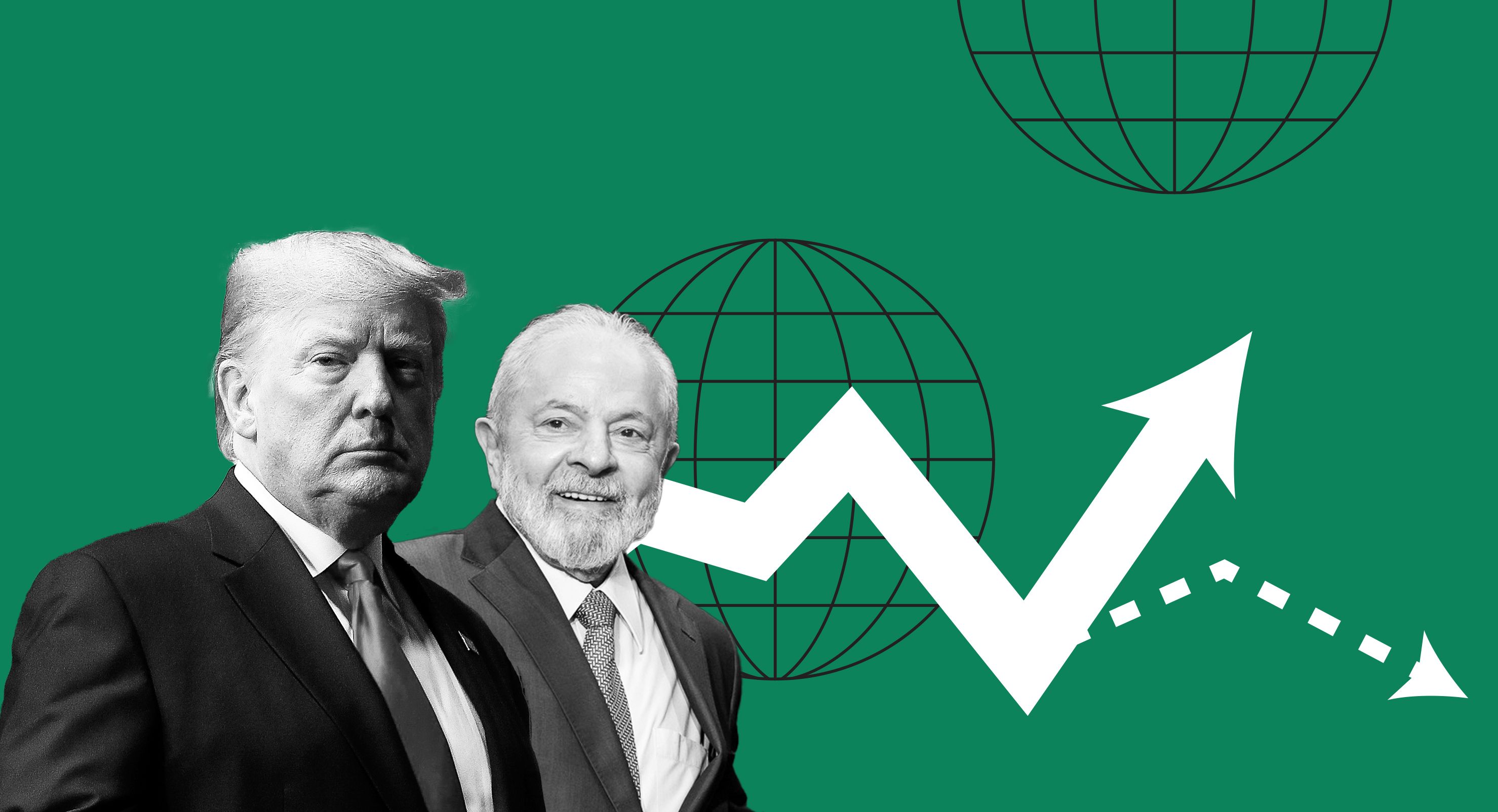
(Photos by Getty Images)
Brasília hopes to position itself as a constructive and autonomous voice as the international system grows more contested.
This piece is part of a Carnegie series examining the impacts of Trump’s first 100 days in office.
For Brazil, U.S. President Donald Trump’s return to the White House presents at least two significant risks and one strategic opportunity in the bilateral relationship and the evolving global order. These risks are primarily political and economic, while the opportunity reflects Brazil’s long-standing ambition to position itself as an autonomous actor in a multipolar world.
The first risk is political contagion. Brazil will hold its next presidential election in October 2026, and Trump’s reemergence has emboldened far-right actors domestically. U.S. politics is highly visible in Brazilian public discourse, and recent political events in Brazil—such as the 2018 election of far-right populist Jair Bolsonaro, his refusal to concede defeat in 2022, and the January 2023 storming of government buildings by his supporters—closely mirrored dynamics in the United States. Trump-inspired rhetoric, including attacks on higher education and the so-called deep state, has heavily influenced the Brazilian right. Bolsonaro, now barred from running due to a conviction by Brazil’s electoral court, has called for “support from abroad” to save Brazil from what he claims is a descent into dictatorship, as he faces coup-related charges that could lead to imprisonment ahead of the elections.
Bolsonaro and his allies see Trump’s return as a chance to rebuild legitimacy and gain international backing. Eduardo Bolsonaro, the former president’s son, recently stepped down from his seat in the National Congress and moved to the United States—possibly to avoid legal troubles, but more likely to strengthen ties with U.S. far-right networks. Should Trump or high-profile figures such as Elon Musk intervene in Brazil’s electoral process, as Musk has recently done in Germany, the bilateral relationship could suffer severe strain.
The second risk is economic. Although some sectors of the Brazilian economy could benefit from the U.S.-China trade war—agribusiness may increase exports to China, and Brazil’s footwear sector, the largest outside Asia, could gain access to U.S. markets—the downsides could be numerous. Trump’s new tariffs are likely to redirect Chinese exports away from the United States and toward countries such as Brazil, flooding local markets with cheaper goods. This could deepen Brazil’s ongoing deindustrialization, pressure domestic manufacturers, and potentially force Brazil to raise tariffs on Chinese imports, complicating its most important trade relationship. Although President Luiz Inácio Lula da Silva’s government has responded cautiously so far, any deterioration in global economic conditions would pose serious challenges for Brazil’s economic recovery and its efforts to combat poverty and inequality.
At the same time, Trump’s foreign policy approach reinforces Brazil’s preference for a multipolar world order—an orientation that predates the current administration. Brasília has long sought to reduce its dependence on the West and expand relations with China, Russia, and the Global South. Trump’s attacks on multilateralism and Western alliances create space for Brazil to assert greater diplomatic autonomy. Lula’s recent state visit to Japan and upcoming trips to China and Russia reflect this ambition. Brazil hopes to fly below Washington’s radar while enhancing its influence in a less cohesive international system. Trump’s more confrontational stance toward the European Union has raised hopes in Brasília that countries such as France, which have so far opposed ratifying the EU-Mercosur trade agreement, may now support it as part of Europe’s own diversification strategy.
Brazil’s role as host of key global summits aligns with this broader diplomatic vision. In November 2024, Brazil hosted the G20 summit. In July, it will host the annual summit for BRICS, now expanded to include Indonesia and a new slate of Global South partners. The event is an opportunity for Brazil to increase its global visibility and reaffirm its ambition to shape international debates on climate change, multilateral governance, and the energy transition. In November, Brazil will host COP30 in Belém, further positioning itself as a bridge-builder between developed and developing countries during a period of geopolitical instability.
Brazil’s geographic distance from the regions that make headlines provides a degree of insulation from the issues that dominate Trump’s foreign policy agenda. Even when it comes to migration from Latin America, Brazil is far less visible than Mexico, Venezuela, or Central American nations. Brazilian policymakers see this as an asset, allowing the country to pursue an independent agenda without attracting undue attention or pressure from Washington. This helps explain why Lula has restrained himself to only occasional criticisms of Trump. Additionally, the fact that the United States runs a trade surplus with Brazil makes it a less likely target of punitive tariffs and reduces Brazil’s potential exposure to the protectionist backlash that has hit other nations.
Nonetheless, Trump’s more transactional foreign policy and more limited commitment to a rules-based order increase risks for a country like Brazil, which lacks military power and relies heavily on a stable and predictable global environment. Growing uncertainty reinforces Brazil’s desire to hedge its bets, diversify its partnerships, and increase strategic wiggle room.
Ultimately, Brazil seeks to minimize friction with Washington while expanding its global footprint. Trump’s return reinforces the urgency of this approach. For Brasília, the key lies in maintaining flexibility, avoiding open confrontation, and leveraging global disorder to advance its own priorities. As the international system grows more contested and multipolar, Brazil hopes to position itself as a constructive and autonomous voice—an emerging power that can engage all sides while avoiding entanglement in great power rivalries.
Read more from this series, including:
Senior Fellow, Democracy, Conflict, and Governance Program
Oliver Stuenkel is an associate professor at the School of International Relations at Fundação Getulio Vargas (FGV) in São Paulo, Brazil. He is also a senior fellow affiliated with the Democracy, Conflict, and Governance Program at the Carnegie Endowment for International Peace.
Recent Work
Oliver Stuenkel, Adrian Feinberg
Oliver Stuenkel, Adrian Feinberg
Carnegie does not take institutional positions on public policy issues; the views represented herein are those of the author(s) and do not necessarily reflect the views of Carnegie, its staff, or its trustees.

The acknowledgment has sparked fears of a new arms race with China and Russia.

Chris O’Meara

The summit may be remembered as a fatal blunder, when Washington, Beijing, and the AI industry collectively chose ceremony over action.

Jeffrey Prescott
The real test may come after the leaders leave the room.



Sheena Chestnut Greitens, Oriana Skylar Mastro, Yukon Huang, …

The Horn of Africa countries are among those facing a new security calculus.


Andrew Leber, Lesley Anne Warner
Why governance of rapidly evolving technology will be distributed and complex.


Stewart Patrick, Scott Singer