

Commentary
- +8
Sophia Besch, Eric Ciaramella, Steve Feldstein, …
{
  "authors": [
    "Eric Ciaramella"
  ],
  "type": "commentary",
  "blog": "Emissary",
  "centerAffiliationAll": "dc",
  "centers": [
    "Carnegie Endowment for International Peace"
  ],
  "englishNewsletterAll": "ctw",
  "nonEnglishNewsletterAll": "",
  "primaryCenter": "Carnegie Endowment for International Peace",
  "programAffiliation": "russia",
  "programs": [
    "Russia and Eurasia"
  ],
  "projects": [
    "Ukraine Initiative"
  ],
  "regions": [
    "Russia",
    "Ukraine",
    "United States"
  ],
  "topics": [
    "Foreign Policy",
    "Security"
  ]
}
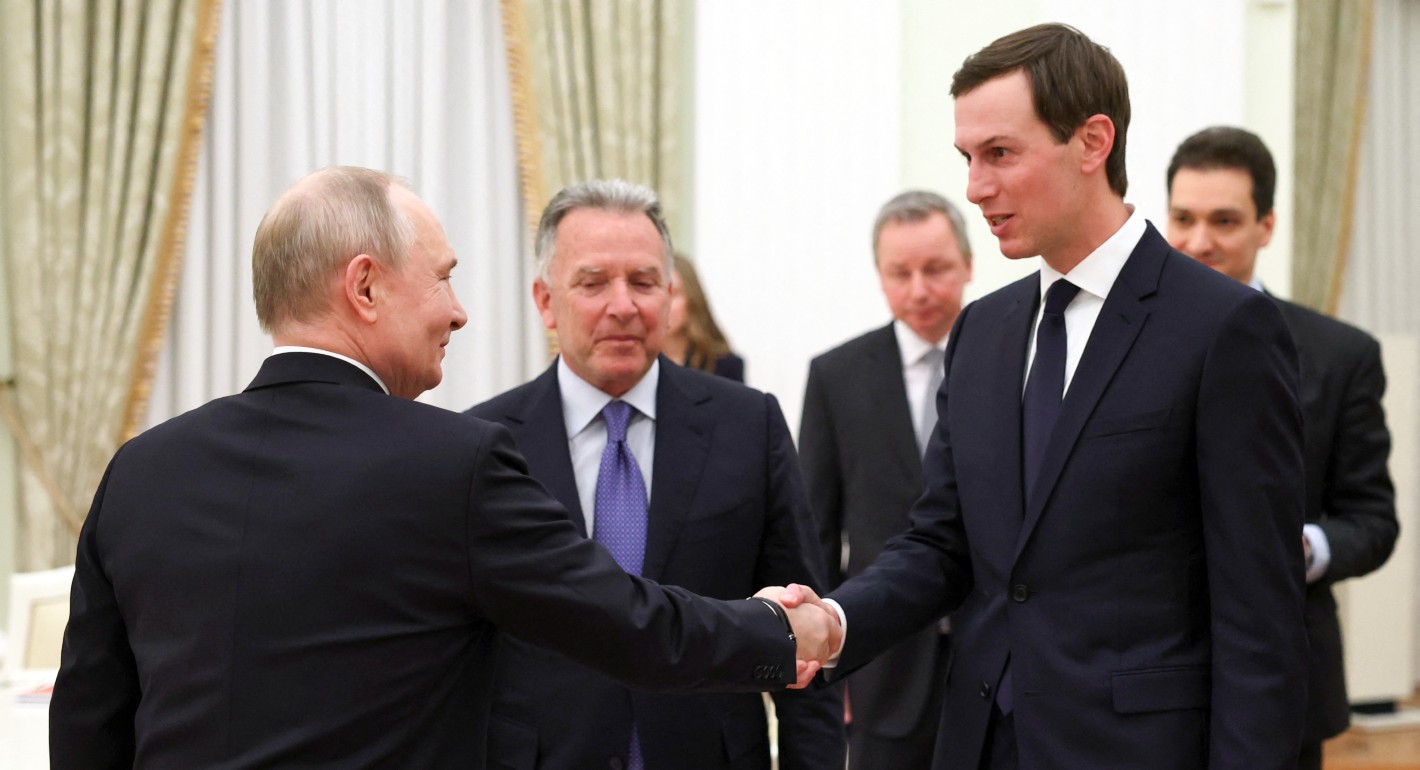
Putin welcomes Witkoff and Kushner at the Kremlin on January 22, 2026. (Photo by Alexander Kazakov/pool/AFP via Getty Images)
It’s dangerous to dismiss Washington’s shambolic diplomacy out of hand.
President Donald Trump’s yearlong attempt to negotiate peace between Ukraine and Russia may feel like living through a doom loop of late Soviet humor: a glimmer of hope, a ritualized attempt to improve the situation, and a denouement that reveals the effort was utterly pointless. We can see the punchline coming from a mile away, yet the system absorbs the failure and reproduces the same behavior, each time with greater farce.
“I really believe we’re probably … closer than ever before with both parties,” Trump said at a White House press conference in late December while standing alongside Ukrainian President Volodymyr Zelensky.
On February 4 and 5, senior Ukrainian and Russian security officials met face-to-face in Abu Dhabi for the second time in less than a month. Predictably, Trump administration officials hailed the talks as evidence that the peace process is gaining momentum.
Most experts disagree. Whereas Ukraine—under immense pressure from Trump—has shown admirable flexibility in its negotiating positions, Russia has not budged an inch. President Vladimir Putin, they argue, is not engaging in peace talks in good faith; rather, he wants to lure a cadre of inexperienced Trump confidants into an endless process of working groups and meetings while Russian forces gain advantage on the battlefield and pummel Ukrainian cities from the skies.
But what if Trump’s envoys manage to pull off the unthinkable? What if we wake up one morning to a presidential Truth Social announcing that the so-called deal of the century has been reached? It’s a long-shot scenario, but one that skeptics of the White House’s approach—myself included—would be foolish to disregard.
When Trump took office, he pledged to end Russia’s war against Ukraine within twenty-four hours, a deadline he later extended, then reissued and revised, then pretended he had never given in the first place. Trump has admitted that the war proved a “little bit more difficult” to solve than he had anticipated. In December, he boasted that he had tapped real estate developer Steve Witkoff to end the largest war in Europe since World War II even though Witkoff “knew nothing about” Russia or Ukraine. When Witkoff’s errant comments on his dealings with Putin and other Russian officials began to create widespread confusion in Washington and Europe, Trump turned to his son-in-law, Jared Kushner, and the person responsible for procuring the federal government’s office furniture to clean up the mess.
Trump’s dogged pursuit of a peace settlement is laudable. But his good instincts end there. For the better part of the past year, he has turned the screws on Ukraine while letting Russia off easy. After taking Zelensky to the woodshed under the world’s astonished gaze last February, Trump endangered the entire Ukrainian war effort by suspending vital military and intelligence aid. He quickly lifted the intelligence hold and later agreed to sell weapons to NATO allies for transfer to Ukraine. But the message was clear: Kyiv had to play ball, lest the rug be pulled from under it.
As a result of Washington’s unrelenting pressure, Ukrainian officials have gone to great lengths to show flexibility. Last spring, Zelensky agreed to Trump’s initial proposal of an unconditional ceasefire. Later in the year, at Trump’s insistence, he said he was open to abandoning Ukraine’s bid for NATO membership and accepting certain limits on the size of Ukraine’s military. Zelensky has even entertained the possibility that Ukrainian troops could withdraw from the remaining parts of the Donetsk region under Kyiv’s control—an area roughly the size of Delaware—if it becomes a demilitarized zone.
For Kyiv, these concessions represent reasonable but painful compromises on several of the key issues that Putin has included in his laundry list of demands to end the war. But as Ukraine twists itself into knots trying to satisfy Trump, Putin sits back and watches the show. Only once in the past year has Trump attempted to put meaningful pressure on Moscow, when the Treasury Department in October announced sanctions on two of Russia’s largest oil companies. Since then, there is no sign that Putin feels compelled to moderate his demands. On the contrary, Russia has obliterated Ukraine’s energy infrastructure during one of the coldest winters in recent memory, all while Trump has blamed Ukraine for the lagging peace talks.
It’s tempting to see the recent Abu Dhabi talks as yet another pointless charade. Both sides, arguably, are playing along to placate Trump: Russia is stalling to gain advantage on the ground, while Ukraine aims to preserve a modicum of American support at a time when its army and society are under extreme pressure.
But the story may not be so simple. Well-placed contacts in Kyiv tell me that the parties talked in Abu Dhabi in greater detail than ever before about how a ceasefire could work and the steps both sides would need to take to implement one. A breakthrough? Hardly. But a sign that a ceasefire might not be out of the question? Perhaps.
Notably, Putin tapped his military intelligence chief, Admiral Igor Kostyukov, to lead the Russian team in Abu Dhabi. Perhaps, as some have suggested, he was not there to negotiate, but to deliver the Kremlin’s uncompromising line. On the other hand, if the complex security-related parameters of a potential deal were up for discussion, he would be more capable of doing so than a dilettante such as business envoy Kirill Dmitriev, who until Abu Dhabi had been Moscow’s main channel to Witkoff and Kushner.
Kostyukov is also a more apt counterpart to Lieutenant General Kyrylo Budanov, Ukraine’s former military intelligence chief whom Zelensky named in January to lead his presidential office. Budanov stepped into the role after Zelensky dismissed his previous chief of staff, Andriy Yermak, in the wake of a corruption scandal. Yermak and Budanov clashed frequently behind the scenes about how to end the war. Yermak took a rigid view of the peace talks, while Budanov, who has spoken candidly about Ukraine’s manpower challenges, sought a more pragmatic strategy that would entail some form of compromise from Kyiv.
Moreover, Budanov is one of a small number of Ukrainian officials with a track record of negotiating with the Russians. Even as the war raged on, he quietly hammered out agreements with his Russian counterparts to bring home thousands of Ukrainian prisoners of war. If there were any single individual in Ukraine who has the popular credibility to talk to the Russians and to walk the tightrope between pragmatic thinking and defending the nation’s security interests, it is probably Budanov.
Ukraine’s apparent strategic rethink is a notable development. But on its own, it does not get a deal across the finish line. The bigger question is why Putin would agree to stop fighting on terms that would be minimally acceptable to Kyiv.
Here, it’s important to distinguish between Putin’s strategic aims and the means by which he pursues them. His desire to control Ukraine as a polity has not changed. Although Putin is fixated on conquering the remainder of the Donetsk region, Trump administration officials have erroneously concluded that the war is all about territory. It never was, and it isn’t now. Putin has always set his sights higher. Ukraine’s “true sovereignty,” he wrote in his sweeping 2021 manifesto that laid out his rationale to invade, “is possible only in partnership with Russia.” In other words, Ukraine should exist only as a Russian vassal.
The problem for Putin is that, even with the battlefield trending in his favor, there’s no clear path to achieving that goal. That raises the question: what if he changes tack?
Cue the back-and-forth on the territorial issue. Ukraine long insisted that it would never withdraw troops from the remaining parts of Donetsk under its control. But recently—under duress from Washington—Zelensky has signaled openness to creative solutions, including a pullback of Ukrainian forces that would leave the territory as a “demilitarized” and “free economic” zone. Putin the absolutist would reject such a proposal; after all, he wants nothing short of Ukraine’s capitulation. But Putin the tactician could see value in signing up to that arrangement. In practice, it would be virtually impossible to prevent him from sending Russian forces into the zone once Ukraine vacated it—potentially without firing a shot.
The trickier part for Putin is the question of Western security guarantees for Ukraine. The United States and European nations appear to have devised a package of security measures that satisfy Ukraine’s concerns that a ceasefire would leave it vulnerable to another Russian attack. At first blush, it is hard to see why Putin—even if he secured an acceptable outcome on Donetsk—would consent to having his archenemies take a formal role in Ukraine’s long-term security. But what if he thought the West was bluffing? What if he thought that, no matter what Europe and the United States promised on paper, Russia could bully them into backing down if a new crisis erupted? Put differently, there is a plausible world in which Ukraine is content with the security pledges on offer, yet Putin sees them as hollow and unenforceable.
Moreover, Putin will be confident that he can exploit the ambiguities, contradictions, and loopholes that will plague any agreement between two parties that fundamentally do not see eye to eye. Sequencing matters. Many of the biggest incentives for Ukraine—such as accelerated membership in the European Union and massive funding for reconstruction—are years down the road, if not downright fanciful. Perhaps Putin thinks he can use a deal, even one that falls short of his ultimate aims, to coerce Kyiv into following through on its obligations while reneging on Russia’s own commitments and expecting the West to do the same.
An enduring peace deal between Ukraine and Russia will require a strategic shift in Moscow, a credible set of Western security commitments to Kyiv, and a herculean amount of planning and technical expertise. None of those ingredients is present in the ongoing talks. Instead, we have a transatlantic alliance in disarray, an anxious leadership in Kyiv, and an opportunistic Putin who has pivoted plenty of times before to achieve his strategic aims through other means.
But looking for perfection in a deeply flawed process is futile. A shoddy deal—but a deal nonetheless—could take shape rather suddenly. Ukraine and its supporters would be wise to start preparing for what comes next. A strong Ukrainian defense and ethos of self-help, backed by Western resources, has foiled Putin’s war aims for nearly four years. No matter what course the negotiations take, that combination will remain the essential recipe for success.
Senior Fellow and Ukraine Initiative Director, Russia and Eurasia Program
Eric Ciaramella is a senior fellow in the Russia and Eurasia program at the Carnegie Endowment for International Peace. His work focuses on Ukraine and Russia.
Recent Work


Sophia Besch, Eric Ciaramella, Steve Feldstein, …


Eric Ciaramella, Aaron David Miller, Alexandra Prokopenko, …
Carnegie does not take institutional positions on public policy issues; the views represented herein are those of the author(s) and do not necessarily reflect the views of Carnegie, its staff, or its trustees.

Despite public disputes over trade and immigration, the strategic partnership’s foundations remain sturdy.

Sameer Lalwani

It signals a new era of tech diffusion and warfare.
Steve Feldstein
Despite its flop at the box office, the film raises important questions for the climate community to answer.

Leonardo Martinez-Diaz
The acknowledgment has sparked fears of a new arms race with China and Russia.

Chris O’Meara
The summit may be remembered as a fatal blunder, when Washington, Beijing, and the AI industry collectively chose ceremony over action.
Jeffrey Prescott