

Paper
Alasdair Phillips-Robins, Teddy Tawil, Sam Winter-Levy
{
  "authors": [
    "Alasdair Phillips-Robins"
  ],
  "type": "commentary",
  "blog": "Emissary",
  "centerAffiliationAll": "dc",
  "centers": [
    "Carnegie Endowment for International Peace"
  ],
  "englishNewsletterAll": "ctw",
  "nonEnglishNewsletterAll": "",
  "primaryCenter": "Carnegie Endowment for International Peace",
  "programAffiliation": "TIA",
  "programs": [
    "Technology and International Affairs"
  ],
  "projects": [],
  "regions": [
    "United States",
    "China"
  ],
  "topics": [
    "Technology",
    "AI",
    "Foreign Policy",
    "Economy"
  ]
}
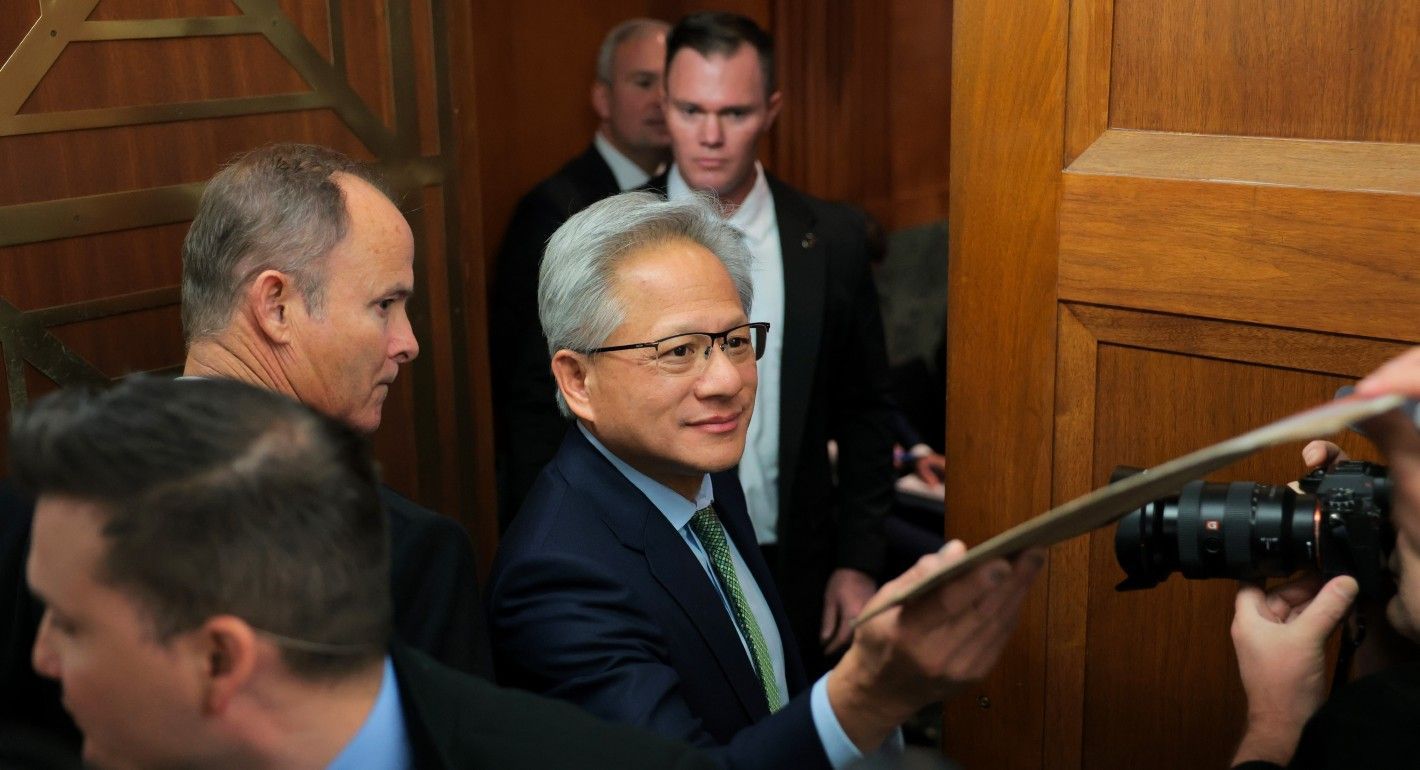
Nvidia President and CEO Jensen Huang on Capitol Hill in December. (Photo by Anna Moneymaker/Getty Images)
Trump can still keep America’s edge in the AI race.
U.S. President Donald Trump’s decision to sell advanced AI chips, including Nvidia’s H200, to China has sent Washington’s hawks scrambling. Former State Department official Chris McGuire described the move as “a transformational moment for U.S. technology policy.” China’s strengths in engineering and electricity generation make the choice to export American hardware “possibly decisive in the AI race,” warned Rush Doshi, a former National Security Council China hand.
Selling H200s is, indeed, a sharp break in U.S. strategy, but how consequential the move will be depends on what the administration does next. The more important decision—and one that the administration has seemingly yet to make—is how many of the chips to sell. If the Trump team allows China to buy millions, it will risk upending the AI race. But if it limits the numbers, and uses each shipment as leverage, the effects will be far less dramatic.
Taking the latter course would mean repeating the strategy the administration has adopted in AI sales to the Middle East—a big announcement followed by a slow drip of exports. If it does that, Washington may manage to boost Nvidia’s market share in China without conceding America’s overall compute advantage. Of course, selling any number of H200s will bring risks, including alienating crucial allies, and Trump seems to have made his announcement without winning anything from China in return. But as so often with Trump, the reality may be less dramatic than the immediate fireworks suggest.
Released in March 2024, the H200 is Nvidia’s flagship product from its Hopper generation of chips. Although Hopper chips have been overtaken by Nvidia’s newest offering, the Blackwell line, the H200 is still widely used in AI training and inference. Most of the world’s largest clusters of AI chips depend on the H200 and its predecessor, the H100. Despite its age, the H200 is still some 30 percent more powerful than the best Chinese chip, Huawei’s Ascend 910C.
Nor is China about to close the compute gap anytime soon. Huawei, China’s top chip designer, predicts it will not produce a chip that matches the H200 until late 2027, nor can it match Nvidia’s production volume. According to public estimates, in 2025, U.S. firms will produce at least twenty times as many chips (adjusted for performance) as Chinese producers, and in 2026 they will produce at least fifty times as many.
Selling H200 chips, therefore, will give China’s AI ambitions a real boost. Even without easy access to American chips, Chinese developers are producing powerful AI models and capturing growing market shares. Those same developers consistently say that their inability to buy enough AI chips is the main thing holding them back from even faster progress. Already, big Chinese tech companies, including Alibaba and Tencent, are reportedly pushing the government for access to future H200 imports.
That, of course, is the Trump team’s hope. They argue that Nvidia will pull demand from Chinese chipmakers, starving them of the revenue and research and development feedback loops they need to improve their products and win more customers around the world. Yet China is determined to build a domestic AI supply chain, and its indigenization strategy long predates U.S. restrictions on the sale of AI chips. Already, the Chinese government has signaled that it will force customers to keep using Huawei products, with foreign offerings filling in what Chinese companies cannot produce.
No wonder, then, that many see danger for the U.S. AI industry. “This decision is nuts,” former national security adviser Jake Sullivan told the New York Times. “We are literally handing away our advantage. China’s leaders can’t believe their luck.” What’s more, Trump doesn’t seem to have received anything from China in return. At his meeting with Chinese President Xi Jinping in October, Trump won a trade truce without offering up American chips. There is little strategic logic in waiting six weeks only to hand them over anyway.
As strategically baffling as the move may be, it doesn’t necessarily spell the end for American AI dominance. That’s because which chips China can buy matters far less than how many of them it can amass—and the Trump administration still has time to decide how many to sell.
Quantity matters because modern AI is incredibly hungry for computing power. A large installed base of AI chips is essential for training major new models—the biggest models now use tens or hundreds of thousands of the latest chips. It’s also needed to serve customers and to research new architectures and training methods. (In 2024, OpenAI used the majority of its compute for research, not for training or inferencing public models.) A national advantage in computing power has compounding returns: More chips mean better AI products, better products mean more revenue, and more revenue should mean more funds to reinvest in research and development.
What really matters is whether the United States sells China a few hundred thousand H200-class chips—or several million. The Institute for Progress reckons that without any restrictions on exports, China would likely buy more than 2 million chips over the next year. This would shrink the U.S. advantage in installed AI compute from more than 10x to between 1.2x and 5x, and it could help Chinese AI companies leapfrog U.S. competitors. If, on the other hand, the administration approves only a couple hundred thousand chips, it will give the Chinese companies that buy them a shot in the arm, but the United States would likely retain a heavy compute advantage.
There are signs that the administration may not be planning a free-for-all. For starters, Trump’s announcement claimed that chips would be sold only to “approved” customers under “conditions” that would protect national security. Who exactly those customers are matters little, as the U.S. government will struggle to stop chips changing hands inside China, but Trump’s statement suggests that the United States will grant licenses to individual buyers, not remove the restriction on exports entirely.
Keeping the license requirement means the administration will retain the ability to control the volume of sales. Under the export control laws, the Commerce Department can specify how many chips a license covers, when the authorization expires, and any other conditions it chooses. Officials can also revoke a license with the stroke of a pen. Rather than signing off on large quantities right away, Commerce could hold back each approval until Beijing shows progress on one of the Trump administration’s other goals, such as rare earth shipments or trade cooperation.
The Trump administration has already used this “big announcement, slow follow-up” tactic with AI chip sales in the Middle East. In May, during his visit to Saudi Arabia and the UAE, Trump promised vast chip partnerships totaling millions of advanced Nvidia processors. Yet it took six months for the first approvals for shipments to Saudi and Emirati firms to emerge, and even then, the Commerce Department signed off on just 35,000 of the latest Nvidia chips, far less than was originally promised. The delay reportedly came because Commerce Secretary Howard Lutnick pushed Emirati leaders to follow through on their promises of investment in the United States before signing off on exports. National security concerns also reportedly held things up.
Something similar may well happen with H200 shipments to China. White House and Commerce Department officials will have to negotiate license conditions with Nvidia, Chinese buyers, and perhaps the Chinese government. Four agencies—Commerce, State, Energy, and Defense—get to weigh in on license approvals. Every new Chinese provocation will provide a reason to pause shipments. Pressure from Congress may also slow things down.
On the Chinese side, there will be plenty of willing buyers, but there are already signs of friction from the government. The day after Trump’s announcement, the Financial Times reported that the Ministry of State Security is considering asking potential buyers to explain why they cannot fulfill their needs with Huawei products. Many Chinese companies will win approval—Beijing has asked for these chips for years—but the Chinese government will want to ensure continued demand for Huawei chips and pressure for indigenization. That, too, could cause delays.
Even some of the chips that do flow will simply displace China’s existing access to Nvidia processors. China already has a large stockpile, in part from imports before the United States tightened export control rules in October 2023, and many more chips are smuggled into the country every year. In addition, some Chinese companies reportedly have been able to access banned chips through large data centers in nearby countries such as Malaysia, which have seen surges in imports over the past year. If H200 sales end up in the low hundreds of thousands, many of them will likely replace chips that Chinese developers would have smuggled or accessed remotely anyway.
Trump’s decision still has huge strategic significance. For one thing, it will make it far harder for the United States to persuade other countries to impose their own restrictions on the sale of AI technology to China. For years, Washington has pressured allies—including Japan, the Netherlands, and Taiwan—to accept economic pain and diplomatic tensions with Beijing based on American assurances that technology restrictions are vital to their collective national security. If the United States now concludes that selling advanced AI chips to China serves American interests, those allies may question why they should bear the costs of enforcing complementary restrictions.
That is particularly unfortunate, as any coherent strategy to defend the U.S. advantage in chip production depends on allied cooperation. If the Trump administration wants to hold back Chinese chipmakers by letting Nvidia poach their customers, that tactic will work best if it is paired with tougher restrictions on the sale of chipmaking equipment to Chinese companies. A good place to start is the House China Select Committee’s recommendation to bar all sales of deep ultraviolet immersion lithography machines. These machines, which are currently blocked only to a subset of Chinese companies, are a key choke point in the production of advanced chips. They are, however, produced by the Dutch company ASML, whose government may well be skeptical of imposing new restrictions at the request of a U.S. administration with an inconsistent China policy and an apparent hostility to the European project.
There is, of course, another possibility: Rather than attempting a bank shot strategy to undermine Chinese chipmakers, Trump may be in search of a much broader rapprochement with China, one that involves a new world order led by the great powers. But China hawks fearing the worst, and Chinese developers hoping for unlimited H200 deliveries, should remember the lesson that many who have gone into business with Trump have learned: Just because the press release has big promises doesn’t mean you’ll get what you expected when it comes time to sign on the dotted line.
The latest from Carnegie scholars on the world’s most pressing challenges, delivered to your inbox.

Former Fellow, Technology and International Affairs Program
Alasdair Phillips-Robins was a fellow in the Technology and International Affairs Program at the Carnegie Endowment for International Peace, where his research focuses on emerging technology and national security.
Recent Work


Alasdair Phillips-Robins, Teddy Tawil, Sam Winter-Levy

Alasdair Phillips-Robins, Scott Singer
Carnegie does not take institutional positions on public policy issues; the views represented herein are those of the author(s) and do not necessarily reflect the views of Carnegie, its staff, or its trustees.
AI capabilities are moving fast. Most institutions—including governments—can’t keep up.

Anton Leicht, Scott Singer

The books, podcasts, and films that explain the world it made.

Andrew Leber
U.S. trading partners in Asia are closely watching the dispute for signs of how it may affect their own interests.

Barbara Weisel
Congress should ask tough questions about the agreement’s more unique features and whether they advance U.S. interests or compromise them.

Jane Darby Menton

The ninety-three-year-old Biya’s absence and refusal to name a vice president threaten to upend domestic and regional stability.

Lesley Anne Warner