

Paper
James M. Acton, Ankit Panda
{
  "authors": [
    "Ankit Panda"
  ],
  "type": "commentary",
  "blog": "Emissary",
  "centerAffiliationAll": "dc",
  "centers": [
    "Carnegie Endowment for International Peace"
  ],
  "collections": [
    "Korean Peninsula"
  ],
  "englishNewsletterAll": "ctw",
  "nonEnglishNewsletterAll": "",
  "primaryCenter": "Carnegie Endowment for International Peace",
  "programAffiliation": "NPP",
  "programs": [
    "Nuclear Policy"
  ],
  "projects": [],
  "regions": [
    "North Korea",
    "South Korea",
    "United States"
  ],
  "topics": [
    "Nuclear Policy",
    "Foreign Policy",
    "Security",
    "Defense"
  ]
}
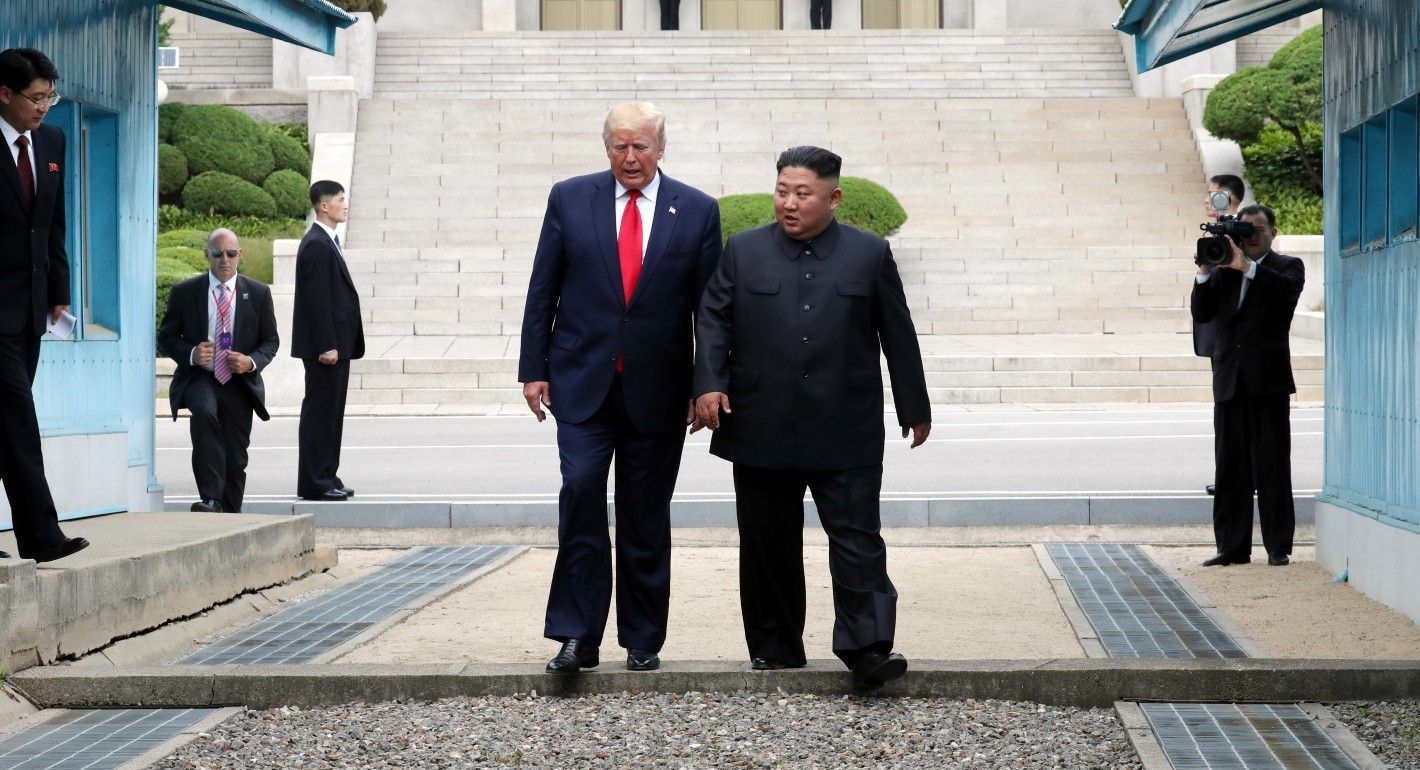
Trump and Kim at the DMZ in 2019. (Handout photo by Dong-A Ilbo via Getty Images)
The president should use the upcoming State of the Union address to offer North Korea a new, concrete vision for engagement and reducing nuclear risks.
In the lead-up to President Donald J. Trump’s trip to South Korea last month, speculation mounted about the possibility of yet another summit between him and North Korean leader Kim Jong Un. During Trump’s first term, the two men met three times, including the president’s historic steps onto North Korean soil in June 2019. Subsequently, North Korea rejected wholesale further talks with Washington and dramatically accelerated the growth and refinement of its nuclear weapons programs while sealing in a new alliance with Russia.
In his second term, Trump has periodically talked up the prospect of engagement with North Korea. He has described the country as a “big nuclear nation”—much to the chagrin of U.S. allies in Northeast Asia—and underscored his “very good relationship” with Kim. Earlier this year, he suggested he would “probably do something with him at some point.” While in South Korea, Trump brushed off a cruise missile test by Pyongyang and said that “we’ll come back and we’ll, at some point in the not too distant future, meet with North Korea.”
The president’s instincts to seek engagement with North Korea provide an important opportunity for the United States, which faces a challenging global nuclear environment amid difficult relations with both Russia and China. The unbounded nature of North Korea’s nuclear and conventional military programs, the deepening alliance between Moscow and Pyongyang, and the intensifying risks of clashes between the two Koreas all create strong reasons for engagement.
Although Trump and his advisers have been unable to generate a pathway to engagement with North Korea in their first eleven months in office, the start of the coming year may present the best opportunity for a new U.S. push. In addition, Kim’s position on negotiations with the United States has hardened considerably since the failures of Trump’s first term, but recent indicators suggest that a sliver of opportunity remains. But to create momentum, Trump must formulate a policy line that will make it easier for Kim to affirm interest in talks.
In May, my colleague Frank Aum and I argued in a Carnegie paper reviewing U.S. North Korea policy that in the near term Washington should adopt a “stable coexistence” framework. This framework would emphasize the prevention of conventional and nuclear conflict on the Korean Peninsula as the primary U.S. strategic interest—supplanting denuclearization, as such—and affirm the lack of any intention to seek the end of North Korea’s regime.
A little more than one month later, South Korean President Lee Jae-myung, in his inaugural address, proffered a similar idea. Lee advocated for “peaceful coexistence” with North Korea, borrowing a term with conceptual origins in the Soviet Union. In September, following repeated invocations of the “coexistence” framing, North Korean state media reported that Kim himself had indicated an openness to this concept—though not in the context of seeking diplomacy with South Korea, but with the United States.
“If the United States, freeing itself from its absurd pursuit of other’s denuclearization and recognizing the reality, wants genuine peaceful coexistence with us, there is no reason for us not to come face to face with it,” Kim told the Supreme People’s Assembly, North Korea’s state legislature, in September. Kim also appeared to reciprocate Trump’s positive framing toward him: “Personally, I still have a good memory of the current U.S. President Trump.”
Despite these bromides and the momentum around a framing of “coexistence,” the reflexive instincts in both the U.S. and ROK governments again revealed the challenges of authoring a major shift in policy. On November 13, the United States and South Korea released a joint fact sheet that covered all outcomes from Trump’s October 29 state visit to South Korea. That document, with no allusions to “coexistence” at all, outlined a policy of seeking the “complete denuclearization of the DPRK,” and the implementation of the “Joint Statement of the 2018 U.S.-DPRK Singapore Summit.”
At no point in its history has North Korea endorsed any documents or agreements seeking the “denuclearization of the DPRK.” From 1991 until 2018, it had periodically endorsed a broader framing of “denuclearization of the Korean Peninsula,” which is the language that appears in the text of the Singapore joint statement. The distinction between these two terms has drawn ire from North Korea repeatedly in the past. Careful to recognize the term’s historical underpinnings, the United States and South Korea previously have been careful to use the “Korean Peninsula” framing. But they appeared to shift during the previous administrations in both Washington and Seoul—the reasons for which were never publicized, but likely were due to former president Yoon Suk Yeol’s harder-line policies toward Pyongyang.
Not surprisingly, on November 18, North Korea’s Korean Central News Agency released a commentary—an authoritative statement—on the joint fact sheet, describing it as a “confrontational declaration.” The commentary observed:
The U.S. and the ROK rulers have replaced the words of the “complete denuclearization on the Korean peninsula” which they touted for mere form’s sake in the past with the ones of the “complete denuclearization of the Democratic People’s Republic of Korea”. It is the unanimous assessment of the international community that it is neither more or less than denying the entity and the existence of the DPRK.
For North Korea and Kim himself, the objectives of denuclearization—be it of North Korea or the broader Korean Peninsula—and coexistence are mutually exclusive goals. The allusion to the denial of the “existence of the DPRK” is consistent with Kim’s post-2021 hardening stance on the centrality of nuclear arms to the survival of his regime and the state. Where North Korea, in the past, remained willing to contemplate denuclearization conditioned on changes to an ever-shifting set of U.S. “hostile policies,” Kim has categorically refused the prospect in recent years. Simply put, if Washington and Seoul continue to prioritize denuclearization of any sort, there is virtually no chance that Kim will see potential value in talks.
Notably, Trump himself has not once endorsed North Korean denuclearization in any remarks since his inauguration earlier this year. If the president and his advisers continue to retain an interest in engagement with North Korea, here lies a critical opportunity.
The U.S. and North Korean political calendars align briefly early next year, presenting a rare opening for engagement. On Pyongyang’s side, the Workers’ Party of Korea will convene a Party Congress—the apex political event in its calendar—likely in February. Kim is expected to make a series of prominent announcements on domestic and foreign priorities. He has already alluded, for instance, to new announcements on the modernization of his conventional and nuclear forces.
If the past is any guide, Kim may reiterate his September 2025 position on engagement around a “coexistence” framing. Although the United States has limited influence over Kim’s choices, Trump could seize the important opportunity to make it easier for Kim to say yes to the prospect of renewed negotiations.
In off-the-cuff remarks primarily to journalists, Trump has repeatedly indicated an interest in meeting Kim, but he has yet to do so in a way that indicates a meaningful shift in U.S. policy. Indeed, the administration failed to mention Pyongyang even once in its National Security Strategy released last week. With that opportunity now forgone, a formal, highly visible speech would be the next most ideal format, and the 2026 State of the Union Address may be the most suitable near-term forum to persuade Kim that the relationship can be reset.
Although State of the Union addresses are traditionally focused on domestic affairs, past presidents have used them to great effect on foreign affairs—from President James Monroe’s 1823 statement of what would come to be known as the Monroe Doctrine to President George W. Bush’s fateful 2002 declaration of an Axis of Evil (which included North Korea). North Korea’s willingness to take up Trump’s informal remarks indicating an interest in Kim appears to be limited, but a prepared State of the Union speech that contains a formal statement of a new desired end-state for U.S.-North Korea relations—one ideally adopting a coexistence framing—could create an opening. Kim may not accept the proposition, but the U.S. goal should be to kick-start momentum on engagement in 2026. Indeed, a highly public reframing of U.S. policy may convey greater credibility to North Korea than new letters, which the administration has sought to deliver to Kim to no apparent success.
Any shift of this magnitude in U.S. policy has implications for U.S. allies in the region. The Trump administration should consult with both South Korea and Japan before unveiling a new framework for relations with North Korea. For Seoul and Tokyo, a key concern will be the possible abandonment of denuclearization as a formal goal and the implicit conferment of nuclear status on North Korea. As I have argued before in these pages, the status question is a red herring in many ways and should not hamstring policy changes that can shift momentum toward risk reduction. The administration would be wise to keep denuclearization as a private, long-term aspiration but omit it from declaratory policy statements, since it currently inhibits any engagement with North Korea. Washington will likely need to persuade its allies that these steps will, on balance, improve the regional security environment if they foster durable engagement.
Above all, Washington, along with its allies, should recognize that the status quo is deeply unfavorable. North Korea’s newfound alliance relationship with Russia will likely remain, but engagement can seek to limit the most harmful forms of deeper cooperation between these two states. In the absence of any shifts in policy, North Korea will keep its current trajectory of hostile relations toward the United States and its allies while the menace of its expanding nuclear forces is unperturbed. Without doubt, the path to risk reduction given these realities will be challenging, but the right way to start is to push on a door that is ever-so-slightly ajar instead of one that is shut tight—as it has been since 2019. A 2026 re-framing of policy that seeks coexistence and an invitation to unconditional engagement in recognition of these new realities is long past due.
The latest from Carnegie scholars on the world’s most pressing challenges, delivered to your inbox.

Stanton Senior Fellow, Nuclear Policy Program
Ankit Panda is the Stanton Senior Fellow in the Nuclear Policy Program at the Carnegie Endowment for International Peace.
Recent Work

James M. Acton, Ankit Panda
Frank Aum, Ankit Panda
Carnegie does not take institutional positions on public policy issues; the views represented herein are those of the author(s) and do not necessarily reflect the views of Carnegie, its staff, or its trustees.
Despite its flop at the box office, the film raises important questions for the climate community to answer.

Leonardo Martinez-Diaz

The acknowledgment has sparked fears of a new arms race with China and Russia.

Chris O’Meara
The summit may be remembered as a fatal blunder, when Washington, Beijing, and the AI industry collectively chose ceremony over action.

Jeffrey Prescott

The real test may come after the leaders leave the room.



Sheena Chestnut Greitens, Oriana Skylar Mastro, Yukon Huang, …

The Horn of Africa countries are among those facing a new security calculus.


Andrew Leber, Lesley Anne Warner