

Q&A
- +1
Amr Hamzawy, Andrew Leber, Eric Lob, …
{
  "authors": [
    "Marwan Muasher"
  ],
  "type": "commentary",
  "blog": "Emissary",
  "centerAffiliationAll": "dc",
  "centers": [
    "Carnegie Endowment for International Peace"
  ],
  "collections": [
    "Trump’s Disruptive 100 Days"
  ],
  "englishNewsletterAll": "menaTransitions",
  "nonEnglishNewsletterAll": "",
  "primaryCenter": "Carnegie Endowment for International Peace",
  "programAffiliation": "MEP",
  "programs": [
    "Middle East"
  ],
  "projects": [],
  "regions": [
    "Saudi Arabia",
    "Middle East",
    "United States"
  ],
  "topics": [
    "Economy",
    "Security",
    "Foreign Policy"
  ]
}
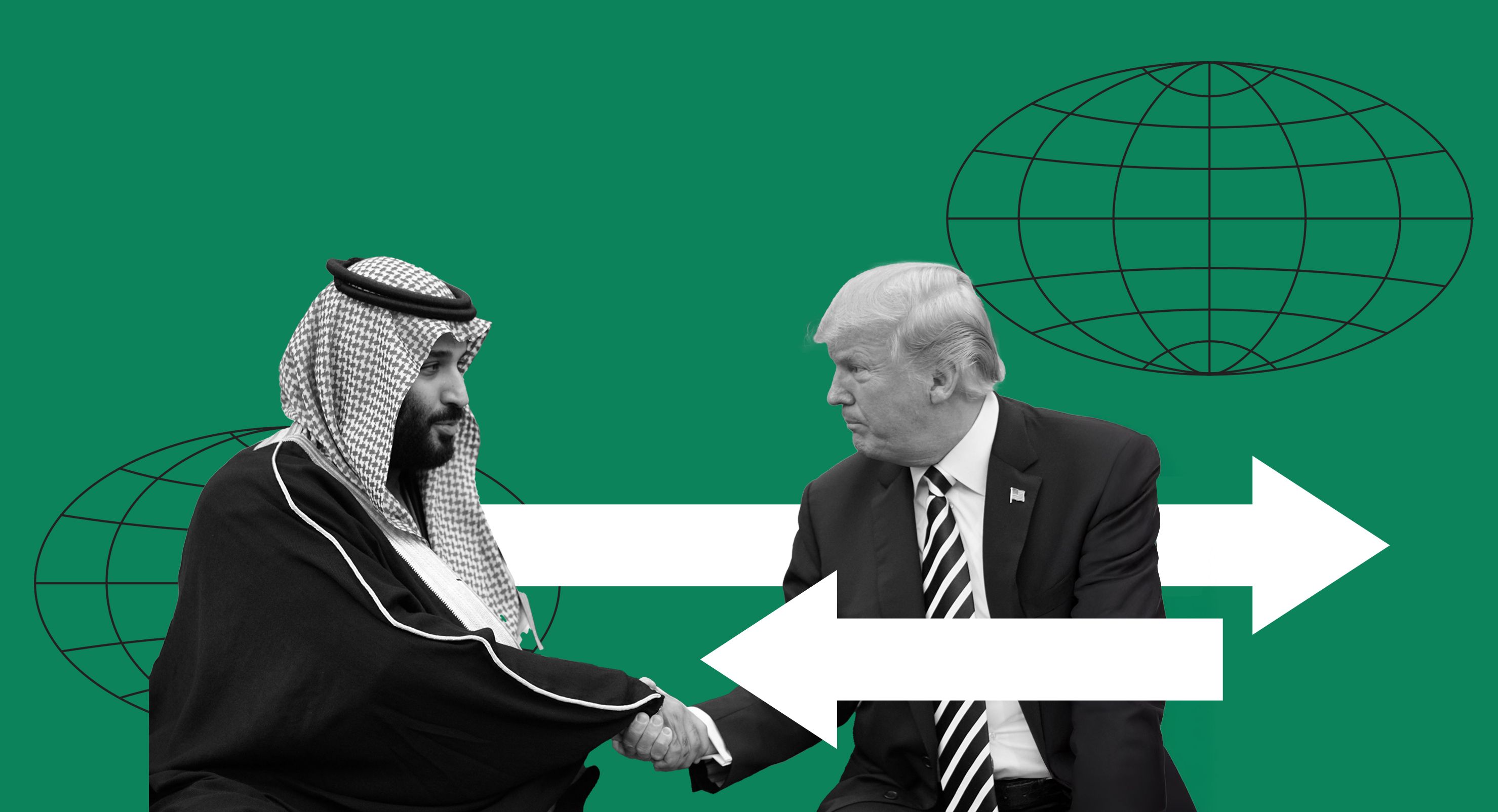
(Photo by Getty Images)
Enhanced security and economic cooperation remains the focus of the kingdom’s leadership during Trump’s presidency, but the Israel-Hamas war could stall progress.
This piece is part of a Carnegie series examining the impacts of Trump’s first 100 days in office.
During his upcoming trip to Riyadh in May, U.S. President Donald Trump likely will learn that Saudi Arabia is not ready to join the Abraham Accords. The accords, which reestablished relations between Israel and several Arab countries during Trump’s first term, have been a key point of negotiation between Washington and Riyadh since the president left office, and Trump is keen to have Saudi Arabia join. But the country’s refusal will not likely affect Riyadh’s intent to further its relationship with Washington, and the first 100 days of the second Trump administration have not much changed Saudi views. The issues of enhanced security and economic cooperation on one hand and the Arab-Israeli conflict on the other likely will be compartmentalized by the Saudi leadership.
Among Arab countries today, Saudia Arabia has outsize influence in Washington. Riyadh’s main focus has been on a new and ambitious economic vision for the country, and that focus is unlikely to be affected by differences over the conflict in Gaza. Saudi leaders are certainly aware of the global fragmentation accelerated by the Trump administration’s policies, but whatever changes the world order is undergoing, they seem likely to prioritize U.S. economic and security commitments as the best bet for their own interests.
The Saudi leadership has traditionally preferred a Republican administration to a Democratic one, and that stands true today, despite the fact that the Trump administration is vastly different than earlier Republican ones (not to mention the contrast between the current and former Saudi leadership). Historically, Republican administrations emphasized issues related to oil and defense, while Democratic ones criticized the kingdom’s human rights record. Democrats were also seen by Saudi officials as softer on Iran than Republicans, who mostly adopted a “maximum pressure” policy on Tehran. When former president Barack Obama signed the deal with Iran that prevented nuclear weapons development but deliberately ignored curbing Iranian influence in the region, Saudi leaders saw this as a slap in the face. As a result, they welcomed the election of Trump in 2016 and immediately worked to strengthen the security and economic relationship with his first administration. The first foreign visit Trump made was to Saudi Arabia in May 2017.
As far as economic and security ties are concerned, not much has changed since Trump’s first term ended. Trump’s tough stance against Iran—even the possibility of a major U.S. strike against the country—is probably seen positively in Riyadh. Trump said that during his trip to Riyadh, he hopes to sign investment agreements possibly worth “a trillion dollars.”
But to some extent, Trump will still need to reckon with the Gaza issue. Saudi Arabia will not join the Abraham Accords without a commitment from Israel, even a nominal one, to a two state-solution that would have it withdraw from occupied Palestinian territories. All the other Saudi demands—a peaceful nuclear program, a defense treaty with the United States that would commit the latter to defending Saudi Arabia from any external threat, and the acquisition of advanced weaponry—were by and large agreed with Washington. But Israeli Prime Minister Benjamin Netanyahu has refused to give even a nominal commitment, going as far as to call Palestinian statehood “a reward for terrorism” in the wake of October 7. His right-wing coalition, which opposes any withdrawal of Israeli forces from the West Bank, would fall. Saudi officials—given their role in agreements such as the 2002 Arab Peace Initiative, as well as taking into consideration domestic and regional sentiments—are not in a position to sign an agreement that does not include meaningful progress on the Arab-Israeli conflict. This is particularly true with hardline ministers in the Israeli government declaring that it intends to annex the West Bank. Saudi Arabia’s recent positions on Gaza have solidly stood behind Palestinians and severely criticized Israeli actions against Palestinian citizens.
Whether Trump will accept the Saudi hardened view on Israel and not push harder for Riyadh to change its position remains to be seen. If, as it is likely, Saudi leaders maintain their current stance, tension in the relationship might very well start to appear.
Read more from this series, including:

Vice President for Studies
Marwan Muasher is vice president for studies at Carnegie, where he oversees research in Washington and Beirut on the Middle East. Muasher served as foreign minister (2002–2004) and deputy prime minister (2004–2005) of Jordan, and his career has spanned the areas of diplomacy, development, civil society, and communications.
Recent Work



Amr Hamzawy, Andrew Leber, Eric Lob, …
Marwan Muasher
Carnegie does not take institutional positions on public policy issues; the views represented herein are those of the author(s) and do not necessarily reflect the views of Carnegie, its staff, or its trustees.
Rubio’s recent visit brought welcome attention, but more capital requires governance changes that may be a hard sell for regional governments.

Jennifer B. Murtazashvili
Why Pakistan, Saudi Arabia, and Turkey are joining forces on regional security.

Alper Coşkun, Amr Hamzawy

Despite public disputes over trade and immigration, the strategic partnership’s foundations remain sturdy.

Sameer Lalwani
It signals a new era of tech diffusion and warfare.

Steve Feldstein
Despite its flop at the box office, the film raises important questions for the climate community to answer.

Leonardo Martinez-Diaz