

Q&A
Andrew Leber, Lesley Anne Warner
{
  "authors": [
    "Lesley Anne Warner"
  ],
  "type": "questionAnswer",
  "blog": "Emissary",
  "centerAffiliationAll": "dc",
  "centers": [
    "Carnegie Endowment for International Peace"
  ],
  "collections": [
    "Africa’s Shifting Politics and Geopolitics"
  ],
  "englishNewsletterAll": "africa",
  "nonEnglishNewsletterAll": "",
  "programAffiliation": "AFP",
  "programs": [
    "Africa"
  ],
  "regions": [
    "Southern, Eastern, and Western Africa"
  ],
  "topics": [
    "Domestic Politics",
    "Foreign Policy"
  ]
}
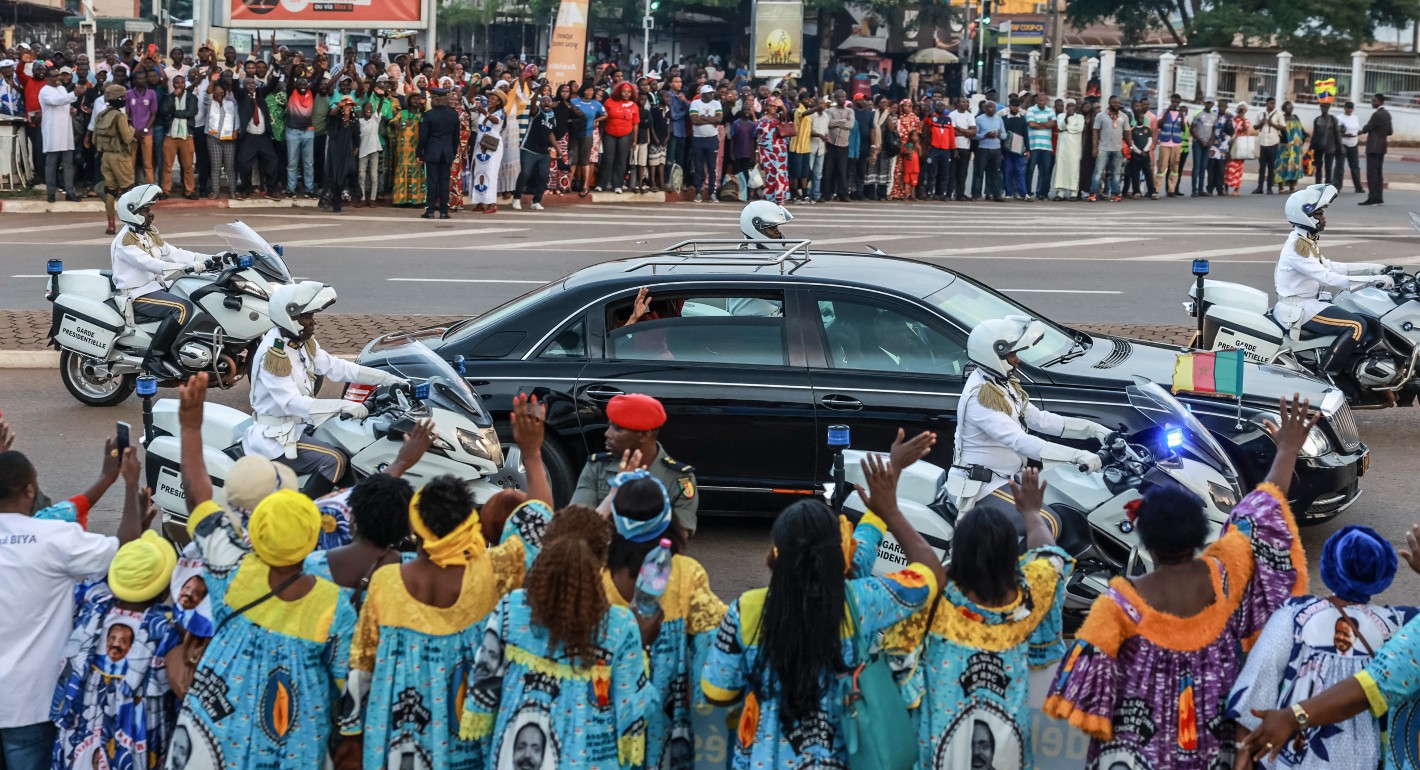
Supporters wave to Biya’s motorcade in Yaoundé on August 20, 2026. (Photo by AFP via Getty Images)
The ninety-three-year-old Biya’s absence and refusal to name a vice president threaten to upend domestic and regional stability.
What’s going on with Cameroon’s president?
On August 20, President Paul Biya returned to Cameroon following a seventy-three-day stay in his home away from home, the InterContinental Hotel Geneva. This foray far surpassed his previous record of forty-two consecutive days abroad in 2024, which itself was sufficiently prolonged that the government took the extraordinary step of banning media from discussing the now-ninety-three-year-old’s health.
Biya’s most recent absence once again fueled speculation about his health, as well as who is running the country. Biya, who has been in power since 1982, lacks a designated successor—a situation that could evoke comparison to critically acclaimed dramas such as Succession or House of the Dragon. The struggle over who holds the reins could either follow the former show’s script of opaque palace intrigue, or the far more dangerous path of the latter, in which a succession struggle unresolved at the time of the patriarch’s passing devolves into a contest that destabilizes the realm.
How has Biya been able to remain in power for so long?
In 1984, Biya faced the most serious threat to his rule: a coup attempt led by soldiers in the Republican Guard, an elite military unit. That incident has shaped Biya’s multifaceted means of controlling the country’s politics and security mechanisms ever since—including throughout his most recent absence.
In the purge that followed the coup attempt, Biya stripped presidential security down to officers he personally trusted. That approach has persisted to the present day, with Biya continuing to stack military leadership with those loyal to him. Approximately two-thirds of these officers—such as Major General Hippolyte Ebaka, the new deputy chief of defense—are from Biya’s Beti ethnic group.
Biya also has systematically eliminated any genuine check on his rule, with the country rated as “not free” by Freedom House. Parliament abolished presidential term limits in April 2008. The opposition has disputed most presidential elections since the reintroduction of multiparty politics in 1992. In the most recent vote in October 2025, postelection violence killed dozens, while 2,000 people were detained. Moreover, members of the country’s electoral commission are appointed by the president, and vacancies are filled at his discretion.
Finally, Biya has deliberately concentrated institutional authority in mechanisms he himself controls, so that every stage of succession would take place within institutions that answer to him. For example, Cameroon’s 1996 Constitution stipulated that in the event of a presidential vacancy, a new election would be required within 20 to 120 days, with the president of the Senate assuming interim duties. The acting president could not amend the constitution, reconstitute the government, call a referendum, or stand as a candidate in the election he was tasked with organizing. Earlier this year, in response to succession concerns, the constitution was amended to reinstate the vice presidency, which would be appointed by the president. But Biya has yet to fill the role. In the event of Biya’s death, resignation, or incapacitation, the Constitutional Council, led by a Biya loyalist, would need to acknowledge a vacancy, and the president of the Senate would assume the function of interim president until a snap election.
What process would select the successor to Biya?
It’s murky—but it will be directly tied to whether Biya selects a vice president in the near future. If he does, his designated vice president likely will succeed him until the end of his term in 2032.
If, however, the music stops without anyone in that chair, then the country could be in uncharted territory. The political elite would have to allow the president of the Constitutional Council to declare a vacancy in order for the president of the Senate to assume the interim presidency and call elections.
Considering that the vice presidency has existed for four months and the president has resisted appointing anyone to fill it—especially during his prolonged sojourn abroad—the position is increasingly likely to be empty when Biya dies.
What would a leadership vacuum mean for Cameroon and its neighbors?
A contested or disorderly succession could destabilize Cameroon and compound insecurity across an already fragile region.
Cameroon sits at the intersection of several overlapping security systems. One is the Lake Chad Basin, where the Islamic State West Africa Province and remnants of Boko Haram exploit the borders Cameroon shares with Nigeria and Chad. Another is the persistent conflict in the Central African Republic, which has driven displacement into Cameroon’s eastern border regions and created recurrent cross-border security pressures.
Domestically, any contested transition would unfold amid the long-running Anglophone Crisis, the armed conflict centered in Cameroon’s English-speaking Northwest and Southwest regions. What began as protests in 2016 by lawyers and teachers over the region’s marginalization within the predominantly Francophone country has since hardened into a separatist insurgency, leaving parts of both regions beyond the state’s effective control.
Should succession politics paralyze or divide the government in Yaoundé, separatist groups could seek to exploit the opening. Farther afield in the Far North, jihadi groups could exploit a distracted and overextended security apparatus, while diminished control along the eastern border would make it harder to manage displacement, trafficking, illegal mining, and armed group activity linked to the conflict in the Central African Republic. As a result, Cameroon could transition from a country absorbing insecurity from its neighbors to being a vector of regional instability.
Who are the president’s potential successors?
One frequently cited candidate is Franck Biya, the president’s son. His power base would likely derive from his family’s networks, including among Beti elites from Biya’s historic Centre and South regional bases. However, his elevation is unlikely, given his lack of political or security service pedigree and the fact that he has spent much of his adult life outside Cameroon. Notably, First Lady Chantal Biya has a frigid relationship with her stepson.
Franck Biya’s chief rival would be Ferdinand Ngoh Ngoh, the powerful and longest-serving secretary-general of the presidency who has held office since 2011. He has signing authority on behalf of the president and the strong backing of the first lady, who reportedly engineered his ascent to that position. Ngoh Ngoh’s power derives from the fact that his position rests at the center of the administrative mechanisms of the presidency, which makes him an essential interlocutor for anyone seeking decisions from the presidency—especially during the president’s more recent distances from the public eye.
Another potential candidate is Philémon Yang, the country’s longest-serving prime minister who held his position from 2009 to 2019. Since 2020, Yang has held a senior but largely ceremonial post in the presidency, overseeing state honors and decorations. Yang, who hails from the Anglophone Northwest Region, also served as the seventy-ninth president of the United Nations General Assembly, representing Cameroon. His lack of a patronage network or identifiable support within the security services likely gives the impression that he is weak and malleable. Yet he would be able to project continuity without threatening the interests of those who might select him as a consensus caretaker candidate. This could be an asset for political elites who may be wary of a Biya family succession or of Ngoh Ngoh’s accumulation of power.
Meanwhile, Paul Atanga Nji and Louis-Paul Motazé are more likely to shape the terms of a succession bargain than to be appointed vice president. As minister of territorial administration, Atanga Nji is charged with providing logistical, security, and administrative support during elections. He also sits atop a cascading state structure of governors and local officers that links the capital to the country’s regions, departments, and districts. He is one of the regime’s most prominent Anglophone figures—although this should not be conflated with a demonstrable ability to deliver Anglophone support.
Motazé is Franck Biya’s cousin, hailing not too far from the president’s own birthplace, and is reportedly akin to a “spiritual son” of sorts. As finance minister, Motazé would be central to efforts to reassure creditors, domestic banks, and politically connected firms during a contested transition. Notionally, Motazé’s ability to prevent fiscal stress from compounding elite and investor uncertainty would make him a valuable broker during the succession process, especially considering Cameroon’s reliance on domestic and regional borrowing.
What will you be watching closely from here?
One important variable is the role the security services could play in protecting elite interests during the transition process.
In the wake of the failed 1984 coup, Biya reformed the security apparatus to reduce the risk of any one institution becoming powerful enough to threaten his presidency. Over time, he has counterbalanced the regular armed forces, gendarmerie, and Presidential Guard, while elite units such as the Bataillon d’Intervention Rapide lie outside the conventional military chain of command and report directly to the presidency. It is a kind of mutually assured destruction, in that it is a system in which no single security service can move decisively without risking resistance from the others.
In the event of a contested succession, this dynamic could produce cohesion behind an elite bargain, sustain paralysis if competing factions block one another, or spark fragmentation if rival claimants succeed in drawing different elements of the security apparatus into their respective camps. With coups back en vogue across parts of Africa, it is also possible that elements of Cameroon’s security forces could coalesce around an effort to seize power for themselves, installing a technocratic caretaker to give the impression of a civilian-led transition. Yet the very architecture Biya built to prevent this very scenario—parallel forces, overlapping mandates, and loyalty-based command structures—would impede coordination while making the risk of discovery before execution high.
The latest from Carnegie scholars on the world’s most pressing challenges, delivered to your inbox.

Visiting Scholar, Africa Program
Lesley Anne Warner is a visiting scholar with the Africa Program at the Carnegie Endowment for International Peace, and has over two decades of experience as a foreign policy expert at the intersection of political transitions, stabilization, and security cooperation.
Recent Work

Andrew Leber, Lesley Anne Warner


Sophia Besch, Eric Ciaramella, Steve Feldstein, …
Carnegie does not take institutional positions on public policy issues; the views represented herein are those of the author(s) and do not necessarily reflect the views of Carnegie, its staff, or its trustees.

The Horn of Africa countries are among those facing a new security calculus.
Andrew Leber, Lesley Anne Warner
The conflict has sent economic and political shock waves through a country with no representation at the negotiating table—and Kenya is not alone.
Georgia Schaefer-Brown, Jane Munga
Washington’s transactional foreign policy is making it indistinguishable from Beijing’s, with consequential implications for African agency.
Jane Munga
The impacts of the Faye-Sonko rupture could go well beyond the country’s borders.
Lesley Anne Warner
African countries need to adapt to a new era of U.S. trade relations.
Kholofelo Kugler, Georgia Schaefer-Brown