

Commentary
Despite its flop at the box office, the film raises important questions for the climate community to answer.
Leonardo Martinez-Diaz
{
  "authors": [
    "Alejandro Martin Rodriguez",
    "Kayly Ober"
  ],
  "type": "commentary",
  "blog": "Emissary",
  "centerAffiliationAll": "dc",
  "centers": [
    "Carnegie Endowment for International Peace"
  ],
  "englishNewsletterAll": "ctw",
  "nonEnglishNewsletterAll": "",
  "programAffiliation": "SCP",
  "programs": [
    "Sustainability, Climate, and Geopolitics"
  ],
  "regions": [
    "South America",
    "Central America and the Caribbean",
    "United States",
    "Honduras",
    "Colombia",
    "Nicaragua",
    "Guatemala",
    "Ecuador"
  ],
  "topics": [
    "Climate Change",
    "Military",
    "Security",
    "Domestic Politics",
    "Foreign Policy"
  ]
}
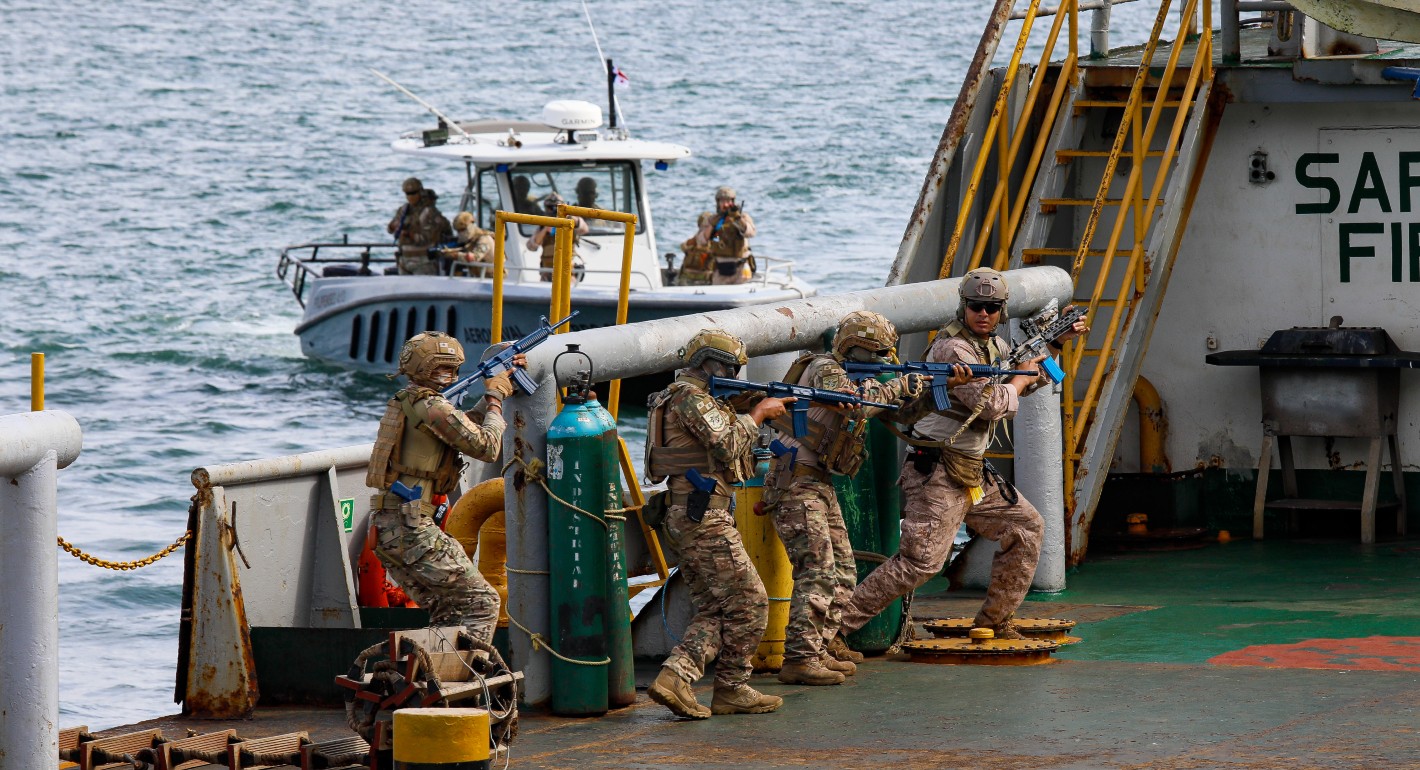
Military personnel participate in multinational exercises to safeguard the Panama Canal on August 9, 2026 in Panama City, Panama. (Photo by Daniel Gonzalez/Anadolu via Getty Images)
By focusing only on hard security, the Shield ignores the conditions that fuel cartel power.
Earlier this month, Colombia joined the Shield of the Americas, U.S. President Donald Trump’s new flagship security architecture for the Western Hemisphere. The week before, newly elected Peruvian President Keiko Fujimori pledged to join as well. Argentina, Ecuador, and Costa Rica joined the initiative when it was launched in Miami last March. Alongside their Shield membership, these Central and South American countries all have elected right- or far-right leaders in the past three years.
Some analysts have labeled the Shield as a partisan, security-only club. But the group’s narrow focus on hard security leaves out the conditions that actually fuel the cartel power driving much of the crime in these regions. If it does not address these root causes, and the extent to which a changing climate is exacerbating them, the Shield is structurally set up to fail.
The Shield reflects the current U.S. administration’s turn to what it perceives as its own backyard. Launched in March 2026, the Shield of the Americas highlights a core commitment to the use of military force and cooperation against cartels and so-called narco-terrorists. This builds on a hard security approach advanced most prominently in El Salvador by President Nayib Bukele that helped reduce the country’s homicide rate from 53.1 per 100,000 people to a historic low of 1.3 per 100,000 in seven years, according to official figures. El Salvador now enjoys the highest percentage of people in Latin America (87 percent) saying that they would feel safe walking alone at night. This has fed a spread of “Bukelismo” in the fight against crime in the region, one that shapes the ideology of the Shield of the Americas.
The case for that approach is not trivial. Its proponents, including the right-wing governments across the region now advancing hard security policies, argue that cartels have grown into armed, transnational actors capable of a speed and lethality that can only be matched by law enforcement and militarized responses. El Salvador could appear to prove them right. But defenders of the Bukele model, including those trying to replicate it in Ecuador and elsewhere, tend to skip the step that made it work: quiet negotiations with gangs. They also fail to fully consider its costs, including concerns over justice and transparency issues connected with mass imprisonments, falling disproportionately on young people, women, and children. Following the implementation of the Bukele model, El Salvador now has the highest incarceration rate in the world.
The Shield’s design, according to its public documents and mission statement, assumes cartels are a military and law-enforcement problem and therefore can be defeated with force. Hard security can be part of the state’s response to this problem, but it is insufficient against the multidimensional challenges that create and sustain the structural causes of violence in the region.
Cartel power feeds on poverty and social exclusion, and it grows by filling gaps left where formal institutions are absent—remote rural areas, informal urban settlements, places the state reaches late or not at all. Climate shocks, including drought, crop failure, extreme weather, and extreme heat, widen those gaps. They destroy the livelihoods that keep households out of the illicit economy, and they land hardest where state capacity is already thinnest. Displacement becomes more likely where service delivery collapses after a shock and where recovery is slow, and people turn to whomever can provide services, which is sometimes cartels.
Military force cannot fill that governance vacuum, and heavy-handed deployments can deepen the mistrust that lets cartels present themselves as the more reliable authority. In addition, those who leave are often funneled into the same criminal networks as those who remain: Cartels extract large sums from migrants and frequently terrorize them along the way, turning displacement itself into a revenue stream.
Honduras illustrates this well. A fungal infection called coffee rust, worsened by climate variability and heat, cut national coffee production by nearly a quarter in 2012–2013. Coffee is so central to the rural economy that a modest fall in world prices a few years later was enough to more than double migration from coffee-growing municipalities. By 2018, more than four in ten Hondurans were food insecure—roughly double the share six years earlier—and those who could not reliably feed their families were far more likely to say they intended to migrate. Climate change acted as a driver of insecurity in this case.
Adopting a hard security approach compounded the problem. Honduran police and security forces were widely regarded as corrupt and were repeatedly implicated in human rights abuses. One in four Hondurans reported being asked for a bribe in 2018, and migration intentions ran nearly 50 percent higher among those asked for bribes than among everyone else. This hard security approach and climate-exacerbated migration in Honduras collided to later show up at the border. For example, Honduran family-unit apprehensions grew from 513 in 2012 to 188,368 in 2019. One study found that the link between rainfall deviation and border apprehensions strengthened in Honduran departments with higher homicide rates: Migration rose as regions weathered precipitation shocks, more violence, or both.
Ultimately, the choice for policymakers should not be between hard versus soft approaches to security. Durable security gains come from combining approaches that respond to immediate needs while also addressing root causes, particularly on a warming planet that exacerbates the latter. The Shield of Americas’ approach ignores those root causes.
Going back to the Honduras case shows what this could look like in practice. Policies aimed at enhancing climate adaptation, such as provision of drought-tolerant and rust-resistant seed for small-scale farmers or financial instruments that ensure that one bad harvest does not become a permanent loss, are also among the cheapest tools available to counter-recruitment. Colombia’s peace process offers an example, showing the benefits of integrating analyses of conflict, violence, and fragility drivers into peacebuilding. Security gains held where they were paired with the issues driving the conflict in the first place, including rural development and land reform in territories where climate stress and illicit economies overlap. The reverse case is just as instructive: The sudden and unstructured dismantling of the U.S. Agency for International Development in 2025 showed how quickly conflict can rise when the assistance that underwrites resilience and rural livelihoods is withdrawn.
Acknowledging the limits of hard security approaches does not require the Shield to abandon its methods. But a number of low-hanging-fruit policies could help make the Shield more effective, even in the hard-security context.
First, the Shield could build environmental risk into the threat assessments it has said it plans to conduct. Those assessments should map drought, storm exposure, and crop failure against cartel recruitment and territorial control, so that members can see where the next opening will appear before it occurs. Second, the Shield could also use member militaries for stabilization, not just interdiction. Engineering, logistics, and airlift are what the region’s armed forces genuinely do well, and committing them to resilience-enhancing efforts such as restoring roads, water, and clinics in contested rural areas soon after climate-exacerbated disasters could deny cartels the recovery gap that they now reliably fill.
The Shield of the Americas’ stated goal also requires its leaders to think beyond the absence of violence. The must look toward durable security grounded in positive peace, built through hard security approaches alongside other measures, with all actions respecting human rights and humanitarian principles. On a warming planet, that means treating climate-exacerbated root causes as a security problem rather than a development footnote.
Yet the Shield’s mission statement and the growing rhetoric of leaders in the Western Hemisphere point against their capacity, or willingness, to do so. Their exclusive focus on hard security, even where it operates in a legal gray area at times within and at times beyond the bounds of domestic and international law, risks exposing an Achilles’ heel that could lead to the Shield’s failure.

Fellow, Sustainability, Climate, and Geopolitics Program
Alejandro Martin Rodriguez is a fellow in the Sustainability, Climate, and Geopolitics Program at the Carnegie Endowment for International Peace. His research focuses on the social dimensions of climate change, and he manages projects on climate mobility, peace, and security.
Visiting Scholar, Sustainability, Climate, and Geopolitics Program
Kayly Ober is a visiting scholar with the Sustainability, Climate, and Geopolitics Program at the Carnegie Endowment for International Peace.
Carnegie does not take institutional positions on public policy issues; the views represented herein are those of the author(s) and do not necessarily reflect the views of Carnegie, its staff, or its trustees.

Despite its flop at the box office, the film raises important questions for the climate community to answer.

Leonardo Martinez-Diaz
They face an uphill climb, but they could draw on a strategy that other diplomats have used in the past.

Shana Tabak, Alejandro Martin Rodriguez

Over the past decade, China has moved from marginal player to major producer of all things batteries. The United States, Europe, and others are aiming to balance the market.

Milo McBride
Most migrants may have left Ceuta, but the effects may linger.

Alejandro Martin Rodriguez, Sarah Yerkes
The groundbreaking legislation faces an uphill battle, but it creates a framework for others to follow—especially as the effects of climate change intensify.

Liliana Gamboa, Kayly Ober