

Commentary
Darcie Draudt-Véjares
{
  "authors": [
    "Darcie Draudt-Véjares"
  ],
  "type": "commentary",
  "blog": "Emissary",
  "centerAffiliationAll": "dc",
  "centers": [
    "Carnegie Endowment for International Peace"
  ],
  "collections": [
    "Korea: Emerging Player",
    "Dynamic Governance Risks in Asia"
  ],
  "englishNewsletterAll": "asia",
  "nonEnglishNewsletterAll": "",
  "primaryCenter": "Carnegie Endowment for International Peace",
  "programAffiliation": "AP",
  "programs": [
    "Asia"
  ],
  "projects": [],
  "regions": [
    "South Korea"
  ],
  "topics": [
    "Civil Society",
    "Democracy"
  ]
}
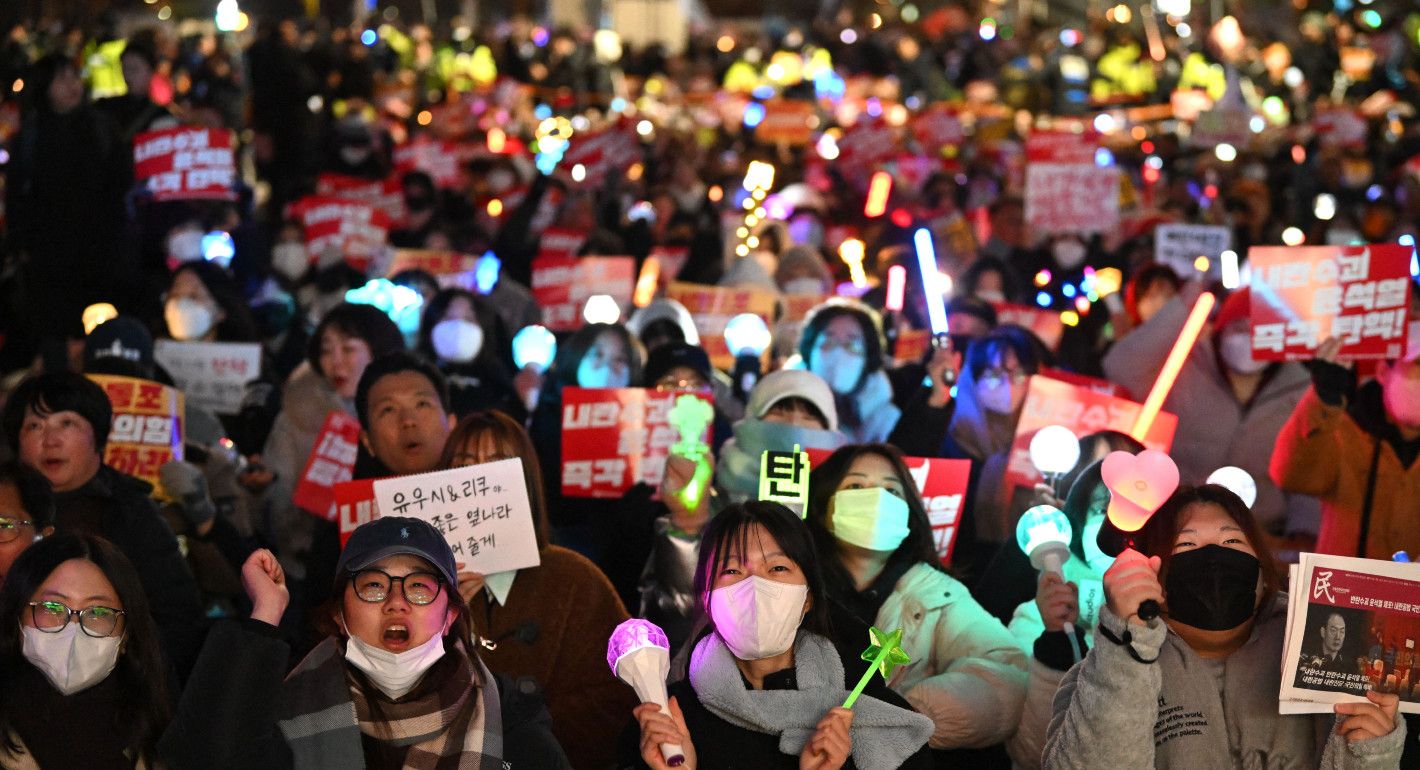
Protesters demand Yoon’s resignation in Seoul on December 10. (Photo by Jung Yeon-je/AFP via Getty Images)
The rapid response to Yoon’s martial law decree emerged from democratic practices embedded in society. Whether they can hold firm against rising polarization is another question.
In roughly three hours last week, South Korean democracy faced and overcame an unprecedented political crisis. Around 10 p.m. on December 3, President Yoon Suk-yeol declared martial law, citing parliamentary gridlock and politically motivated investigations into his administration. The announcement surprised many in his immediate circle and astonished South Korean citizens—many even thought it was fake. Virtually no one familiar with contemporary South Korean politics could believe that a modern president would attempt martial law, particularly when there was no widespread violence or imminent threat to public safety.
The response was swift and decisive. By 1 a.m., Yoon’s attempted power grab had been thwarted by legislators who outmaneuvered military forces to ensure the National Assembly could vote to nullify his decree. But what truly demonstrates the strength of South Korean democracy is how rapidly civil society and politicians mobilized to protect democratic institutions, even in the middle of the night.
This rapid response emerged from democratic practices embedded in South Korean society that were forged through decades of resistance to authoritarian rule and maintained through modern education, social networks, and technology. South Korea, with a population of 51 million, boasts near-universal digital connectivity. Over 90 percent of South Koreans use social networking platforms such as the homegrown KakaoTalk, which alone serves nearly 49 million users in South Korea—bridging a society where many still recall firsthand the struggle for and transition to democracy. The democracy movement isn’t just history but is also actively taught in schools as part of national identity. Although many scholars (myself included) have dissected South Korea’s ethnic homogeneity, a strong sense of civic duty forms just as much of the glue tying together South Korea’s imagined community. Moreover, many former leaders now hold positions in public-facing roles throughout government, academia, and civil society. These three factors combine to create a particularly robust network with the capacity and content needed for large-scale mobilization.
In the 1980s, a powerful coalition of labor unions, farmers, students, and middle-class intellectuals pushed back against military dictatorship. They built what scholars call networks of contention—social and organizational connections that facilitate collective action and resistance through sharing resources, information, organizational capacity, and trust even in high-risk contexts. The civic legacies of the twentieth century remain vibrant today in South Korea, one of the world’s most networked societies, allowing for rapid mobilization when democracy is threatened.
South Korea earned its hard-won spot as one of the biggest success stories of democratization’s Third Wave. After the Korean War, General Park Chung-hee orchestrated a coup d’état and eventually instituted the Yushin Constitution, which granted him sweeping powers to rule indefinitely. His authoritarian reign from 1960 until 1979 was followed by Chun Doo-hwan’s military dictatorship, notorious for violently repressing prodemocracy movements. Only after the massive June Democratic Uprising of 1987 did Chun step down, finally opening the door to democratic consolidation.
The latest crisis reveals concerning fault lines in South Korean politics while simultaneously demonstrating democratic resilience. Yoon’s rhetoric framed opposition as “pro-North anti-state forces” and resurrected Cold War–era tactics used to justify military rule—a playbook that largely rings hollow in today’s South Korea. The defense minister’s subsequent resignation and arrest, coupled with the ruling People Power Party’s defense of Yoon and far-right calls to arrest opposition leaders, point to a deepening constitutional struggle between democratic institutions and serious polarization.
Yet South Korea’s civil society networks and progressive establishment, tested through decades of resistance to authoritarianism, are mounting a coordinated response. This month’s political crisis has evoked many comparisons to the 2016 nationwide protests against former president Park Geun-hye’s abuse of power. In both cases, citizens rapidly mobilized against presidential overreach, though the circumstances differ markedly. While Park’s downfall came after months of peaceful candlelight demonstrations that drew millions into the streets over her corruption scandal, Yoon’s attempted power grab was thwarted within hours through a combination of legislative action and immediate civil society response. The speed of this latest democratic defense suggests that lessons learned during decades of mobilization have strengthened South Korea’s institutional guardrails and nationwide vigilance against executive abuse.
Invalid video URL
South Korea’s mobilization networks have not only empowered grassroots activism but also deeply influenced the growth of the progressive Democratic Party Korea (DP). The DP’s close ties to organizations such as labor unions, student groups, human rights advocates, and professional associations have empowered it to mobilize both electoral and event-based support during critical junctures over the past thirty-plus years. Many prominent progressive leaders in contemporary South Korea—including former presidents Kim Dae-jung, Roh Moo-hyun, and Moon Jae-in—played vital roles in mobilization in the 1980s.
These legacies are often framed as imbuing the contemporary DP with moral authority to root out corruption and government overreach, providing it with a powerful rhetorical strategy that resonates with many South Koreans’ direct lived experience. That said, Seoul’s national track record on civil liberties, particularly when it comes to minority rights, is anemic compared to similar postindustrial societies, and the DP is no stranger to scandals of its own. In fact, the assumed frontrunner for a future presidential election, the populist former governor Lee Jae-myung, has faced legal controversies, including a recent conviction related to election law violations. Many on the right see him as too left-wing or overly friendly toward China and North Korea, which is a central partisan issue driving South Korean politics.
Another organization at the forefront is the Korean Confederation of Trade Unions (KCTU), one of Asia’s most powerful labor organizations that represents 1.2 million workers across South Korea’s key industries. Instead of fragmented labor movements, umbrella organizations such as the KCTU create cross-sector incentives for coordinated action, amplifying organized labor’s leverage. Within hours of Yoon’s announcement, the KCTU called for a general strike—a move that, pending the member unions’ decisions, will threaten production at many of the nation’s most vital industries, as well as critical public services such as healthcare and transportation. The KCTU’s mobilization carries particular weight with the pro-business Yoon administration, given South Korea’s position as the world’s twelfth-largest economy and a crucial link in global supply chains, especially for semiconductors and electronics. The KCTU’s strike threat will put tangible economic pressure on the leadership, and combined with nationwide mobilization by citizens and student groups, it demonstrates how deeply democratic values have become embedded in South Korean political culture.
Conservative leaders now have to choose between democratic principles and party loyalty. Yoon’s domestic authority appears severely compromised, with his administration paralyzed by historically low approval ratings and significant internal party divisions. The DP has escalated efforts for redress, although its impeachment motion failed on Saturday due to a walkout by members of Yoon’s People Power Party (PPP) that blocked the two-thirds majority required for passage. The DP has since advanced a bill to appoint a permanent special counsel to investigate Yoon’s martial law declaration. The DP is likely to pressure the PPP to hold its president accountable, keeping the political crisis at the forefront of national debate.
The unfolding crisis is not just a test of Yoon’s political future or the future of the PPP, but also a critical moment for South Korea’s democracy. Last week’s events demonstrate the maturity of the country’s democracy, largely thanks to a robust demand for protecting democratic practices and for accountability at the highest levels of power. The proliferation of investigations and special counsel bills also expose deep political and institutional fault lines and could have the consequence—whether unintended or part of a DP political gambit—of miring South Korean politics in the very deadlock and polarization that Yoon stated he sought to circumvent or curtail.
These underlying tensions—deep political polarization, weakening trust in institutions, and the temptation to weaponize investigations for partisan gain—mirror challenges facing democracies worldwide. History suggests South Korea’s democratic foundations and mobilized citizenry will prevail, but the coming weeks will test whether the attempted power grab marks a decisive victory for how civil society and the political establishment act to protect democracy or exposes how even well-defended democratic systems remain vulnerable to the broader crisis of polarization.
The latest from Carnegie scholars on the world’s most pressing challenges, delivered to your inbox.
Fellow, Asia Program
Darcie Draudt-Véjares is a fellow in the Carnegie Asia Program.
Recent Work
Darcie Draudt-Véjares
Darcie Draudt-Véjares, Tim Sahay
Carnegie does not take institutional positions on public policy issues; the views represented herein are those of the author(s) and do not necessarily reflect the views of Carnegie, its staff, or its trustees.
The crisis is not just a story of energy vulnerability. It’s also a complex, high-stakes political challenge.
Darcie Draudt-Véjares
The conflict is exposing the deep energy vulnerabilities of Korea’s chip industry.
Darcie Draudt-Véjares, Tim Sahay
The recent record of citizen uprisings in autocracies spells caution for the hope that a new wave of Iranian protests may break the regime’s hold on power.


Thomas Carothers, McKenzie Carrier
New data from the 2026 Indian American Attitudes Survey show that Democratic support has not fully rebounded from 2020.

Sumitra Badrinathan, Devesh Kapur, Andy Robaina, …
Lessons from Korea’s political right.
Darcie Draudt-Véjares