

Commentary
Amr Hamzawy
{
  "authors": [
    "Amr Hamzawy"
  ],
  "type": "commentary",
  "blog": "Emissary",
  "centerAffiliationAll": "dc",
  "centers": [
    "Carnegie Endowment for International Peace"
  ],
  "collections": [
    "Regional Security in the Middle East and North Africa"
  ],
  "englishNewsletterAll": "menaTransitions",
  "nonEnglishNewsletterAll": "",
  "primaryCenter": "Carnegie Endowment for International Peace",
  "programAffiliation": "MEP",
  "programs": [
    "Middle East"
  ],
  "projects": [],
  "regions": [
    "Middle East",
    "Israel",
    "Iran"
  ],
  "topics": [
    "Security",
    "Defense",
    "Foreign Policy"
  ]
}
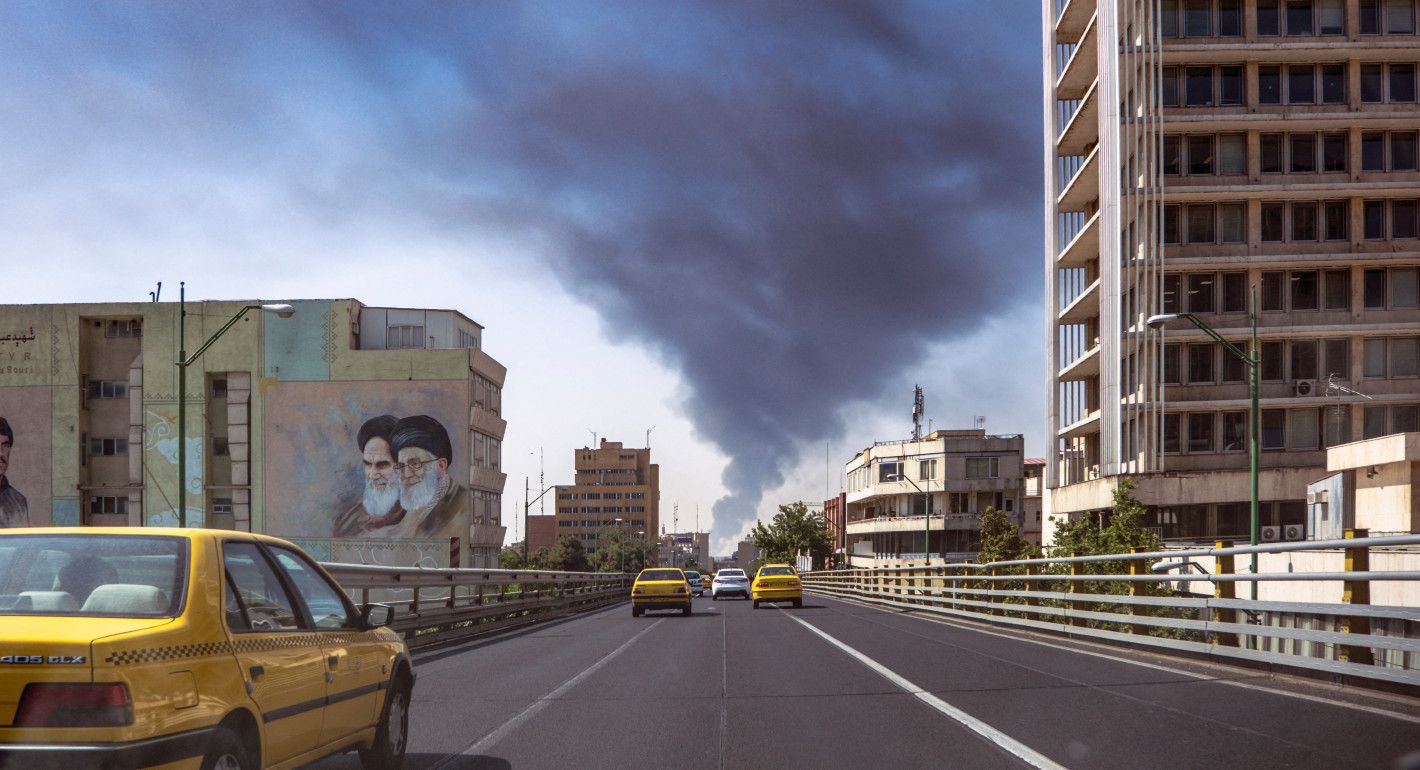
Smoke rises from an Israeli airstrike against Iran on June 15, 2025. (Photo by Zara/Middle East Images/AFP via Getty Images)
The region will not see stability without the development of mechanisms for collective security.
For the past few months, the greatest threat to security in the Middle East has been the military adventurism pursued by Israel’s far-right government and its belief in its ability to impose its will on its enemies through warfare, coupled with its effective rejection of negotiations and peaceful solutions.
Sure, other dangers should be addressed, including the unregulated military applications of AI and the destabilizing effects of the Palestinian situation on Egypt, Jordan, Syria, and Iraq. But what is most alarming is the ease with which wars and armed conflicts now erupt in the Middle East (either directly or via proxies), the near-total absence of collective diplomatic frameworks, and the vast disparities in military and intelligence capabilities among regional powers.
Invalid video URL
As a result, the breakout of war between Israel and Iran last week was not surprising. Nor was the fact that Israel struck Iranian nuclear facilities and military sites across a wide geographical area and that it targeted nuclear scientists and military leaders. Equally unsurprising was Iran’s response: missiles launched at Israel, directed at military and strategic targets—some of which landed in residential areas. Nor was it unexpected that Israel insisted on prolonging the war, viewing the Iranian nuclear program as an existential threat, or that Iran offered to return to negotiations with the United States over its nuclear program once Israeli attacks ceased—effectively implying a ceasefire proposal.
The vast imbalance in military power and intelligence capabilities heavily favors Israel over Iran. The Islamic Republic’s most advanced air defense systems (the Russian S-300s) were destroyed in earlier Israeli strikes. And perhaps most notably, its proxies in the region—the cornerstone of its regional influence doctrine, largely established after the 2003 U.S. invasion of Iraq and the fall of Saddam Hussein—are either militarily or politically depleted.
Iran, under its supreme leader and the Revolutionary Guard, has long relied on a different form of military adventurism—proxy wars in Lebanon, Iraq, Yemen, and to some extent in Palestine. The aim was to secure substantial influence in the region, deter Israeli and U.S. attacks on its own land by keeping their interests under constant threat via proxies, and to strengthen its hand in regional conflicts and any future grand bargain with the United States.
However, over the past eighteen months, this strategy has suffered severe setbacks. Israel has inflicted devastating damage on Hezbollah, Bashar al-Assad’s regime in Syria has effectively collapsed, and the Houthis’ missile capabilities have been steadily degraded through Israeli and American airstrikes.
Faced with the realities following October 7, 2023, the Iranian leadership had to recognize that its long-standing strategy was no longer sufficient to protect Iranian security or to deter Israeli aggression.
Perhaps Iran began to realize this strategic shift and responded by opening channels for negotiation with the United States over its nuclear program. It also sought to improve diplomatic relations with its Arab neighbors in the Middle East, hoping that an Arab rejection of possible Israeli attacks on its soil would serve as a regional buffer, and that some Arab states might mediate between Tehran and Washington.
Indeed, recent statements and positions from Gulf states, Egypt, Iraq, and Jordan show that the Arab world has clearly opposed Israeli strikes on Iran. Oman and Qatar have continued mediating with the United States in an effort to pressure Israel to halt its military campaign.
Still, the modifications in Iran’s regional behavior, its rapprochement with Arab neighbors, and its rounds of negotiations with the United States have not been sufficient to deter Israel. Tel Aviv’s far-right government had already scored a sweeping strategic victory over Iran’s proxies across the Middle East, and as Israeli political and military leaders have repeated several times, the road to Tehran now appears wide open.
Unless the United States intervenes clearly and decisively to stop the ongoing war between Israel and Iran, military operations are likely to continue for some time. The reality is that the administration of President Donald Trump appears unwilling to exert serious pressure on Israel to halt the war—possibly seeing the conflict’s potential outcome as a strategic opportunity to dismantle Iran’s nuclear program once and for all. That’s the short-term outlook.
In the medium and long term, however, the Middle East will not see stability or restored security unless regional mechanisms for collective security are developed—frameworks that can facilitate peaceful conflict resolution and bring an end to wars and military confrontations. Such mechanisms must be led by effective regional states—particularly Arab nations not involved in direct or proxy military adventurism—and supported by international actors.
The latest from Carnegie scholars on the world’s most pressing challenges, delivered to your inbox.

Director, Middle East Program
Amr Hamzawy is a senior fellow and the director of the Carnegie Middle East Program. His research and writings focus on governance in the Middle East and North Africa, social vulnerability, and the different roles of governments and civil societies in the region.
Recent Work
Amr Hamzawy

Amr Hamzawy, Sarah Yerkes, Kathryn Selfe
Carnegie does not take institutional positions on public policy issues; the views represented herein are those of the author(s) and do not necessarily reflect the views of Carnegie, its staff, or its trustees.

The United States ignores the region’s lived experience—and the tough political and social trade-offs the war has produced—at its peril.

Evan A. Feigenbaum
Neither the Abraham Accords nor the presence of large U.S. bases are enough to protect Arab Gulf states.

Marwan Muasher
A conflict launched in the name of American security is producing the opposite effect.
Sarah Yerkes
Restoring competence and trust to the anemic, neglected disaster recovery agency is a matter of national security.


Sarah Labowitz, Debbra Goh

Although the IAA often differs from the IRA, European policymakers can still take note of the U.S. act’s shortcomings.

Milo McBride